
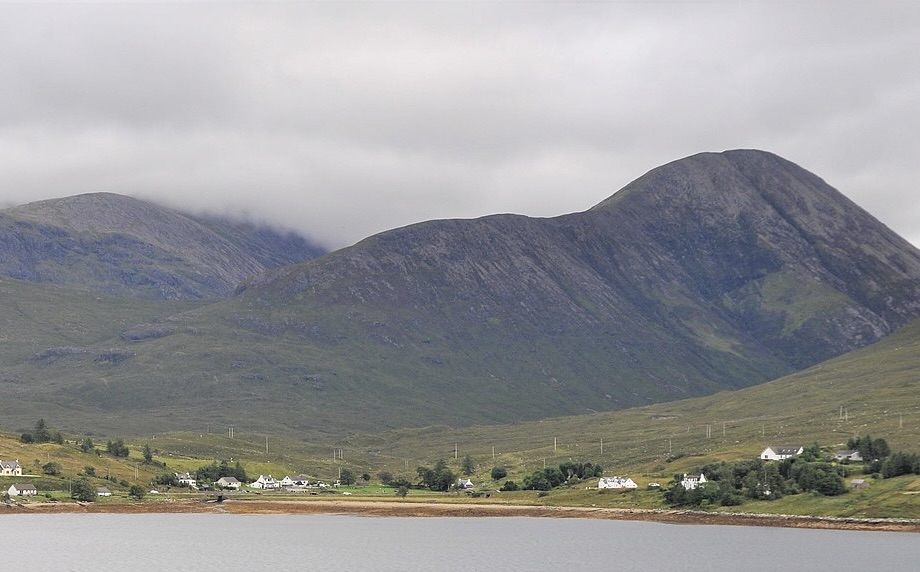
The Skye Witch
Dan Belanger
The faint smell of death, that she hadn’t been able to scrub out, lingered in the large estate that Magda, after inheriting it from her sister, had converted from a funeral home into a bed and breakfast. Magda’s sister, Anika, a slight woman with jet black hair and soft blue eyes that retained a youthful sparkle as she grew older had married the undertaker from a tiny island off the Isle of Skye upon her first visit to Scotland.
Anika, who was three years younger than Magda, was killed in an automobile accident on the road to Edinburgh where she and her husband, Peter, were going to celebrate their thirty-fifth wedding anniversary. A camper driven by a tourist who fell asleep at the wheel ran them off the road, and into the murky depths of Loch Garry.
Magda and Anika, who were orphaned at a young age, had looked out for one another until Anika married and moved to Scotland. Even then, Magda benefitted from their deep connection, remaining in close contact with Anika through the exchange of long, expressive letters until Anika’s unexpected demise.
Ever since they were little girls, Magda and Anika had longed to see Scotland, their mother’s country of origin. They were finally able to do so when, upon Anika’s twenty-first birthday, the orphanage released the pittance of an inheritance left for them by their father’s meager estate. They had been holding on to it since the girls were placed into the orphanage when their father committed suicide a year after their mother died giving birth to Anika.
The moment they got the money, Magda and Anika lit off to see their mother’s homeland. Upon their arrival, Anika joined a tour out of Glasgow to the Isle of Skye, while Magda, who was not feeling well, went on to their hotel, which was in Edinburgh.
Anika met her husband, Peter, after the tour bus driver and guide died right in the middle of a long-winded explanation of the geological significance of Kilt Rock. The tour was delayed while the company looked for a replacement. While she was waiting, Anika ended up attending the funeral of the tour guide, who happened to be a native of the tiny adjacent Storr island which was where she met her future husband.
It was a stomach virus, which she must have contracted on the flight from Bucharest, that prevented Magda from joining her sister on the Isle of Skye tour. A few days later, she got word that Anika would be delayed coming back, so, feeling better, she decided to go out and see Edinburgh. She was having an extremely nice time exploring the city and its ancient treasures before her sister sent message to Magda asking that she come immediately to the Isle of Skye to attend Anika’s wedding.
“How can I get married without my Maid of Honour?” Anika said in her letter. “Please hurry!”
“My but those highlanders work fast!” Magda thought as she quickly packed and rushed off to attend her sister’s wedding.
Magda, unlike her sister, had always seemed mature beyond her years. Tall, and stately as a tree, Magda had a quiet, thoughtful way about her that contrasted with Anika’s fun-loving personality. She had, also, a quiet, graceful beauty that she hid under plain, simple clothes, and a demeanour that fit her determined, hard-working nature.
Following Anika’s wedding, Magda went back to the orphanage looking for work, which she found when they hired her on as a cleaning woman. Twenty years later, Magda had worked her way up to assistant to the assistant director. It didn’t pay very well, but Magda was incredibly good at saving money. So, when, some fifteen years after reaching what would be the pinnacle of her career at the orphanage, she returned to Scotland, her purse held a modest sum. She had paid the price, though, of loneliness, for, in all those years, she never met anyone with whom she might share her humble earnings.
After attending her sister’s funeral on the Isle of Storr, Magda returned to Skye where, captivated by its beauty as well as its foggy, rain-prone climate, which felt deeply familiar to her, she stayed until the reading of her sister’s will. Every day, she went out to the Quiraing, a place where the land seemed to flow like a storm-stirred sea in topsy-turvy waves of swelling grassy hills and giant, odd-angled rock formations. There was a rhythmic wildness to it that seemed so familiar to Magda, it was as if it had sprung from the unexplored wilderness of her heart.
Upon her arrival on Skye, she began to feel as if her world was no longer real, as if she had entered into a storybook reality, the likes of which her mother used to read to her when she was a child. Her favourite was called The Selkie and The Sea Captain, which told the story of a seal-like creature that climbed aboard the captain’s ship one night, transformed into a beautiful woman with whom the captain fell in love.
She was never able to find the story in any other volume of fairy tales. When, years later, she found the storybook in a collection of her mother’s things that the orphanage had been saving for her and Amika, all the pages had faded away, the words and pictures having completely disappeared. The wild landscape of Skye brought to mind the storybook description of the island where the selkie and the sea captain lived happily ever after.
“It’s just a story,” her mother once told her. “In real life, most selkies would one day return to the sea.”
This is mother’s land, Magda thought, remembering that the people at the orphanage had told her that her mother was from the Isle of Skye.
It was shortly after learning that she had inherited the funeral home on the little island next to her mother’s place of birth, that Magda decided to move to the Isle of Storr. Having little interest in death, she converted the funeral home into a bed and breakfast. It was not long thereafter that a local gossip spread the terrible rumour about her being a witch who had joined a coven on the Isle of Skye after moving there from some far off region of the world. The gossip said that she had not so much inherited the funeral home as stolen it after casting a deadly spell upon her sister and brother-n-law, Peter, the well-liked local funeral director.
It was hard, at first, getting the business off the ground. The witch rumour spread across the island where, unlike the inhabitance of the Isle of Skye who she found to be friendly and welcoming, the people came across to her as being cold, almost cruel in their indifference. When she went into Sgaile, the only town on the island, for the first time to stock up on groceries, people stopped what they were doing to gawk disdainfully at her. Walking back home, school children taunted her.
Skye witch, lie witch
She’s not an inn-keep, she’s a faker
who flash-fried the baker
And buried the undertaker
They threw apples stolen from a nearby orchard, even after she went into the house. Once one of the apples thrown broke a window. Feeling like an unwelcome stranger, she never reported it, and so the little brats kept it up.
Sly witch, Skye witch,
Careful not to cross her
Or she’ll cast you a nice little spell
And you’ll end up down a well
After a while, though, she leaned how to use the rumor to her advantage. When the renovations were complete, she opened up under the name of The Craft Inn, where, her online ads said, guests were guaranteed to have a bewitching good time.
Nevertheless, the cruel taunting of the island children, caused, with their incessant chanting, her first guests, a timid older couple from London, to check out early.
Skye witch, don’t snitch
Or she’ll bury you in a ditch
While she laughs to bust a stitch
She’s like a scratch that you can’t itch
One night, after the awful children went home to bed, Magda, decided to go out for a walk, to explore the glen behind her property, and so take her mind off of them. She strolled down through the green and orange grasses to the rocky cliffs beside the sea. There, on a jagged rock jutting up from the blue-green sea-swirl, she saw a large, leather bound book just sitting there. It was as if it had grown, like some kind of peculiar moss or lichen, directly out of the rock formation.
Or, she fancied as she gazed upon the unusual object placement, like a book of verse misplaced by a sleepy selkie who’d been having a bit of a read before diving into deep green dreams. After wading into the water and retrieving the volume, which, somehow, was not in the least bit soggy, she began to imagine that it was, perhaps, not just read, but written by a mermaid or some other highly intelligent sea creature.
She walked home quickly, and, after drying off, threw a log on the fire, and poured a dram of Tobermory 21, one of a few very good Highland single malts that came along with the place, which she felt quite guilty to think of as a cherry on top of her bittersweet inheritance. Snuggling into an overstuffed chair by the fire, she opened the thick volume, and felt herself being immediately pulled, as if by a strong undertow, into its waves of deep, beautiful language. She’d never read anything like it before. There was no title, or author listed, and the entire thing was handwritten in long, flowing sentences that seemed to Magda to stream like deep sea currents.
She stopped, and took a sip of her scotch, mulling a devilish thought that just then entered her mind-maybe the book was a collection of magic spells.
“Might just be that I will become the witch that they accuse me of being!” she told herself. “Not a Skye Witch, perhaps, but a Sea Witch. Then I’ll cast a spell upon the whole lot of them!”
As she settled in to read the mysterious volume, though, she learned that it was not a book of spells as she’d hoped, but a collection of ancient myths, mostly about the highlands. It began with the description of a low rumbling in the earth that, it said, was once one thing with no division between land, sea and sky. One day, the rumbling turned into a tumbling quake that led it to shake loose from itself into mountains, streams, oceans and skies.
There was occasional reference to the various highland clans but the book’s protagonists seemed to be rocks, trees and heather-strewn hillsides; birds, sheep, Highland Coos and deer. There were magical beings, mostly fairies, kelpies, selkies and witches who roamed the highlands, interacting with the heroic flowers, stones and leaves. The clan members crossed paths, on occasion, with the main rabbit characters, protagonist periwinkles, heroic heather.
There were stories about sticks banding together to form trees, fish swimming circles around sea serpents, clouds gathering on the highlands to create rainstorms flooding green valleys between peaks of distant mountains. Magical beings arose to intervene when people threatened the environment like the story about the witch who poisoned apples when children broke their limbs in climbing them to pick their fruit. The story was told from the green apple perspective.
It described the feeling of the sun shining warm on their hard green bodies. The sensation of a gentle breeze moving around them, ruffling the leaves, and whistling through the wild woods. It spoke of the anguish of being infiltrated by worms or pecked by a bird. For the most part, though, it described the peaceful existence of apples, and their low level consciousness, aware of being apples hanging from trees but not much more.
Still, thought Magda, it was beautiful. There didn’t need to be much more. Just to be should be enough. What could be lovelier than to just exist; to sense cool blue afternoons stretching into peaceful pink dusks that sunk down into dark, lovely nights? To live such a life, she mused, would be bliss.
Still, she was delighted to read about the witch poisoning the apples to take out the bad little disturbers of the peace!
As she read the bizarre tales, Magda remembered that when she first arrived in Scotland, she’d read a series of legends about the highland clans. There were occasional references in this volume to those stories but they seemed to be happening more in the background, just as the rocks, the trees and the glens, the mountains, the lochs and the streams were the background for the clan tales. While those tales were no doubt written by people who belonged to the clans, these seemed to have been scribed by nature itself.
But people are a part of nature, she thought. After all, where do we go after we die? Priests say our souls go elsewhere, but our bodies go back into the earth. We never stop being a part of it. So if the book was written by nature, it was written by people too. The earth’s story is our story as well.
That night, after reading the strange book for several hours, she went to bed and dreamt of being a stone, a bird, and a green apple all at the same time. When she woke, she felt somehow changed. It was as if in reading it, the book was imparting its power upon her. So she left it on the little table by her chair, and read more of it each night.
It was during the stay of her second guest, a tall, silver-haired older gentleman with kind, intelligent eyes that were almost the same colour as his hair, that she learned how the ancient tales held a power much greater than any witch’s incantation.
The story of the witch who killed children with poisoned apples came to mind one day, while shopping at the general store in town, when she recognized one of the children who taunted her looking all kinds of well-behaved with his mother.
“Can I have an apple?” the bright-eyed little brat asked, picking up a green orb from a large bin of apples.
“No,” said the imp’s birther, a crumpled up leaf looking woman of withered complexion and haggard demeanour. “You’ll ruin your sup.”
“I’ll save it for laters,” the brat begged.
“Put it back, Brian,” his mother replied.
“May I?” Magda, opening her purse with a sudden inspiration asked.
“We’re not wanting charity,” Brian’s mother replied.
“Oh, its not charity,” Magda insisted. “We’re neighbours. I’m sure you’ll return the favours one day.
“Well, all right for the once,” the crumpled strumpet relented.
“There you are,” said Magda, with a toothy smile, like a shark happy with its prey. “Now is that the apple of your eye, little one?”
“Yes,” the mini monster replied, picking up the apple of interest from the bin.
“Looks like a good one,” said Magda, nodding to Mr. MacDonald, the store keep as she thought about the real power of myth.
It’s in how much the story told can be related to things happening in the lives of those to whom it is being told.
“You have to be careful choosing, though,” she went on. “You never know which ones the witch might have poisoned.”
“Witch?” the lad repeated the word he’d used in reference to the woman who just bought him an apple.
“Sure,” said Magda, “She lives in the glen behind my place. Once she stopped by to borrow a cup of sugar. She said it was for her children. Have children do you? I asked the gnarly wench. Oh, they’re not my children, she said. They’re my supper. They taste much better when sweetened slightly. That’s when she told me that she poisoned every third apple on every fourth apple tree on the island so that she could catch the kids she cooked. But don’t worry.
“The one you chose is not likely to be the third apple from the fourth tree. Anyway, its nothing to get your knickers twisted over. Poison apples are just a metaphor. Metaphors are used in stories and we all know that stories aren’t real so they can’t hurt you. Not unless it is told well enough, that is. If it is told well enough, a story becomes true. Reality is slowly changing as more and more tales are told into truth. You know how that is, I’m sure. After all, you tell a lot of stories, don’t you?”
“Stop talking to that child!” the crumbled leaf lady growled.
“The spell is cast,” Magda replied mysteriously, bowing deeply before turning away to finish her shopping.
Later that night, little Brian got a bad stomach ache. When he was feeling better, he told his mates that the Skye Witch had poisoned him. After that, they never bothered Magda again.
It occurred to Magda, in the wake of this small victory, that by observing people and choosing specific stories to tell them, she could influence what happened in their lives. The telling of the tale would cast a spell upon them. It would influence what they said, did and thought.
She got the opportunity to test her theory when, as the rumour of the Skye Witch spread, she started getting visits from islanders with issues they thought she might help them resolve with a spell.
There was a young man who was in love but too shy to approach the girl of his dreams. So she told him the tale of a magic glen which grew courage in the form of wildflowers and tall grass She then gave him a strand of heather picked from the meadow behind her house, telling him to place it over his heart as he slept that might. The next morning she said that he should ask his dream mate out. He did. The girl accepted his invitation, and eventually married the formerly shy man, as the reputation of the Skye Witch grew.
As she began making up spells for others using simple common sense and the power of suggestion, she again got the feeling that her life was not real but rather a story in a book.
“I have become the central character in the fairy tale story of the Skye Witch,” she thought.
One night when, after having one too many glasses of scotch, she swore that she saw, right before her bleary, bedazzled eyes, a word writing itself, letter by letter, onto a blank page that she turned to in the book. The word was Selkie.
Frightened, she closed the book and hurried to bed. When she opened the book up to the same page in the morning, the word was gone.
“I must have dreamt it,” she thought, imagining the strange volume she’d been reading had caused the odd dream to occur.
Curiosity getting the best of her, she went back to reading the unusual tales in the book. She started feeling a kind of powerful energy arising from them that was so intense, the telling of them could change the nature of reality itself.
She’d suspected right from the beginning that there was something about the ancient nature of the hand-written volume that gave it power. Maybe, she thought, it was because a book as old as this one was likely to have been read by many.
She imagined that each reader had a sightly different perspective, which would lead to different interpretations of the myths it told. While the words themselves would not change, the meaning behind them would grow and evolve with each reading. This book, she thought, is alive, and so full of as much possibility as any human life.
Magda wondered if this was true of all books, like the book of legends that she’d read upon her first trip to Scotland.
There was something familiar about the old man staying at the inn, she thought as she made breakfast the following morning, that reminded her of those early, enchanting days in Edinburgh.
On Lonnie’s first night in his room at the little B&B with the faint smell of death, he was awakened by the sound of a child crying. Between the death-smell and the sobbing youngster, he couldn’t get back to sleep. Instead, he laid awake the rest of the night thinking about how fragile everything is. In his career as a social worker, he’d witnessed a great deal of pain and suffering. At times, he’d been able to help his clients, while at other times, he failed. Then there were those times when, faced with terminal illness, the goal was not to help his clients to live but to make it easier for them to die.
At times like this, he thought, the dead feel so close that you could reach out and touch them. But it can’t be done. The barrier between us and them is impenetrable.
He thought about the loved ones he’d lost to death, including his wife who died recently, his brother whom he’d lost just after the holidays, and his parents who passed, one after the other, a decade ago.
The next morning, when stepping out for air before breakfast, he saw sheep wandering through the glen behind the inn, and realized that it wasn’t a crying child that he’d heard, but a bleating sheep. He let out a sigh of relief, thinking that he must have let the pain of his recent loss influence his imagination.
It had been some thirty-five years since Lonnie Maclean last set foot in Scotland. When Lonnie’s wife, Cathy, who was also a social worker, died earlier that year, his mind plunged into an ocean of deep memory, his thoughts sifting through waves of past time. Amongst other things, he remembered his first trip abroad on his own after saving up from his summer job as a lifeguard at Lake Quinsigamund.
Inspired by stories told to him by his first generation Scottish grandparents, Lonnie, at the age of twenty-two, lit off for Edinburgh. He stayed in a hostel not far from Edinburgh Castle. He recalled, when first visiting the castle, glancing into the soft blue eyes of a tall, lovely woman. He remembered feeling that she seemed both exotic and familiar, like a tropical island that you’d read about but never visited. It was something that he had never experienced before, like the desire to return to a place that he’d never been.
He was fortunate enough to have bumped into her later that morning, at the Castle Gift Shop. She was rummaging through books on Scotland including one called “Legends of The Highlands” that contained stories of Scottish Highland Clans. Lonnie happened to be walking by on his way to buy a map, when she dropped the book, which landed at his feet. Bending to pick it up, he noticed that it was opened up to a page at the top of which was written “Chapter Nine: The MacLean Clan.”
“What a coincidence,” he said as he handed the book back to her.
“Thank you,” she replied, “but what coincidence is that?”
“The chapter is entitled The MacLean Clan,” he replied.
“Yes?” she said, perplexed.
“I’m a MacLean,” he replied.
“Oh, I see,” Magda said. “But you’re not Scottish, are you?”
“No,” said Lonnie. “American. But my grandfather was from the Isle of Mull.”
“Really?” she said. “I was just reading about Mull.”
“I can imagine,” said Lonnie.
“How’s that?” she asked.
“Oh, the Macleans,” said Lonnie. “They’re from Mull and thereabouts.”
“Oh, that’s right,” she said. “You’re a Maclean.”
“Yes,” he replied. “Lonnie Maclean.”
“Magda Dragoes,” the young woman replied.
Magda, who’d just been reading about a romantic encounter in the book of legends that involved a MacLean and a woman from the Campbell Clan when Lonnie appeared, bought the book and took it with her when she went to have tea with Lonnie at a nearby café. They took turns reading tales from the book while they sipped an unusual blend of tea that Magda convinced Lonnie, a confirmed coffee drinker, to try.
They had such a nice time that they agreed to meet again the next day, to walk the Royal Mile together, down the hill from the castle to Holly Rood Palace at the bottom.
Lonnie never found out why the charming woman he’d met at the castle didn’t show for their date the next day. He couldn’t have known that when Magda returned to her hotel, she received a message from her sister explaining that after being unexpectedly delayed on the Isle of Skye, she no longer planned to come to Edinburgh at all.
He had no idea that, in her letter to her sister, Anika had asked Magda to come immediately to join her in the Hebrides. He didn’t know that Magda couldn’t afford to stay on in Edinburgh on her own or how much she regretted missing her appointment with him.
It was during this magical interlude in Edinburgh that Magda first had the feeling that her life was not real. She had always felt awkward, like being human did not come naturally to her. She’d often fancied that her true self was something deep inside of her that pre-dated her human incarnation. This was the first time, though, that she felt like her life was not a life but a story being told by someone or something outside of herself. Now that she was leaving, it seemed that the story was over.
Magda didn’t recognize Lonnie until his second night staying at the Craft Inn when she was reading a story in the book, which told about Edinburgh Castle from the point of view of the ancient rocks that were used to build it. There was a part in the story in which the rocks overheard the conversation of two young people who met in the castle gift shop. Their names were Lonnie and Magda. She suddenly remembered everything that had happened, while at the same time having the sensation that it had not happened until she read about it in the book. It was as if the story had created her memory as it rewrote her past.
In the next chapter, she read a story told by the sea about an island rising up out of the waves and the mist-the fabled Isle of Storr where the same background characters from the castle met once again. It was then that Magda realized that everything that had happened, and everything that was happening, was being told into being by the book. It occurred to her, then, that there was no Isle of Storr until the book told it into existence.
That was why when her sister first wrote to her about it, she was never able to find it on a map of the region. There was a Storr Hill on Skye with the famous Old Man of Storr rock formation. As she thought about it now, Magda had a flashing fancy of the rock formation coming to life in the form of the old man currently staying in the inn.
Nature, she thought, is reinventing itself in an ever-unfolding tale.
It was in that moment that she came to understand that what she was reading was a living document. The book itself was conscious and aware of Magda’s reading it. It shifted the shape of its narrative to include her, changing her personal history to fit into its tale of the castle.
She wondered if the old man staying at the inn, who she now recognized as Lonnie, the character from the story that the book was telling, was aware of the newly formed past that connected them. She determined that she would find out at breakfast.
The scent of the tea brewing the next morning, brought Lonnie back to a time that he had completely forgotten about. He’d craved his usual coffee when he awoke that morning, but there was something about the kindness in the voice of the woman who ran the place when she offered him tea that made him accept.
He’d just been dreaming about visiting the Isle of Mull to see Duarte, the Maclean castle, and remembering how great it was to walk through the majestic ancient structure, which gave him the sense of being a part of something greater than himself, when the aromatic fragrance of the unusual blend of tea reached his nostrils. It was then that the memory of that one lovely afternoon in Edinburgh came whirling back to him.
Magda had run out of her usual English Breakfast Tea and was using a special blend made in Edinburgh. She too recognized the unusual wild rose and sea salt fragrance of the tea as it brewed.
“Sorry, I ran out of my usual tea,” she said as she brought the tray with sliver pot and delicate, porcelain tea cups into the dining room where Lonnie sat by the window looking out across the grassy glen stretching down to the sea.
“Why didn’t you come back?” Lonnie found himself suddenly asking.
“Come back where?” Magda asked, although she was fairly certain that she knew what he was talking about.
“Edinburgh,” he replied. “The castle. We shared a moment that was sweet thee, didn’t we? We went to tea, and made plans to meet up at the castle the next morning. We were going to go together down the hill, to walk the Royal Mile to Holly Rood. Don’t you remember? You said you would come back. Why didn’t you?”
“Because I was never there,” Magda replied mysteriously.
“What do you mean you were never there?” said Lonnie. “It was you. I know it was.”
“Yes, it was me,” Magda admitted. “but the memory in which we met never happened.”
“You mean all we have is this moment, so don’t blow it?” Lonnie, interpreting Magda’s cryptic words as a strange joke, said sardonically.
“Exactly,” said Magda, thankful that Lonnie was not immediately scared off by the crazy words that she found herself saying.
“Pretty funny,” Lonnie said with a slightly sheepish smile, “but to be perfectly honest, I’ve got to tell you-what you’re saying doesn’t make a lick of sense!”
“I know,” she said. “It doesn’t make sense. Nothing that has happened since I found the book makes any sense.”
“What book?” asked Lonnie.
“The book I found,” she said. “It was just sitting there on a rock jutting up from the sea. When I started to read it, I understood that it was not written by any human hand.”
“No?” said Lonnie. “Who wrote it then?”
“It was written by the sea,” Magda replied without a note of sarcasm.
“What!” Lonnie exclaimed. “Come on!”
“The sea,” Magda repeated in the same serious tone, “and the stones lying on the beach. By the grasses and the heather growing on the sides of mountains. By the deer in the forest and by the forest. By the birds, the insects, the squirrels, and the trees.”
“Do you really believe this?” asked Lonnie.
“No,” Magda replied. “not really. It wasn’t written by any one of them any more than it was written by you or me. Not alone anyway. It was written by those things that we’ve never been able to tame in ourselves and in the world – the wild things.”
“Are you feeling all right?” Lonnie asked with genuine concern.
“I’m fine,” she replied. “The book really does exist. Come, I’ll show you.”
She led Lonnie into the drawing room to the chair by the fire, and pointed to the little table, but the book was not there. At first she was baffled, but a strange notion soon took hold of her. The book, she thought, had written itself back into the sea.
“Come,” she said to Lonnie, taking him by the hand and leading him out the back door, and down through the raspberry brambles to the sea where she saw the book sitting on the same craggy rock. Without thinking, she waded out into the choppy water.
“What are you doing?” the confused Lonnie asked as he watched Magda walk into the rough water.
“You’ll see,” Magda cried just before a big wave crashed over her.
She made it to the rock where she saw the book had blown open in the rising gale, to a page near the end of the volume where she read these words:
“Nature writes the book, the book writes the reader, and I wrote you. Your nature is my nature for I am your mother, and I have always been with you as I knew that I would be when I wrote you long before I left the sea. I was there with you in the eyes of your father and in the tears that he cried when I died. I was there with you and your sister in the orphanage when you were in such pain. I was there in the walls and the floors and the rooftop. I was there in the grass that grows on the grounds and in the trees of the forest that surrounds. I was in the stones of Edinburgh Castle, watching as you explored. Where ever you went, I went with you. To be with you, I was forced to leave the sea, but the sea never left me. And so you, who are of me, are also of the sea. My mind is your mind. My flesh is your flesh. Look under the bookand you will see.”
Underneath the book, Magda found a sheath of shiny dark green seal skin.
“It can’t be,” astonished, Magda whispered, as she remembered seeing something shiny in the water on the ferry ride over from Skye. It seemed to be following the small vessel.
“I have always been with you,” she whispered the words that her mother said according to what she’d just read in the enchanted book.
“When I left the sea to marry your father, I left my skin here for you,” the book read. “I knew one day you would find it. This is your legacy. Now you have a decision to make. Put on the skin of your mother, and return to your true home in the sea…”
“Or?” Magda asked, as she turned to the last page to see what choice would be offered by her mother, who must have written these words, and perhaps the whole book, many years before she was born.
“Or you can write your own story,”were the only words written on the last page.
Magda, feeling like she finally understood what the magical volume was trying to tell her, looked back at Lonnie and smiled. She then let go of her mother’s shiny selkie skin and, leaving the book where it was, slowly waded ashore.
The insights of a social worker should prove most helpful in tailoring spells to meet the needs of islanders, she thought, as she took Lonnie’s hand, and walked back to the inn. There Magda continued the story of the Skye Witch, written with love in the language of the living.
END
photo: Vincent van Zeijst (2018) on Wikimedia Commons
Creative Commons Attribution-Share Alike 4.0 International license
 JONAH magazine