
Take the Money and …
Larry Lefkowitz
On that Thursday (as he thought of it ever since), he was on his way to Tel Aviv from the kibbutz to take the lanolin that the kibbutz supplied from its sheepfold. He stopped on the way, as he always did, at “The Memory of Jacob” town to fill out his lottery card in the hope of winning the big pot. And, as always, he felt embarrassed at the sheepish odor that surely was evident upon him; his own nose, inured to the smell, was of no help to his olfactory objectivity. He thought the fact that he was named Jacob and the place was named “The Memory of Jacob” might aid him in his gamble. This time a brilliant idea struck him, he would apply the dialectical method of selecting his lotto numbers:
for the First of May
for the fathers of Marxism, Marx and Engels
7- for the letters of Trotsky’s name
12-for Eva Luxembourg’s name
But unlike the many times before, this time he won! (12-Eva Luxembourg). And won not small. 20 million shekels. “A lot of lanolin,” in the argot of the sheep tending brotherhood. The sole winner. In dollars, 6.5 million. In yen –but any dealings in yen would be in the future.
Of course, he could not sleep after seeing the draw on television (for which he absented himself from a kibbutz meeting concerning the budget) and seeing that he won. And he could not tell his wife since he was divorced or his “life partner” (a terminology given to over-optimism) since she had left him not two months before. And talking to the sheep, as he liked to do, wouldn’t help in the matter, sheep were used to being counted, not counting.
The next day he threw aftershave on his hands (to cover up the sheep odor) and went to the lotto office to pick up his check. He refused to wear the traditional winners’ bag over his head to disguise himself from potential demands for monetary assistance. The socialist tradition dictated honesty, even in capitalistic matters.
He ran to the closest bank to deposit the check, humming a tune which he then realized was the socialist anthem, “The Internationale”, sung on the kibbutz on May 1st, perhaps a subconscious counterbalancing to his capitalistic act. When the bank clerk saw the figure on the check, he summoned the bank manager who bestowed on Jacob overwhelming willingness and attention, which discomfited Jacob, since he was not used to being a celebrity. Once the check was deposited, he was happy to be free of his burden and the fear that he would lose it. He was sorry he hadn’t taken from it 10 shekels to eat in a restaurant but consoled himself that he had saved himself embarrassment before the bank manager for taking out such a small amount. This capitalism wasn’t so easy, as surely Marx knew. Marx had apparently never hit it big on a gamble (except for Marxism, of course). Nor even Engels, despite his wealth, could be said to be a big winner. So he went back to the kibbutz and the sheep, and told nobody because he feared how they would receive him ideologically more than the fact they might force him to “donate” the money to the kibbutz. But he couldn’t hold it in any longer and he whispered it to his favorite sheep, and felt better for it.
Alas, such a secret could not remain a secret long, and even if it could, Jacob wasn’t your closed-mouth-secret-keeper. Too much ideology and soul-baring in his youth (dialectical revelation was the vogue) had made this impossible. He turned to Dotan, the closest thing to a confident he had on the kibbutz. Dotan, like himself, was on the lower end of the kibbutz honor hierarchy, both having had served in the clothing dispensary in the army, while the top of the hierarchy had served in the elite army units.
At first, Dotan thought Jacob was pulling his leg. It took all of Jacob’s persuasion efforts, not his strong forte, but under the impetus of the secret burning a hole in his soul he succeeded. Showing Dotan the deposit receipt for the check also helped.
“So what do we do with the money?” Dotan asked.”
“We?” shot back Jacob, suspicious.
“Of course, I am using the collective ‘we’—the kibbutz ‘we,’ not you and me.”
“You think it is a kibbutz problem?” Jacob said, though he knew it was.
“Oi, boychick, and how!” confirmed Dotan..
“I thought you promised that this would remain between us.”
“Yes, I promised that it would. And I won’t tell anyone, but –”
“Nor me,” affirmed Jacob.
“But it will come out anyway, these things always do. Especially if there is only one winner and he took – how much, 20 million?”
“Shhh,” whispered Jacob, looking around, though there was no one around, “Do you think I should tell the kibbutz?”.
“I think you should. It will be in your favor. Revealed by you, not discovered from outside. But you’d better do it fast, before the 20 million cat is out of the bag.” Dotan paused. “Some cat!”
Jacob looked downcast.
“Don’t worry. It’s not a confession, though there are some members who will treat it as such. Our ideologically pure.”
And so, at the next general meeting, after the perennial disputes over whether the kibbutz children should sleep in the common children’s sleeping quarters or sleep at home with the parents, and who should be drafted for orchard picking duty when the crop was ripe, were finished, and as Menachem was about to adjourn the meeting, Jacob stood up to the surprise of all, as he usually sat passively without saying anything.
“Kibbutz member Jacob, you have something to say?” asked Menachem, in an irritated voice.
“Just …that …I…have…won…20… million… shekels… in the lotto.”
There ensued a stunned silence, rare in kibbutz meetings. If Jacob had announced that he was engaged to marry a sheep the silence couldn’t have been more deafening. When it ended, however, it really ended. Cacophony. The final of the 1812 Overture, the winning of the European Song Contest, the stadium noise when Maccabee Tel Aviv won the European Basketball Championship by defeating the Soviet team (well, most of the country, the kibbutz was torn between the Old Guard who favored the Soviets and the New Guard who favored Maccabee) are but poor examples.
Jacob stood there like Robespierre before the Revolutionary Tribunal.
It took all of Menachem’s podium skill to return order.
“Is that all you have to say?” Menachem asked
“All?” murmured Jacob. “Isn’t it enough?”
“I was referring to what you will do with your ill-gotten … your money.”
“Do? I haven’t decided.”
“Member Jacob, you are standing here in front of a general meeting of the kibbutz. Your kibbutz. The sole kibbutz in the country that raises the banner of Marx-Leninism, the rest of the kibbutzim following the pale principles of socialism. Your kibbutz is in need of financial assistance. Certainly it is an act of Providence –well, fate—that you came into your good fortune. Well?” he said, hands on hips.
Jacob grasped what Menachem was after. Everybody at the meeting grasped it.
Dotan rose to defend his friend. “Marx said, ‘From each according to his ability, to each according to his needs.’ Jacob belongs to the second category.”
They hooted him down, a prelude to pro, con, and in between opinions as to whether Jacob should donate all, part, or none to the kibbutz.
This time it took twenty minutes to quiet the horde, for horde it had become. By then Jacob’s new friends had raised him on their shoulders and carried him out of the dining room, where kibbutz meetings were held. Did they share in his joy – or hope to share in his profits? It is difficult to say. As Marx put it, “Reason has always existed, but not always in a reasonable form.”
Two days later, Jacob received a message from the kibbutz telephone operator. His ex-wife had called. Jacob was astounded. They hadn’t talked in five years. For a few moments, he couldn’t think what had brought about this diversion from practice. Then he realized why. But he hadn’t time to dwell on the matter because the operator informed him that Aviva had called. His ex-life companion. He suspected she might be regretting the “ex.”
He sat down with his head in his hands. Thoughts of continuing his life quietly on the kibbutz with the sheep were evaporating in favor of alternative thoughts of villas, new cars, trips around the world were looming. Capitalism, the anathema of the kibbutz way of life, didn’t seem so terrible.
By the time of the next kibbutz general meeting set to discuss “the matter of Jacob” could be convened, the kibbutz, as concerning so many other matters, was divided into two camps: those who thought Jacob should donate the money to the kibbutz, and those who thought he should be allowed to keep it.
Jacob had his own thought on the matter. “I believe I am entitled to the money,” he announced.
‘But what of ideology!” someone shouted.
“Privatization is the trend, ” Jacob countered. “More than one kibbutz is considering having the members as individual ownerships.”
“They aren’t in the situation where one of their members won 20 million shekels,” someone pointed out.
“The principle is the same, “Jacob tried to argue.
“I’ll settle for the interest,” another commented.
The arguments continued. To each appeal to the collective principle, or to kibbutz laws, Jacob had an answer. “I bought the ticket with my own money, not kibbutz funds, I bought it outside of kibbutz territory.
Arguments began. Words like “brothers”, “the common good;” slogans like “all for one and one for all”, “shoulders pulling together” – well you can imagine. And , as in past situations, no one could agree and the meeting was adjourned without a decision.
Members refused to speak to other members. Some turned their backs on Jacob. Others rallied to his side. A few quietly asked for “loans” or proposed “deals.” The virus of capitalism was battling the antigen of socialism. And the sheep were being neglected, for Jacob had much on his mind.
The calls from his two exs became more frequent. He ignored them yet knew it was only a matter of time before they came in person. The next Saturday the ex-life partner arrived as Jacob was sitting in the living room, deep in thought. He did not see her come in (kibbutz doors were not locked in those days). She approached him and, to his surprise, embraced him. “I have thought it over,” she purred.
He was trying to find words to get rid of her when the other ex – his ex-wife, arrived. “I’m entitled to part of it,” she said immediately. Then she spied the ex-life partner. “What is she doing here!” both exclaimed simultaneously. Soon they were shouting out their preferred claims and then turned to physical contestation, rolling around on the floor. Because of his experience with the sheep, Jacob soon separated them.
“You’ll hear from my lawyer,” the ex-wife shouted at him on leaving.
“You’ll hear from my psychiatrist,” his ex-lifer shouted at him.
But before the lawyer or the psychiatrist could contact him, or the kibbutz could come to a decision, Jacob embraced and kissed his sheep goodbye, hitched a ride to Tel Aviv and drew a goodly sum from his bank account. The rest he transferred to another bank so that what remained could not be obtained by the many who would want to get their hands on it.
Rumour abounded as to the whereabouts of Jacob. Some put him in South America. Some in Switzerland. Some say he had been seen in Hong Kong. No one really knew, but if you ask me, I would put my money on Australia.
They have wonderful sheep in Australia.
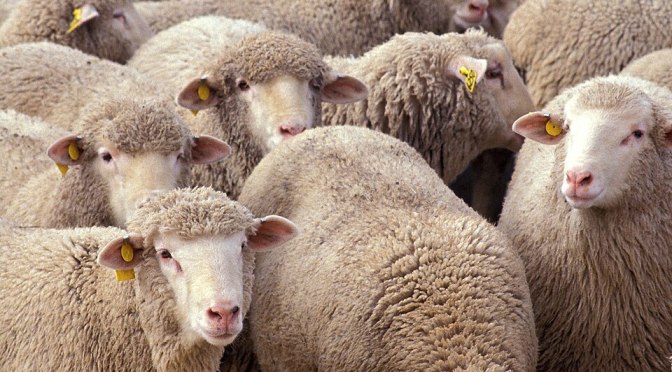
Image: Keith Weller, Herd of white sheep (2004?)
Wikimedia Commons

 JONAH magazine