
Category Archives: William Miller

Katrina Brick

Katrina Brick

William Miller

                                 I knew this woman, old New Orleans

                                 in her light graceful manners, 

                                 slightly dark humor. Her family house on Laurel Street

                                 had stood for over two-hundred years.

                                 Sarah gently told stories of disasters—

                                 a slave woman who burned her mistress to death,

                                 set her dress on fire with a coal pulled from 

                                 the kitchen fire with a pair of iron tongs.

                                 And one about her planter third great-grandfather

                                 who hanged himself in the attic with a cord

                                 from his Chinese dressing gown. 

                                “No ghosts,” she said, laughing.”  “No ghosts.”

                                But I wanted more, tourist-hungry and new

                                in town.  They all had them:  year-long flights

                                to California, dead bodies floating in the canals,

                                whole families stranded on rooftops.

                                She walked me through the wrought-iron gate 

                                into the shade of a cypress tree, pointed to an odd brick,

                                new among the moss-covered old.

                                “Eight dollars,” she said.  “That’s what Katrina

                                cost my family.  “A single brick blown down the street.”

                                There was guilt in the lines of her face, a survivor’s mask

                                of stoic charm.  And she was waiting for the next

                                African wind, a furry wheel in the gulf.

                                Once more, she’d risk a storm even if it meant

                                blown-out dormer windows, a caved-in mansard roof,

                                the death of an old family’s last daughter.  “A brick,”

                                she said sadly.  “The price of a single brick.”
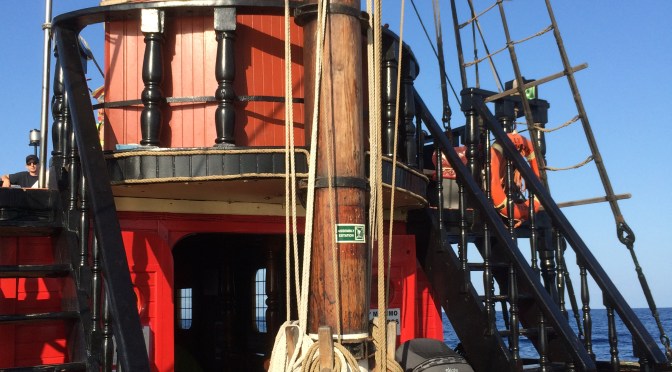
Death of a Pirate

Death of a Pirate

William Miller 

For two hot weeks he had pinned tourists

to the walls of charming old houses,

threatened locals with his sword outside

their favorite bars, the Lucky Dog stand.

One nutty eye leered beneath 

the pulled-down brim of his cockade hat.

He had no name, was just “the pirate”

or that “crazy pirate bastard”.  

Harmless enough, even though he wore

in a black and gold scabbard

a real honed, cutting sword.  On the hottest day

ever recorded in New Orleans,

he hectored the wrong homeless man

who stabbed him to death with three

quick thrusts of a prison shank.

Garbage men muttered, Japanese couples

snapped pics.  A pirate in a town where pirates

prospered and kept alive with smuggled rum

slaves from banned countries, he kept some kind

of faith.  Like all street performers, he gave

the crowd what they came to see,

traveled so far to post to their friends

back home.  His blood was extra,

more than what they paid for.

Songs for a Mad Woman

Songs for a Mad Woman

William Miller

The police car pulled up and then I was 

in hand cuffs, in disbelief, driven with two vagrants.

But I protested, cursed, screamed—“Don’t you know 

who I am?”  For those words, not all the ones

I published for thirty years, the books and magazines

that burned in the apartment fire, I was taken

to a place Kafka never dreamed worse.  A psych ward,

a treatment center where you were kept

without a phone call, a release date. 

A girl was raped in there, not by an inmate but two

attendants who took their pick from the gurney

they wheeled in daily, hourly.  An Aryan with 

a swastika tattooed across his back told me 

to stay quiet, play the game, nod and smile.

In the dayroom, the damned colored in coloring books.

For an hour, we sat in the shade of a wall topped

with concertina wire.  A woman with long silver hair

conjured birds with tiny wing-like hands—an old “traiteur”,

someone told me.  There was another woman,

“Gwen,” lost in her own shadows, eyes like

burned-out fuses. I needed a purpose and spoke

to her, made faces, sang songs she might know.

Her eyes lit up at “Yesterday”.  And then she said:

“I see many soldiers”.  The light in her eyes

went out and never came back.  I hoped she was

in a better place, soldiers all around, where someone 

tried to sing to her, at least knew her name.

Gay Christians

Gay Christians

William Miller


Gay Christians parade
up Dauphine Street.

It’s a rainbow double
line: black, white, Cajun
with Indian blood.

A marching band,
bass drum and wild horns,
leads them all.

They mix gospel
with Cher and Lady Ga-Ga,
play their own
funky jazz.

Church people threaten
them with hell fire,
unless they repent
right here, right now …

They ignore their critics
as more people, far more,
clap and whistle for them.

A young guy shouts out.
“Was Jesus gay?”

His lover wraps his
arm around his neck,
kisses the boy
on top of his head.

But the question lingers
in the air …

The Bible never says
if Jesus was gay or straight.

He could have had
a boyfriend who went
with him to raise
the dead, heal
a passing leper …

They are dancing now,
joyful, silly, and saved
for all time.

Near Canal, the parade
starts to break up,
but one last bigot shouts:

“Jesus died for my sins
but not yours!”

Laughter is the reply,
though some wave as
if they knew the man—
the same God
made them all.