
Something to Bury
John Martino
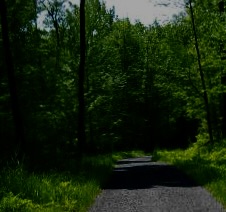
When he sees we’re drifting away from the berm, the headlights crossing the double yellow line, he looks over and up at me, and I can tell he is wondering why we are veering off, leaving the main road. For the past five miles or so, ever since hitting one on that long stretch with no overhead illumination, he’s been staring out the passenger window, watching the roadside reflectors flash by in a steady, rhythmic wink, hypnotic and calm, the seemingly endless strip of white marking the shoulder’s edge, and now the high beams are pointing down a very dark, uneven dirt surface, bumpy and rutted, hemmed in on each side by a skeletal wall of winter trees.
“When you hit one,” I tell him, “you have to bury it. That’s why we stopped back there. So I could put it in the bed of the truck.” He thinks about this for a moment, then nods and asks, “Should we report it?” His question irks me and my voice snaps “To who?!” harder than I’d intended. He looks down, then away, back to the window framing the darkness outside. I turn on the radio, find a station offering music. “There’s no need for that,” I add, softening my tone. “We’ll take care of it ourselves.” Regaining his confidence, he asks, “Do you think it hurt?” He wants to know, and I don’t hesitate. “I imagine it did. Almost certainly. But the impact was pretty instant, so. . .” and leave it there for him to fill in the rest.
I pull to the side of the dirt road edging the forest and back the pickup into a small clearing between the trees that I know is there. I cut the headlights, but keep the truck running, the heater on, the jazz station turned low. “Wait here. This won’t take long.” But of course he wants to come. “It’s too cold out there. Too dark. Wait here where it’s warm.” “But you’re going.” “That’s because I have to do this.” “But I wanna watch. See how it’s done.” “No, not this time. Now stay here and keep warm.” He turns back to the window and I reach under my seat with my left hand for the pistol, a Ruger, which he doesn’t know I keep, while leaning over with the right to remove the heavy, tactical flashlight from the glove compartment, then go out, closing the door with a soft click.
I click on the high-powered, concentrated beam, which seems to smoke in the chill night air, the frozen ground cracking under my boots, and give the area a slow careful sweep, panning the bright spotlight from trunk to trunk, the narrow gaps in between, watching whole sections of darkness dissolve, recede, then raising the beam higher, following some of the thicker branches to their leafless finger-like tips, all the while peering, listening. A twig snaps and something skitters, and I shift the light back down in that direction, but whatever it is it’s moving away, deeper into the forest. I cut the beam and lay the heavy light on the truck’s back bumper, then reach into the bed for the shovel. The smell is already sharp and keen. By the tail lights’ red glare, I begin digging. The door squeaks open, slaps shut, footfalls cracking, slipping a bit on, the glazed surface. It’s near zero, and my breath steams out of me like the gray exhaust from the truck. I stomp again on the back of the shovel’s blade and slice into hard, frozen ground, an icy slick metallic sound, incisive, sure. I glance over at him. Huddled in a puffy black cocoon of a coat zipped past the chin, he’s rocking from foot to foot to keep warm, balled hands buried deep into his pants pockets. He’s watching me widen, deepen the hole and seems taken by the rhythmic sound of the shovel splitting the earth, and after I dig a bit more, he asks to try. “Not now,” I say, shaking my head. “Another time. Let me finish. It’s bitter cold,” and I pull a pair of gloves out of my coat pocket. When I toss them to him, I can see the mask of disappointment on his face, the empty, downcast eyes, as if some unspoken bond between us has been irrevocably broken. I dig three more shovelfuls, then call him over.
It’s difficult for him to get the blade into the ground. “Use the heel of your foot, not the middle,” I offer. He manages to loosen and scoop up a chunk of frozen dirt and dump it next to the edge of the deepening hole. He does this two more times before relinquishing the shovel back to me. “These gloves are too big.” “It’s okay,” I tell him. “It’s not your fault. The ground is too cold, too solid at night. I’ll let you try again tomorrow. When the sun is out.” He shrugs his shoulders, says with some dejection, “But what will be the point then.”
“Well,” I say, making it up as I go along, “we also need to bury something. Of ours. To correct for what’s been done, what’s been taken. It’s a way of keeping things balanced. Even. Understand?”
“To say we’re sorry.”
“Yes, exactly. To say we’re sorry.”
He stays silent for a while. The smell is stronger now, and I’m giving the area another slow sweep with the flashlight, pausing the spotlight on one particular area between two trees twenty yards or so to my left where I thought I saw something, when I hear, “Is that why you had to bury mom? To say sorry?” His voice catches me off guard and, startled, I wheel around towards him with the high beam out like a lightsaber. He flinches and screams, covers his face, his eyes, and I manage to kill the light before it can do any serious harm.
“Are you okay?” I ask, moving towards him. He’s rubbing his eyes with the oversized knuckles of the gloves. Standing near the taillights, he’s bathed in red like the inside of a darkroom. I take his hands away and look at his face, which he tries to avert, the eyes squinting and wet. “I’m okay!” he snaps and turns to leave. But I grab one of the over-puffed coat sleeves to stay his retreat. I have to squeeze deeply, as if through a thick spongy layer of air, to know his arm is there. “Listen,” I tell him softly but firmly, “we’ve had this conversation before, and we’re not going to have it again. Not now. Not here. Anyway, it isn’t the same. Your mom died. When someone dies, they get buried. It’s custom. What we do. Not about sorry.”
“But she died because of me,” he says, his pained and saddened face looking directly into mine, and I watch the white breath pour out of him and mix with the truck’s exhaust.
“That isn’t true. Stop saying that.” I let go of his arm and unzip my coat a bit, fumble for the pack of “emergency” smokes I keep in the inner breast pocket. My fingers are numb, my brain is on fire, and it’s tough to work the lighter, to spin the little wheel, but I finally manage to get it lit. “Stop thinking like that,” I exhale. “It isn’t true. I told you, the hospital, the doctor, made a serious error, a bad mistake. One they had to pay for. And it’s been a long time now.” I inhale. “Some things you have to let go. Some things you have to…” and I can’t find the word as I exhale. Then realize it’s right in front of me: “…bury. And then forget them.”
“Have you forgotten mom? Because I haven’t.” He turns then, wiping his eyes, and walks back to the passenger’s side of the truck and I hear the door once again creak open and slap shut. I stand there for a while still listening to his words, and all I can think is, “You didn’t even know her!”
About twenty minutes later, I climb back in behind the wheel, turn up the heater and hold my hands in front of the hot warm air, which stings at first, painful, and I rub them together to get the blood flowing. The radio has drifted to static and I shut it off.
I’m about to put the gear shift into drive, when he looks at me and asks, “What will we bury?” I don’t understand at first, and stare back at him, strangely, like someone I don’t recognize, someone I don’t know, someone I could easily. . . . Then I remember. “I’m not sure, yet. Any suggestions?”
“Can it be anything? If so, we can bury a book. One that I really like but have already finished. It’s called The Time Machine. By H. G. Wells.”
I tell him I’ve heard of it, that it’s a great idea and has the right sense of symbolism. He asks me to explain symbolism, and I do my best, using the cross as an example, the way its vertical beam is rooted to the earth, to now, the present moment, but extends upward to the sky, to what will be, its arms stretched wide open, completely vulnerable, as if to say “This much.”
photo: Harry Rajchgot, Dirt Road 2013

