Tag Archives: JULY 2026

Leviathan

 LEVIATHAN  Michael J. Shepley

on the

concrete-ish

beach bleached

beige by cold

distant indifferent

sun sat

the bones

of the whale

chaser 2 centuries

dead

the bone tone

desert dry

rib cage

tinted a rosy-er

red in

sun setting

on the

turtle green

turning churn

South Atlantic

sea side shore

the wind

was sharp

cutting knife

edges through

the chinks

in our armor

of parka

snow pants

and iron hard

frozen mittens

and wicked salt

stung the

naked eyes

like bees,

or wasps

rather, because

they never

lose their

burning barbs

impressive

and huge

like a

dinosaur age

carcass stripped

of all flesh

flayed by

years of cool

dry rasping air

so that only

a spine of

wood born

skeleton stayed

glowing slightly like

some Da Vinci polished

white marble

tinted with a

light bloody

blush

some of

our crew

are busy

with their

cyber powered

eye, the 

Foto Cyclops

that tries to

capture the

spirit of

the eternal moment

in a paler

ghost image

of the long

long past

not yet lost

we came 

to the

very bottom

of the earth

for this

sight

words framed in

a northern poetic

affectation

following the

fading footprints of

oil hungry

sailors over

3 thousand

pathless miles

and

as was said

2 centuries

the poor ship

had no say

the whales 

undoubtedly would

prefer things went

a different way

like neither 

the sail ship

not the men

in it

were ever sent

never even did exist

in that sense

the wreck

is a living

animal monument

that resurrects,

maybe just saves,

a distant moment

still kinda

barely breathing

beneath the waves

photo: Alex Dawson, Underwater Photographer of the Year, 2024

THEY’LL NEVER KNOW

THEY’LL NEVER KNOW

John Richmond

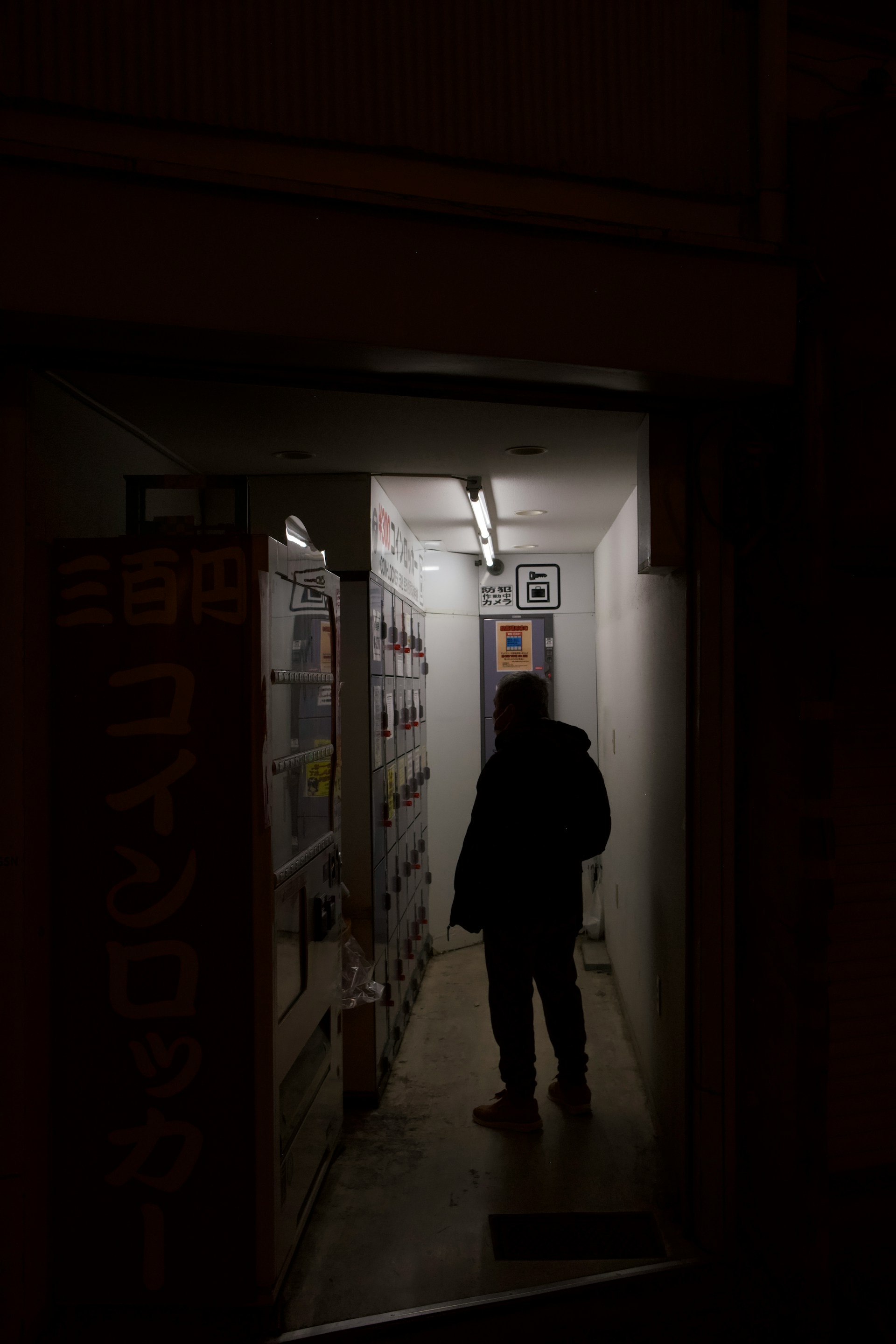
Photo by Noah Nothman on Unsplash

It was scheduled as just another, routine, away high school basketball game at a school out in the suburbs.

Tonight, though, this game was going to be different, almost pleasant.  You see, it was a brand new school, which meant a brand new building, basketball court and, especially, a brand new- fresh- locker room.

The entire team was looking forward to a reprieve from foul smells, rusting lockers and grungy showers.  Now, if that wasn’t enough, the home team was one of the worse teams in the league.

Which meant, tonight had all the makings if not “a walk in the park,” then, “a walk in the suburbs.”

Enter, “The Boy,” a junior, stepping off the team bus, travel bag in hand, heading into the gym and on to the visitor’s locker room.

“Amazing,” he said to himself as he took in the newly built looks, smells and feel of a beautiful place- pristine- a locker room that was almost begging you to walk around barefoot.

There were rows- aisles, really- of lockers with wooden benches down the middle of each.

“The Boy” made his way, with his teammates, trying to find a locker- and a spot on a bench opposite it.

However, as he scanned the lockers so as to pick one, he noticed the oddest thing- almost none of the lockers had locks on them.

“Suburban kids,” he told himself.

This realization caused him to stop and open one- it was loaded with clothing, sweats, towels and sneakers.

Finally, he found an empty locker, put his travel bag on the bench in front of it and proceeded to open it so as to get changed for the game- until.

Yes, until.  Until he took out his uniform and socks, then discovered he had failed to bring his sneakers.

“Damn it!” he shouted at the top of that extra pair of lungs that silently resided in his brain.

Checking his bag, again- all the way to the bottom- triggered another silent “Damn it!” even louder than the first one.

Immediately, he had two thoughts, one just slightly ahead of the other one.

The first one was- “I can’t believe it!”

His second thought was the more problematic one- “I can’t tell the coach about this- I just can’t!  He’ll go absolutely crazy!”

These two thoughts prompted him to sit down on the bench and try to think, try to find some way to avoid what soon- if left unaddressed- would become a major problem.

He sat there, now, his hands and fingers across his forehead, and shaking his head, ever so slightly in growing disbelief.

Gone at once was the internal debate- scrutiny- of how this could happen, replaced by the urgent need to find a solution.

His first thought was a completely idiotic and stupid one, though he entertained it just to get it out of his mind.

“I could ask if they’d let me play in my street shoes.”

Instantly, he checked himself with an equally absurd answer- “Sure kid, we spent tens of thousands of dollars on a brand new floor and we’d love it if you’d screw it up!”

The next thought?

Well, he wasn’t sure if it was a “more dumber” thought or a “less dumber” one, but for a moment he wondered if he could play in his socks.

Of course, traction would probably be at a minimum.

Quickly, he was at the end of any thoughts left in his mind, except to tell the coach and deal with the consequences.

It was at exactly at that moment that he brought his head and face up out of his hands and stared at the lockers in front of him.

His body moved up into a straight-up sitting position as an idea- perhaps the only one left- came to him.

“I know what I’ll do,” he advised himself as he stood up in front of the bank of lockers.

“Almost none of these kids put locks on their lockers.  So, I’m going to start going through them until I find a pair of sneakers that are my size.  I’ll use them for the game, then, after, I’ll put them back where I found them!”

This led him to smile as he approached the first locker, proud now of his larcenous-loan plan.

That first- almost ceremonial attempt- led to nothing.

After that, there were shoes that were too small, too big, too old, wrong color- they had to be white.

His preference was the Chuck Taylor high tops, but that quickly gave way to something- anything- that would be suitable in a basketball game.

After checking a couple of lockers, he found an old, worn pair, though, a good size match, but they did look like something you’d wear to the beach.

Regardless, he was relieved.

“These will have to do!” he told himself.

So, he suited up, put the sneakers on then headed out with the team for the warm-ups- trying to get used to them- yet understanding that they were fairly worn down, so getting up the court on a fast-break was going to suffer, but, still, he was out there at the start- so far so good.

Until that first jump ball, oh, his team won the tip, but as he pivoted to go after the ball, he slipped.

Initially, in the game, that slip proved to be no big deal, his team quickly got control of the flow- going up by fourteen points by the end of the first quarter- but throughout, he struggled, slipping some more, sliding, being faked out and unable to recover.

He became slower than his usual self, and he knew it, but more importantly, so did his coach.

It only took until the game got to the midway point in the second quarter for the coach to make his decision.

“Time out, Ref,” Steve heard the coach call out.

The five of them walked over to their bench.

“Bill!” the coach called down the bench, “you’re in for Steve.”

Hearing that, Bill headed down the court to report in at the scorer’s table.

The coach now turned to Steve.  “Are you feeling all right?” he asked.

Steve knew exactly where the Coach was headed.

“I think so, Coach.”

“You think so?” the Coach echoed.  “You think so, but you don’t look so good.  You seem off your game- slow, getting beat- like you’ve got lead in your feet.  What the hell is wrong with you?”

Steve looked from the Coach to his teammates and back at the Coach.

“I don’t know, Coach- it’s the floor, there’s something about the floor,” he concluded with a shrug.

The Coach ran his fingers across his forehead, thinking.

“Okay,” he finally said, “we’ve got this game easily.  We all know our next game against Tech is a big one.  I need you to be a hundred percent- you understand?”

“I understand, Coach,” he concurred.

The Coach reached over and patted him on the shoulder.

“Why don’t you call it a night, head over to the locker room, get changed and come back on the bench?” the Coach instructed, encouraged and ordered him in the most benign tone possible.

Steve nodded.

“Will do, Coach, will do,” he replied, then paused, “sorry about all this,” he concluded.

“That’s fine, we all have bad day.  Be happy that yours was against this team.  Okay?  Now, get going.”

With that Steve walked the length of the bench, turned up toward a hallway between two sets of bleacher seat and made his way to the locker room.

Once inside, he went over the bench across from the locker the shoes belonged to and took them off.

Picking them up, he opened the locker and prepared to return them to their rightful owner.  Yet, before he put them back in, he held them up for a moment so as to be eye-to-eye with the pair.

“Thank-you for being available, you got me out of a big jam.”

Then, he placed the sneakers back in the locker and took hold of the door, but before closing it, he said one last thing to the sneakers.

“Hey!  You guys and me- we’ve got a little secret.  Whoever you belong to, they’ll never know what went on tonight.”

That said, Steve closed the locker and returned to his own to get changed.

Once done, his walk to the locker room door albeit it in his own street shoes felt good both in body and mind, happy that he had the wherewithal to be able to dodge what would have been an embarrassing moment/experience.

Now, he was ready to rejoin the team as his new, old self.

photo: Lockers by Noah Nothman, 2026

Something to Bury

Something to Bury

John Martino

When he sees we’re drifting away from the berm, the headlights crossing the double yellow line, he looks over and up at me, and I can tell he is wondering why we are veering off, leaving the main road. For the past five miles or so, ever since hitting one on that long stretch with no overhead illumination, he’s been staring out the passenger window, watching the roadside reflectors flash by in a steady, rhythmic wink, hypnotic and calm, the seemingly endless strip of white marking the shoulder’s edge, and now the high beams are pointing down a very dark, uneven dirt surface, bumpy and rutted, hemmed in on each side by a skeletal wall of winter trees. 

“When you hit one,” I tell him, “you have to bury it. That’s why we stopped back there. So I could put it in the bed of the truck.” He thinks about this for a moment, then nods and asks, “Should we report it?” His question irks me and my voice snaps “To who?!” harder than I’d intended. He looks down, then away, back to the window framing the darkness outside. I turn on the radio, find a station offering music. “There’s no need for that,” I add, softening my tone. “We’ll take care of it ourselves.” Regaining his confidence, he asks, “Do you think it hurt?” He wants to know, and I don’t hesitate. “I imagine it did. Almost certainly. But the impact was pretty instant, so. . .” and leave it there for him to fill in the rest.

I pull to the side of the dirt road edging the forest and back the pickup into a small clearing between the trees that I know is there. I cut the headlights, but keep the truck running, the heater on, the jazz station turned low. “Wait here. This won’t take long.” But of course he wants to come. “It’s too cold out there. Too dark. Wait here where it’s warm.” “But you’re going.” “That’s because I have to do this.” “But I wanna watch. See how it’s done.” “No, not this time. Now stay here and keep warm.” He turns back to the window and I reach under my seat with my left hand for the pistol, a Ruger, which he doesn’t know I keep, while leaning over with the right to remove the heavy, tactical flashlight from the glove compartment, then go out, closing the door with a soft click. 

I click on the high-powered, concentrated beam, which seems to smoke in the chill night air, the frozen ground cracking under my boots, and give the area a slow careful sweep, panning the bright spotlight from trunk to trunk, the narrow gaps in between, watching whole sections of darkness dissolve, recede, then raising the beam higher, following some of the thicker branches to their leafless finger-like tips, all the while peering, listening. A twig snaps and something skitters, and I shift the light back down in that direction, but whatever it is it’s moving away, deeper into the forest. I cut the beam and lay the heavy light on the truck’s back bumper, then reach into the bed for the shovel. The smell is already sharp and keen. By the tail lights’ red glare, I begin digging. The door squeaks open, slaps shut, footfalls cracking, slipping a bit on, the glazed surface. It’s near zero, and my breath steams out of me like the gray exhaust from the truck. I stomp again on the back of the shovel’s blade and slice into hard, frozen ground, an icy slick metallic sound, incisive, sure. I glance over at him. Huddled in a puffy black cocoon of a coat zipped past the chin, he’s rocking from foot to foot to keep warm, balled hands buried deep into his pants pockets. He’s watching me widen, deepen the hole and seems taken by the rhythmic sound of the shovel splitting the earth, and after I dig a bit more, he asks to try. “Not now,” I say, shaking my head. “Another time. Let me finish. It’s bitter cold,” and I pull a pair of gloves out of my coat pocket. When I toss them to him, I can see the mask of disappointment on his face, the empty, downcast eyes, as if some unspoken bond between us has been irrevocably broken. I dig three more shovelfuls, then call him over. 

It’s difficult for him to get the blade into the ground. “Use the heel of your foot, not the middle,” I offer. He manages to loosen and scoop up a chunk of frozen dirt and dump it next to the edge of the deepening hole. He does this two more times before relinquishing the shovel back to me. “These gloves are too big.” “It’s okay,” I tell him. “It’s not your fault. The ground is too cold, too solid at night. I’ll let you try again tomorrow. When the sun is out.” He shrugs his shoulders, says with some dejection, “But what will be the point then.” 

“Well,” I say, making it up as I go along, “we also need to bury something. Of ours. To correct for what’s been done, what’s been taken. It’s a way of keeping things balanced. Even. Understand?” 

“To say we’re sorry.”

“Yes, exactly. To say we’re sorry.”

He stays silent for a while. The smell is stronger now, and I’m giving the area another slow sweep with the flashlight, pausing the spotlight on one particular area between two trees twenty yards or so to my left where I thought I saw something, when I hear, “Is that why you had to bury mom? To say sorry?” His voice catches me off guard and, startled, I wheel around towards him with the high beam out like a lightsaber. He flinches and screams, covers his face, his eyes, and I manage to kill the light before it can do any serious harm.

“Are you okay?” I ask, moving towards him. He’s rubbing his eyes with the oversized knuckles of the gloves. Standing near the taillights, he’s bathed in red like the inside of a darkroom. I take his hands away and look at his face, which he tries to avert, the eyes squinting and wet. “I’m okay!” he snaps and turns to leave. But I grab one of the over-puffed coat sleeves to stay his retreat. I have to squeeze deeply, as if through a thick spongy layer of air, to know his arm is there. “Listen,” I tell him softly but firmly, “we’ve had this conversation before, and we’re not going to have it again. Not now. Not here. Anyway, it isn’t the same. Your mom died. When someone dies, they get buried. It’s custom. What we do. Not about sorry.” 

“But she died because of me,” he says, his pained and saddened face looking directly into mine, and I watch the white breath pour out of him and mix with the truck’s exhaust.

“That isn’t true. Stop saying that.” I let go of his arm and unzip my coat a bit, fumble for the pack of “emergency” smokes I keep in the inner breast pocket. My fingers are numb, my brain is on fire, and it’s tough to work the lighter, to spin the little wheel, but I finally manage to get it lit. “Stop thinking like that,” I exhale. “It isn’t true. I told you, the hospital, the doctor, made a serious error, a bad mistake. One they had to pay for. And it’s been a long time now.” I inhale. “Some things you have to let go. Some things you have to…” and I can’t find the word as I exhale. Then realize it’s right in front of me: “…bury. And then forget them.”

“Have you forgotten mom? Because I haven’t.” He turns then, wiping his eyes, and walks back to the passenger’s side of the truck and I hear the door once again creak open and slap shut. I stand there for a while still listening to his words, and all I can think is, “You didn’t even know her!” 

About twenty minutes later, I climb back in behind the wheel, turn up the heater and hold my hands in front of the hot warm air, which stings at first, painful, and I rub them together to get the blood flowing. The radio has drifted to static and I shut it off.

I’m about to put the gear shift into drive, when he looks at me and asks, “What will we bury?” I don’t understand at first, and stare back at him, strangely, like someone I don’t recognize, someone I don’t know, someone I could easily. . . . Then I remember. “I’m not sure, yet. Any suggestions?” 

“Can it be anything? If so, we can bury a book. One that I really like but have already finished. It’s called The Time Machine. By H. G. Wells.” 

I tell him I’ve heard of it, that it’s a great idea and has the right sense of symbolism. He asks me to explain symbolism, and I do my best, using the cross as an example, the way its vertical beam is rooted to the earth, to now, the present moment, but extends upward to the sky, to what will be, its arms stretched wide open, completely vulnerable, as if to say “This much.”

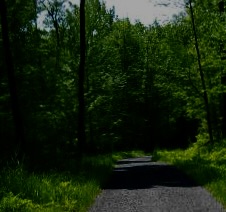
photo: Harry Rajchgot, Dirt Road 2013

Inuit Karaoke

Inuit Karaoke

Mark Concannon

I voted for The Big Man three times and so did everybody else I knew 

‘cause he was the only one who did anything to stop all those damn 

criminals with their brown faces and their funny way of talkin’ from 

pourin’ in from Mexico and Guatemala and all those other sorry-ass 

places, and messin’ everything up.

The way that I and all the other folks who did farmin’ in Gunther 

County, that’s in Nebraska by-the-by, the way we saw it, anyone with 

skin, that you know, looked real sun-tanned, was real bad news. Now, 

mind you, we all hired some of those individuals, I guess because we 

had to because nobody local would do them jobs for that money but 

none of us really liked ‘em and we sure as hell didn’t trust ‘em.

When you’re in the fields every day, brother, you pay a whole lotta 

attention to the weather, which we did religiously but we never 

believed in all the talk about global warmin’, figuring that was just some 

fancy talk from those folks on the other side tryin’ to scare us.

But sonovabitch, turns out they were right about that one. Gotta give 

those boys credit because that Nebraska county I was tellin’ you about, 

where my family owned a farm for like 150 years? It’s now like 100 

degrees there, every day. And they don’t get no rain. And this is 24-7-

365.

It happened real fast. The soil got real dry, the crops started wiltin’ and 

when they start wiltin’ it’s a whole lot easier for the bugs to eat ‘em, so 

the yields got low then they disappeared altogether. And what’s worse 

is when the pastures get sandy, there’s nothin’ for the animals to graze 

on so you try sellin’ off some of the herd but after a while, ain’t nobody 

was buyin’ ‘em so there were some real sad goodbyes to the cows, 

sheep and goats, plenty of them, you know, farewell dinners where 

they was both guests of honor and the main course.

Now I’ve delivered a few calves in my day but I ain’t no doctor or 

nothin’  but it was real easy to tell when the people in the county 

started fadin’ away too. They wasn’t coughin’ up blood or anything like 

you see in them Zombie movies but there was somethin’ about them 

that told you they weren’t doin’ too good. They just kinda got gray and 

grayer and grayer and one day you didn’t see ‘em around no more. 

Every family knew all the stories about the Dust Bowl in the 1930’s but 

we ain’t never figured it would happen to us.

So it’s hot like everywhere and there are only a few places left on God’s 

earth where anything’s got a chance to grow. Not many spots where 

you can farm with a whole bunch more farmers who are dyin’ (and I 

mean really dyin’) to farm somewhere and mister you’ve got yourself a 

situation.

This group called the United Nations, who’ve sorta been runnin’ things 

since The Big Man passed 20 years ago, figured a way to give everybody 

a shot at workin’ a piece of land. Now I say everybody, but it really 

wasn’t everybody, just those folks who could fork over 100-grand which 

got you a ticket into the lottery to see who got to keep farmin’ and who 

had to try somethin’ else. 

My brother Vernon, his wife Clara and me, the only adult members of 

our family still standin’ on this side of the grass, scraped together the 

100 K, got us a ticket, then jammed into the village hall, the only joint 

around that still got internet, to watch the lottery which was streamin’ 

in from Switzerland, I think. 

So there we were, squeezed in real tight (not as tight as it coulda been 

though since everyone was a might skinnier than previous) bumpin’ 

shoulder-to-shoulder with a bunch of drunk, sweatin’, stinkin’ 

sodbusters (wasn’t much water for showerin’ anymore), all hopin’ 

against hope to hear their names called to get one of them farms in 

them lands that still had ‘em.

The picture on the big screen TV was kinda fuzzy but you could still 

make it out pretty good. The show was called “Crop Luster” and It was 

a real glitzy deal with some silver-haired dude in a tuxedo drawin’ 

names out of a bucket that two chicks wearin’ fancy gowns pulled up 

from a well that looked fake as hell but I guess they wanted to make 

believe they were on a farm or somethin’.

They called out 100 names that night and wouldn’t you know it, the 

very last name they called was “CVB Farms in Gunther County, 

Nebraska” and that was us! 

The “CVB” stands for Clara, Vernon and Bunk, my sister-in-law, my 

brother and me. Now my real name is Eugene but people around here 

call me Bunk ‘cause I tend to run my mouth and exaggerate a bit from 

time to time. 

And even though they was pissed they didn’t have a winning ticket, 

everyone in the town hall offered us congratulations and best wishes 

and we said we hoped they would win next time but there was like ten 

more of them shows and nobody from Gunther County got picked.

But we sure did and that’s how come I’m in Esmitte, that’s in Greenland 

by-the-by, workin’ the land with Clara, Vernon and their two teenage 

boys. 

Now Esmitte used to be just north of what they called the Arctic Circle, 

you know, big ol’ sheets of ice that went on for miles and Polar bears 

roamin’ around. The bears and ice are all gone but some of the 

prettiest soil there ever was stretches as far as the eye can see.

It’s warm enough now to plant wheat, which we got a bunch of on our 

lower field. We stuck in some broccoli, kale, beets, carrots, turnips and 

radishes in the upper field closer to the house. 

And plantin’ around here took some gettin’ used to. When I first broke 

ground, some pretty weird, squiggly characters popped up from 

underneath. They didn’t look like any of the worms, grubs or crickets 

from back home but turns out they didn’t do no real harm to the 

harvest.

There are quite a few of us here now, so they needed to build some 

roads so we could all get around and I’ve become buddies with some 

boys from Iowa who got picked to be part of the highway crew.

And when all that ice melted, there was all kind of bones, like real 

ancient ones of bears, whales, seals and fish, so an army of them 

people who dig up old bones and stuff came here to investigate, 

wearin’ puffy jackets, carryin’ binoculars, teeny, tiny hammers and 

magnifyin’ glasses, lookin’ like them real educated types, you know, like 

some of them folks on the other side we didn’t used to care for but 

they were real nice, one of ‘em even stayed on to be principal at the 

grade school, and they even paid us a thousand bucks a day to look 

around on our land and there were film crews filmin’ them doin’ it and 

they all needed a place to stay so we got us a 200-room hotel, the 

Northern Lights Inn, just south of town. 

And these science people from Nuuk (that’s like the New York City of 

Greenland) just told us that real soon it might be gettin’ nice enough to 

grow corn, peppers, cukes and tomatoes. Hell, even pumpkins. That 

would be a big hit for the kids trick or treatin’ at Halloween.

And did I tell you, by-the-by that I’m a dad now? Don’t that beat all? I 

never did much with the ladies back in Gunther but mister, let me tell 

you, one look at Lusa at the hotel’s karaoke night and I was a goner. 

Lusa, which means “midnight” in Greenland talk was up there on stage, 

beltin’ out one of them Eskimo folk songs. I didn’t understand none of 

the words but it was a real catchy tune and that girl, I’m tellin’ ya’ that 

girl was somethin’ else. 

She’s singin’ away, her movin’ parts movin’ real good, her two long, 

black pigtails swayin’ to the music and then she starts givin’ me the eye 

and I’m poundin’ down a Coors Light and getting’ real sloppy with 

chicken wings and ranch dressin’ but still managin’ to give her the eye 

right back. Afterwards, she waves me over to her table and we get to 

talkin’, you woulda never guessed it by lookin’ at her, but hell, her 

English was better ‘n mine, and I come to find out she used to work in 

minin’ (which I told her was hard to believe since the little lady is like 

five foot tall standin’ on her tiptoes but when she invited me to 

commencin’ arm wrestlin’ to prove her point, I took one look at them 

muscles when she rolled up her sleeve and reckoned she’d whip my ass 

directly) and processin’ fish guts which she hated and now she’s just 

startin’ out as a tour guide for all the visitin’ folks who want to see what 

we’re doin’ over here and wouldn’t you know it one of the stops she’s 

making is our farm! Never thought in a million years I’d be a tourist 

attraction!

And in a billion years, never thought I’d marry a brown beauty but I did. 

There wasn’t no fancy ceremony. Lusa says in these parts, a boy and girl

 just agree to be married and that’s that. And I mean it could be first 

thing in the morning, last thing at night or durin’ a long day when she’s 

helpin’ us in the fields, no matter what, that girl always looks fresh, like 

she just stepped out of the shower. Never seen nothin’ like her and I 

never wanna be with nobody else.

Our kids, got two boys, Juko, who I call Johnny, Pittaq, Petey to me, and 

a girl, the apple of my eye Angajulleq, my little Angie. Lusa had some 

other goofier names in mind with a whole bunch more q’s but I put my 

foot down on that one.

Lusa’s been doin’ some redecoratin,’ makin’ these wood carvings that 

look like little Mr. Potato Heads with a bunch more teeth and puttin’ 

em all over the house. She says they’ll bring us good luck and they’ve 

been workin’ great for that so far. Little Angie knitted some green 

outfits for ‘em for Christmas and even Vernon and Clara, not exactly the 

smiliest people you’d ever know, got a chuckle or two out of it. 

The kids were complainin’ they were hot so I got one of them above 

ground pools they could splash around in. I taught ‘em how to play 

Marco Polo and it’s quite a sight, them chocolatey faces with black mop 

tops bobbin’ up and down in the water. Sometimes, I’ll take a dip 

myself, just layin’ back admirin’ all the greenery and the daffodils and 

cornflowers growin’ everywhere, like a blue and gold blanket down in 

the valley. Sometimes Lusa will bring me out a mug of what she calls 

“Greenlandic coffee” while I’m floatin’ around and I don’t know what 

she puts in there besides coffee but it sure as hell isn’t half and half and 

it sure as hell takes the edge off.

Things are goin’ real good.  We’re as busy as all get out. Trucks comin’ 

in three, four times a day, drivin’ down to Nuuk where they fly our 

produce to all corners, feedin’ the world, or what’s left of it anyway.

I mean, I still pay a whole lotta attention to the weather and it’s 

definitely  gettin’ warmer but it’s nothin’ like it was back in Nebraska 

back in the day so I’m thinkin’ we’re gonna he alright here.

Yeah. That’s what I’m thinkin’.

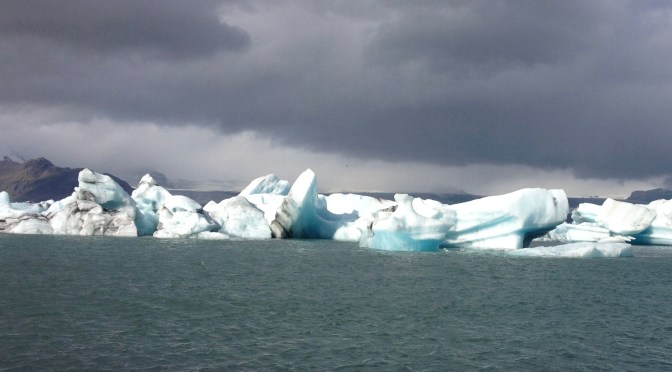
photo: Philip Rajchgot, Icefields 2014

THE SALAMANDER’S PATH

THE SALAMANDER’S PATH

Nadine Kraman

It’s a two-hour drive to Deerfield, Massachusetts, plenty of time to think about my intention to go inward after my healing circle, alone in a cabin for five days, no running water, a two-burner hot plate and wood stove for warmth as cities and strip malls give way to rolling hills and fewer houses, four lanes become two, then a narrow dirt road . . . things start to slow down. 

  *   *   *   *   *

The first thing that catches my attention as I pull out of the Fresh Pond shopping mall parking lot after buying a few last-minute groceries: some fish, more garlic, something to munch on while I drive, is how beautiful everything looks when I decide I am getting away. The clouds look almost luminous. Is it because I am headed out on an adventure? Because I am leaving my daily responsibilities, my schedule, commitments, the responses others expect of me, my expectations of how I should behave, how I should be available. 

Then I’m blindsided with a moment of panic, “Why am I doing this? What good will being alone for a week do? Why am I so self-focused? Old, internalized doubts and fears, old tapes. Then the reality of the situation becomes clear. I know I am headed in the right direction, due west, keep the sun on your left, to let go of my mundane self by making things simpler: haul water, make fire, eat food, rest (maybe even write). I am craving the caw of a crow in the distance, the starkness of trees barren of leaves, dark clouds curtaining in over a mountain. And so, the miles roll by and there are more miles behind me than in front of me.

The cabin is a simple one room wooden structure with a slanted roof. A single bed and bunk bed at the far end, a broken-down couch and wooden coffee table, a chair and square wooden table in front of a large window: bedroom, living room, kitchen in one rectangular space. 

Once I unpack my gear from numerous canvas bags, I turn my attention to the wood stove. It is cold and damp inside the cabin. The person who laid the fire in preparation of my arrival must have been in a hurry. The lighted match is useless. The newspaper feels damp and is simply folded in half and the wood badly stacked. I take everything out of the firebox and start over. 

Crumping single sheets of newspaper, I lay a good foundation with plenty of room for air to circulate. I place small twigs and kindling, which I find in the wood bin, in a crisscross pattern on top of the paper and then lay some slightly larger pieces of wood, then a couple of quartered logs, their splintered facets facing inward to catch the flame from underneath.

Time for the one-match test. The wooden match ignites as I run it along the rough edge of the matchbox, hold it steady and apply the flame to the edges of newspaper closest to me. I watch as the fire moves slowly at first, drying out the dampness from the paper and then gathering momentum, igniting the kindling and smaller pieces of wood, a crackling sound; flames –– blue and orange –– lick around the quartered logs as the fire takes off. I close the heavy cast iron door and adjust the flue.

Soon the cabin feels toasty, and it won’t take much more than coals to keep the temperature quite cozy. I sit on the couch and stare out the window. It is a peaceful scene, a bit of grass browned in November, a large swarth of tall straw-colored grasses waving in the wind, the dark trees behind, the mountain off to the right. The sky is gray with a wall of clouds. 

I become aware of my mind shutting down. I am observing my mind and thinking “there is no chatter, my mind feels blank.” Except for this awareness there are no other thoughts. I am aware of not thinking. It is so pleasant to just be with this stillness. The magic has begun, it feels like a miracle.

Suddenly I’m sad. I feel the darkness descending. I am alone, this is how death comes, the dimming of the light. My eyes fill with tears. My next thought is “where is the lemon for dinner?” I had been envisioning fish smothered in lemon slices, and I don’t remember seeing the lemon when I unpacked. Did the lemon roll out of the bag? Clearly, I am not dying but very much alive and hungry.

I step into my boots and climb the now partially frozen muddy path to where my car is parked. And there is the next miracle. Above the dark gray undulating outline of the mountains in the distance, the setting sun has created a rainbow of the fog. The first layer has a tinge of yellow to green-blue. There is a definite band of purple between the blue and rose bands of color, and above the rose is a peach-colored fog.  The setting sun has cast the clouds on the horizon as a rainbow, like layers of fluff in a parfait glass. 

The colors dissolve and disappear within a few moments. I realize that if I hadn’t gone in search of the lemon at that exact moment, I would never have caught the transitory and highly unusual refraction of light.

I find the lemon in the cooler. I cook the fish in a cast iron pan on the wood stove that I’ve stoked hot. After enjoying a delicious dinner, I clean up a bit. I sleep in my sleeping bag and the pillow I brought from home. I wake up in the middle of the night cold, coax the fire back from embers. And so, the days pass: haul more water from the main house in plastic jugs, eat, sleep, keep the fire going. 

On the third night I pull back the curtain and peek out of the small window over the counter where I’ve been washing dishes in a plastic tub. The night is dark. There is an abundance of stars. There is a hint of light on the horizon. I step into my boots and fling on my jacket, bounding up the path. 

As I stand, legs astride, a sliver of white emerges over the mountains. As it continues to grow, I have a new awareness that the moon is stationary, and it is the earth that is rotating on its axis, moving fast enough to be perceived as a moonrise! As minutes tick by, the earth turns, and the moon appears round and full and very BIG above the mountains! Another unexpected miracle.

On the day before I am scheduled to leave, I take a walk in the late afternoon.  I walk around the field to watch the weather move off the mountains into the valley, west to east. Dark clouds roil in and with them a chill and the rustle of raindrops on dry grasses parched of color by an early frost.

           I walk by purple brambles, thorny blackberry patch, and spears of plush red sumac candelabra above a thicket of wild, wild rose. I squish a rose hip between thumb and forefinger to lick the juice, sweet and perfumy on my tongue. The rain is the fine mist New Englanders call spitting rain.

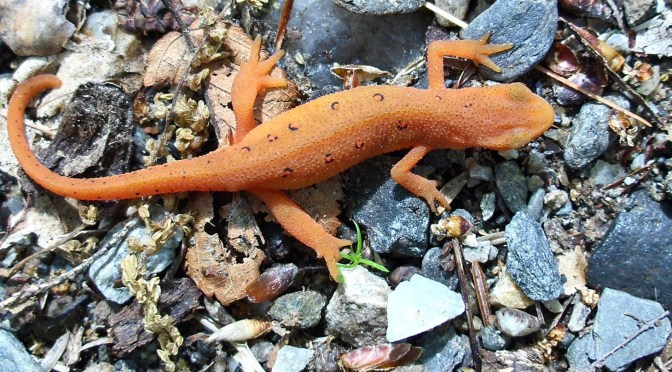
And then I see her. A bit of orange against the dark brown of pine needles and leaf litter, a small salamander, the type I’d seen as a child but never since. We used to go for a walk after the rain when everything was wet and dripping, summers in the country in New York State when I was a child. When the heavy downpour of a sudden thunder shower had let up and our cooped up indoor play energy got to go outside again. 

My cousin Suzanne, my sister, and I, accompanied by our mother and aunt Dossie, would go off on an expedition carrying a gallon sized glass jar. We were collecting specimens of a certain very prolific salamander that littered the roadside after the rain. They must have lived in low places under rocks and leaves and emerged when the earth was temporarily soggy with water. These weren’t your brown or green newts. These were your bright orange salamanders with two rows of six or seven red dots encircled by a dark perimeter, which ran along either side of their delicate spines. 

Each salamander, though similar in shape, long and narrow, around three inches in length with three toes on each of its four crooked legs, was different and had a character all its own. By the time we’d circled around and headed for home, we’d have the gallon jar half full of writhing orange amphibians, a wonder that the ones at the bottom didn’t get crushed or asphyxiated.

At home, we’d sort through the salamanders for the liveliest and race them across the cement steps in front of the house, never thinking about the fragility of their skin against the rough surface of the cement. We’d push and prod them to move in the direction of the race. Finally, we’d dump the rest of them out on the grass. Hundreds of orange salamanders would take off down the hill, making haste toward their new homes. 

Today, on my retreat, the salamander is the lone amphibian out for a stroll. After I carefully pick her up by her tail, she continues striding along the palm of my hand. I put one hand in front of the other to keep up with her pace. She never realizes she is on a treadmill. She is focused on the terrain under her feet, unaware of the enormity of the forest, the trees towering above her, the wind sending shivers in the topmost branches of the pines. 

The sky begins to lighten. I can only wonder if her tiny amphibian brain knows in some incredibly direct way that the storm has passed and that the sun is trying to come out. Occasionally, she stops and cocks her small fragile head to one side as if to check out the environment which has shifted.

I am mesmerized by her every move. She seems so vulnerable and yet, I am struck by her strength and resolve to keep going forward. After giving her a soft kiss, I put her back on the mass of dark brown leaves from which I had plucked her. She keeps up her pace by reaching one front leg forward while swinging her opposite crooked hind leg in a large arc until her rear toes almost touch the toes of her front leg on the same side. Then she repeats this maneuver on the other side. Her posterior end, including her tail that is as long as her body, switches from side to side as she walks, while her head and shoulders moved fluidly forward without the lightest trace of the intense shifting going on in her hindquarters.

I watch for a long time. She keeps moving straight ahead, putting one foot in front of the other. She seems undaunted when she tumbles over the edge of an upturned leaf and nearly falls on her back. Her forward movement continues without skipping a beat, her head held high. At last, she disappears under a log. 

I am aware of how still I have become while watching this diminutive but dynamic drama unfold. As I turn to go, I glimpse a bit of orange striding from under the fallen tree, “The salamander’s path,” I say out loud, hoping I can integrate some small part of what I have learned from my time alone in nature as I prepare to return to the challenges of my busy, cluttered life at home.

My Grandmother’s Twentieth Century

My Grandmother’s Twentieth Century

Elissa Greenwald

I read a newspaper article recently about life and death in Lviv, the westernmost city in Ukraine. There babies continue to be born while traffic stops for the funerals of soldiers who died in other parts of Ukraine fighting Russian invaders. Increasingly, Lviv too is under attack.

When my courage flags in the face of recent catastrophes, I think of my grandmother. Born outside Lviv in 1894, she spent her twentieth year hiding in a basement there with her infant daughter and younger sister after World War I drove them from their home. It is excruciating to see so much of her experience repeated in Ukraine and the Middle East today: war, civilians under fire, prejudice leading to violence.  

My grandmother’s life spanned the twentieth century. If my nephew, born in 1999, lives as long as his great-grandmother, he will live through the entire 21st century.

When the pandemic began, I told my nephew, “You are living through a historic time.”  “I’m too young to be living through a historic time,” he protested. At 20, he was then a college sophomore. At that age, my grandmother, along with her sister and daughter, was making her way across war-torn Europe with no resources except her wits and strength.

My grandmother was born in what humorist Calvin Trillin describes as “a suburb” of what was then Lvov, Poland–a shtetl known in Yiddish as Boyberke, which today is Bibrka, Ukraine. The man whose stories inspired Fiddler on the Roof lived nearby. His pen name, “Sholom Aleichem” (peace be with you), was ironic given the poverty and pogroms that oppressed Jews in the nineteenth century in the narrow region of Eastern Europe, the Pale of Settlement, to which they were confined by law. Sholom Aleichem’s stories and the musical based on them show how the lives of impoverished Eastern European Jews were enriched by music, religion, and family ties. Almost overnight, my grandmother lost all but the music.

My grandfather fled Poland for the United States soon after his daughter’s birth in 1913, on the eve of World War I, to avoid being conscripted into the Austro-Hungarian army like my grandmother’s four older brothers. I believe they all perished in the war. My grandfather promised to send for his wife and daughter to join him in the United States when he had earned enough to pay for their passage. 

A few years earlier, my great-grandmother had died and my great-grandfather remarried. His new wife treated my grandmother and her younger sister with hostility, favoring her own children. My grandmother continued to live with her parents after her baby was born.

Then the First World War broke out. My 20-year-old grandmother, taking her baby and 12-year-old sister, fled Boyberke for nearby Lvov in 1914. My aunt once told me her earliest memory was of gazing out a window from a basement to glimpse the sun. Penniless, they were probably squatters in an abandoned building.

Every morning, my grandmother went to the town square to buy fruit at the market. Then she walked miles to the train station in Lvov–now Lviv–, the same station I have seen on television recently. She sold fruit at higher prices to soldiers passing through Lvov heading to the front. While my grandmother worked, her sister took care of my year-old aunt.

Because Lviv has been in the news over the past several years while war in Ukraine continues to rage, I have seen pictures of the places my grandmother frequented–the train station and the cobblestoned town square surrounded by medieval buildings. Knowing how beautiful the city is, I find it easier to contemplate my grandmother, her sister, and my aunt struggling to survive there. 

The opera house is ornate, white with gold trim. As a teenager, my grandmother would sometimes sneak away from home and walk five miles to hear opera from the standing room section. I like to imagine that sometimes, after a long day selling fruit, she caught strains of music as she walked past the opera house to the basement where she lived.

A temporary haven for my grandmother over a century ago, Lviv became a haven in recent years for thousands of Ukrainians fleeing the Russian occupation and war in eastern Ukraine that began in 2022. For a while, every day, refugees streamed off trains into Lviv. Since 2024, however, Lviv too has been the target of Russian bombing.

The Russian invaders of Ukraine have been merciless. Tales of atrocities in eastern Ukraine have filtered out: rapes of women by Russian soldiers, for example. 

My grandmother was nearly raped by a Russian soldier on a train leaving Lvov over a century ago.

That is the story I’ve heard from my mother. Lvov must have become unsafe or unsustainable, so my grandmother must have fled by train. How could she afford train tickets for herself, her child, and her sister? Did they sneak onto the train? Maybe that was why they became endangered. How could a soldier try to rape a woman traveling with her younger sister and her baby? That is the least puzzling question, for brutality is inherent to war. Did my grandmother escape rape or even murder by bribing the soldier to leave her alone? 

That encounter wasn’t the first time my grandmother escaped disaster. It wouldn’t be the last. She ended up in Paris, more than a thousand miles from her birthplace. How did she know Paris would be a good place to escape to, when she had never traveled further from her shtetl than the five miles to Lvov? Perhaps she had heard that Paris was a magnet for refugees, including Jews, from all over Europe. My grandmother stayed there, and her sister and daughter grew up there, for six years. 

I made a possible connection to my grandmother when I visited Paris twenty years ago. At the end of the twentieth century, the Museum of the Art and History of Judaism in Paris, housed in a mansion in the Marais district, opened. Posted on the building’s iron gates are photographs of Jewish tailors who lived in the mansion when it was cut up into apartments early in the  twentieth century. When I saw those pictures, I imagined that my grandmother, a talented seamstress, lived there, supporting herself and her family. Though the Marais was impoverished then, with ancient, crumbling buildings, it is now fashionable. Although it once housed a burgeoning Jewish community, almost all the Jews in the Marais were taken away and murdered during the Holocaust. Today the only remnant of Jewish presence in the Marais besides the museum is a single street of Jewish shops, several tiny synagogues, and many blue markers indicating the places from which Jewish people were taken.  

Luck saved my grandmother from the fate which engulfed six million European Jews.  Eight years after parting from her husband, seven years after losing contact with him when she left her village, one day in 1920 she was walking down the Champs Elysées when someone called her name.

 “Sarah? Sarah Teichman?” She turned around and saw a former neighbor from Boyberke. “I just left your husband in New York,” he said. 

Through that chance encounter, my grandparents were reunited. The path to their reunion was not smooth. The first crisis occurred when my seven-year-old aunt fell off the train which she, my grandmother, and my great-aunt were taking to Rotterdam to board a ship to New York. My aunt, exploring the train on her own, fell off the platform at the back. 

It took my grandmother a moment to realize what had happened. She alerted the conductor, who stopped the train so they could get off. My grandmother and great-aunt walked back along the tracks through a forest until they found my aunt, who had twisted her ankle. My grandmother carried her daughter on her back for miles to get medical treatment. Her sister must have walked beside them, bearing all their earthly possessions.

My grandfather had sent enough money for second-class tickets for their passage to the United States, but the delay caused by my aunt’s injury created new hazards. By the time they reached Rotterdam, the port was closed, probably because of an outbreak of Spanish flu. My grandmother bribed a ship’s captain to take them on his vessel, the last one allowed to leave the port, in steerage.

My 103-year-old mother still wonders why my grandfather sent only enough money for two tickets. Perhaps he did not have enough money for three. Or maybe, after my grandmother bribed the ship’s captain, the money for three second-class tickets could only buy two in steerage. In that case, my aunt’s wandering on the train and subsequent injury might have indirectly caused the death of the woman who raised her. 

My grandmother corresponded with her sister, who returned to Boyberke, until World War II began in Europe in 1939, when my mother was 17. After that, my grandmother received no response to her letters. She never knew what happened to the sister she left behind. My great-aunt was probably one of the six million Jews who died in the Holocaust.  

My grandmother parted from her sister, my aunt from her surrogate mother, at the port in Rotterdam, though my grandmother couldn’t have known then that she would never see her sister again. There must have been tumultuous tears on both sides when they parted.

  My mother, like my aunt, loved to wander as a child–once she fell off a billboard she climbed when my aunt was supposed to be watching her. My grandmother’s extreme reaction to that event, beating my mother, may have been related to what happened when her daughter fell off the train and, as a consequence, her younger sister was left behind in Europe.

I never learned my great-aunt’s name. Now there is no evidence that she lived except in the stories my mother tells. I have not yet summoned the courage to find out the precise fate of the Jews of Boyberke, my grandmother’s shtetl, which was predominantly Jewish before World War II. When I learned that a student of mine from Ukraine was born in the same village as my grandmother, I asked if she knew of my grandmother’s family, the Golds. She told me there were no Jews left, nor any trace of them, in Bibrka.

My aunt and grandmother did not know in 1920 that they were escaping nearly certain death by leaving Europe. Perhaps my grandmother felt ambivalent about leaving Paris for an uncertain future in New York. They had a rough crossing in steerage, the crowded belly of the boat. My aunt was seasick throughout the weeks-long crossing.

In the photograph my mother has of my grandmother and aunt when they arrived at Ellis Island, my well-dressed grandmother stares unsmiling at the camera, formidable at 27. My aunt, despite the fashionable bow in her hair, looks fragile and bewildered at eight. No wonder: she had already lost her primary caregiver, her home (three times), her language, and even her name: Polish Manya became American Mildred.

When they reached Ellis Island, along with throngs of other immigrants, they had to undergo a medical examination. Because my aunt had an eye infection, she was quarantined apart from her mother for a week. Most people with such infections were sent back on the next ship. Did my grandmother, despite not knowing English, convince the person doing medical inspections at Ellis Island not to send her daughter back to Europe without her?

When I try to imagine my aunt’s experience in her first week in this country, I think of the scene in The Godfather, Part Two when the godfather arrives at Ellis Island alone as a boy and sings to himself in a solitary, white-walled room. Perhaps my grandmother, waiting for a week for my aunt to be released from quarantine, slept on the floor of the Great Hall, using her few belongings as a pillow.  

When the newcomers were allowed into this country at last, my grandfather stood on the Hoboken dock to meet “der griener” (the greenhorn, the newcomer). Searching for the Polish peasant girl he married, my grandfather at first didn’t recognize the fashionably dressed Parisian woman with the seven-year-old girl in a sailor suit. My grandfather had left Europe when my aunt was an infant. When my grandmother introduced my aunt to her father, my aunt squirmed away in fear of the strange man.

My aunt never developed a good relationship with her father, though she remained close to her mother until my grandmother died at 102. Not surprisingly, my aunt developed a fear of abandonment which led her to remarry an abusive husband, but that is another story. 

It is miraculous that my grandmother and aunt got into the United States. They arrived in 1920; my mother was born in 1922. Had they tried to enter a few years later, I would not be around to tell this story. That is because, four years later, the United States passed legislation  restricting immigration for people from Eastern Europe and other areas, including Asia. Those restrictions, which stayed in place for decades, are one reason millions of Jews, probably including my great-aunt, perished in the Holocaust. Many could have been saved if the United States had accepted them. After the war, in 1945, President Truman finally admitted thousands of displaced persons, primarily survivors of the death camps.  

My grandmother continued to reinvent herself from the moment she landed in the New World. Through the hard work and entrepreneurial skills she first demonstrated by selling fruit in Lvov, she became the owner of a candy store in North Bergen, New Jersey, and again supported her family. She worked seven days a week even after her second child, my mother, was born two years after my grandparents reunited. 

My grandfather, with a heart weakened by childhood rheumatic fever, couldn’t help much in the store. During the seven years he was in the New World by himself, working as a waiter, he had developed a gambling habit. Sometimes he robbed the till of the candy store for gambling money. My grandmother fumed, but nonetheless nursed her husband as his heart weakened. Two years after he died, she retired at 66. 

She moved to Miami Beach, where she lived for nearly four decades. She sent my brother and me letters enclosing her winnings from gambling on greyhound races she attended with her new boyfriend. Her letters were well-written except for spelling errors; in the 1920s, she had attended free night classes in English offered in the public schools. She was a great fan of the United States, where decades of hard work enabled her to raise two daughters–my mother is 103, while my aunt lived to 91–,  to cherish four grandchildren, and to find peace in sunny Miami, as far from war-torn Poland as the sun is from the moon.

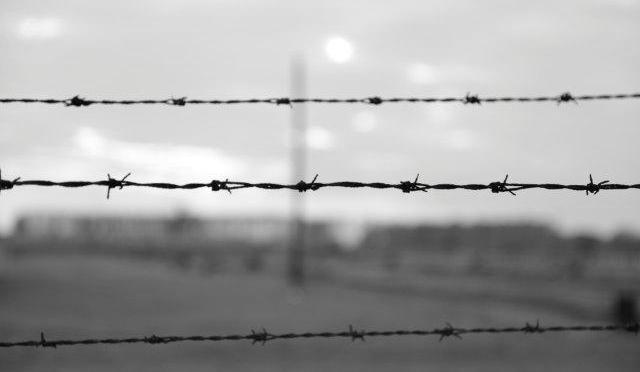
photo: barbed wire, Dr Fred Leitner

VILLAINY

VILLAINY

John Grey

Some villainy is afoot-

I have noticed that all is not the same 

with me, with you, 

though I cannot give it a name, 

I do believe within there is an enemy- 

some villainy.

Relationships are less at ease, 

creased around the edges, 

wedged between the walls 

are doubts – 

not shouts, but whisperings.

Is it true-

do you feel it?

all is not the same as used to be – 

the trappings of love are being 

replaced slowly

by lowly villainy.

I notice it in the merest things- 

the way your face turns sullen, 

dullened by the lack of ardor 

in your eyes- 

you seem harder- 

is it true? 

who is the villain,

me or you?

The tenderness we felt 

is replaced by a welt deep in my shoulder- 

is it because we are older 

in our years and in our hearts – 

this welt bleeds – 

needs are not met by all these moments 

we are choosing to forget.

Seme villainy is entrenched- 

this is not the way of all dreams, 

splitting seams, seemingly splitting,

nothing gleams any more- 

at least not to me- is this the villainy?

Does time cut into affairs,

incisions at the base, 

decisions in the face of failing fervor- 

after the end, why does it go on as if 

it’s really just begun- 

can anyone tell me? anyone?

Curse the villainy, 

curse my failure, 

curse the dangers of estrangement, 

rearrangement ‘til we’re strangers- 

saying au revoir to each other 

but still staying.

Romance ends here, 

not with a tear but with a shrug- 

a sigh- some villainy 

but no one’s going to die- 

something will live- 

we will each peer deep into our own soul and forgive.

Susan

Susan

Holly Day


I stood and watched you sleeping, had

stood there watching for nearly five minutes in

the shadow of the 

hallway for nearly five minutes of circus

time before I dropped your purse on the chair, quiet as death 

and slipped out the door, defying

detection. Your bare back

was open to anyone and everyone coming in, bareback

riders slip in through the cracks of hotel security all the time, defying

even little girl sanctity. Yesterday, I dreamt of your death

how I would deal with it, wondering if you survived the circus

of the imaginary midnight ambushes that haunted my mind, the

big sister duties I’d imposed upon myself stuck in

my head, driving me crazy–Why didn’t you call this morning? I had

this idea of how this would all work out, I had

it all planned out, but I can’t play everyone’s mother, not in

this life. I’m stretched too thin as it is. The

alarm clock rings in my head before true circus

time, and I can’t sleep for worrying about you, little girl—death.

Nobody is going to come when you scream. It defies

all logic, but it’s true. You left your bare back

open all night. Please tell me you lock your door now.

Please tell me 

you’re all right.

Flawless Virtuosity of a Stumbler

Flawless Virtuosity of a Stumbler

Elaine Clayton

In that era of my life, I was denied beauty in the ways youth sometimes forces through fate, or through innocence or naive stupidity. I had been, as a palm reader described while examining the map of my open hand, “severely trapped.” And she was correct. My first footing out of home and into the adult world was a drastic stumble. I married young and to a man who was abusive due to multiple factors including the sudden death of his mother when he was a child and the acquisition of a scheming and domineering stepmother. Whatever the reasons, he’d rage and throw furniture at me every two weeks and such harrowing treatment was a thing nobody talked about back then and so I was trapped by shame as well as by the situation itself. I had no idea, without a car, how to escape that sacramental terror and calamity. And so it was that I went to work that day, with a burn wound on my back from a silver pot of café au lait hurled at me from behind.

I was at work as gallery guide at the museum’s junior gallery, featuring a long-term installation exhibit based on the five senses, when in walked the most graceful grand jêté leaper of all, Mikhail Baryshnikov. His partner at the time, Jessica Lange, was content to sit on the giant tongue wrapped in scarves to conceal her identity, while “Mischa” took their three year old daughter from the camera obscura eyeball into the interior exhibition spaces. Nobody else was there yet, so besides me, they had the junior gallery to themselves.

Screenshot

I wanted desperately to look up at the mounted video monitor knowing they’d be entering the Prismatics room where, on stepping into the darkened space, a screen projected the image of the contour of your body in swirling, colorful, dynamic fantasia. I knew if I looked up at the monitor or followed them into that room, I’d shatter at the magnificence of what he might do in there. I knew he’d cabriole, he’d caper and pirouette.  I knew he’d probably leap six resplendent feet into the air and that my discouraged and weakened interior lattice could not bear the great beauty of it and I’d combust into a powdery hillet of ash on the floor. So, I gave them privacy, diverting my eyes, like a fool, denying myself the possibility of an utterly exquisite sight.

The final room of the exhibit displayed a harp that bounding kids (or their wistful parents) usually twanged with clumsy exuberance and a splendid trompe l’oeil mural depicting a still-life palace feast. A counter replicating a long table was affixed with scratch-n-sniff stickers that gave a range of scents from onion to berry to cinnamon so a child could pretend to partake in this banquet by inhaling aromas. I saw that Mischa and Jessica’s daughter progressed into that area and she stood there tiny before the elaborate feast table. It was my role to show her how to scratch and then whiff the scent of each sticker. She eyed me warily but did as I did. Just as I instructed her how to get a good impression of the smell of dill pickle, I was surprised to hear the harp two feet behind me sweetly awaken.  The most angelic timbres quivered and I felt the tenderness of sound. I swivelled to see, and it was Mischa at the harp. He gazed at me as his fingers moved along the resonating strings intoning euphony through the hollow body of the instrument. And through the sorrowful density of my own.  Who knew he could strum a harp?  I may have denied myself seeing him dance in the Prismatics room, but he found a way to send waves of transcendent, emotive hues through me with that harp.

After a few moments, I stepped lightly away from the melodic sensory tableau, strolling light-headed into the main exterior of the exhibit. Jessica, still disguised, dismounted the giant tongue and the three of them exited the gallery. But first, Mischa walked toward me, beaming benevolently and gazing with his rounded moonglow eyes into my own as if delivering a message through eons of time. I saw that his eyes were closer together than you realize in pictures. At this moment, I felt elevated from my nucleus, as if my heart center shimmered with a sense of new courage. 

Old school phraseology for cultivating confidence like, “Keep your chin up,” is fine, but  after my experience, I’d say you have to keep your ribcage up. I know because when you’re in an abusive relationship, you have to learn how to fly. It’s the only way out and it’s the feeling that the ribcage not only protects your breath of life but your heart, as well. It allows your entire body a fundamental strength and poise. Dancers are taught to be aware of the center, to engage the transverse abdominis and pelvis, which lets the ribcage lift. If you can sustain an elevated ribcage through trauma, you can walk as if long jump leaping across Swan Lake.  An upward gliding step that ascends into easy flight. Eventually you lower, having made excellent progress in terms of height and distance and then you leap again. And not long after, I, myself performed a grand jêté out of the misery that had wounded my heart into heavy immobility. With one long leap, keeping my ribcage up, up, up, I flew into the promise of a new life.

Screenshot

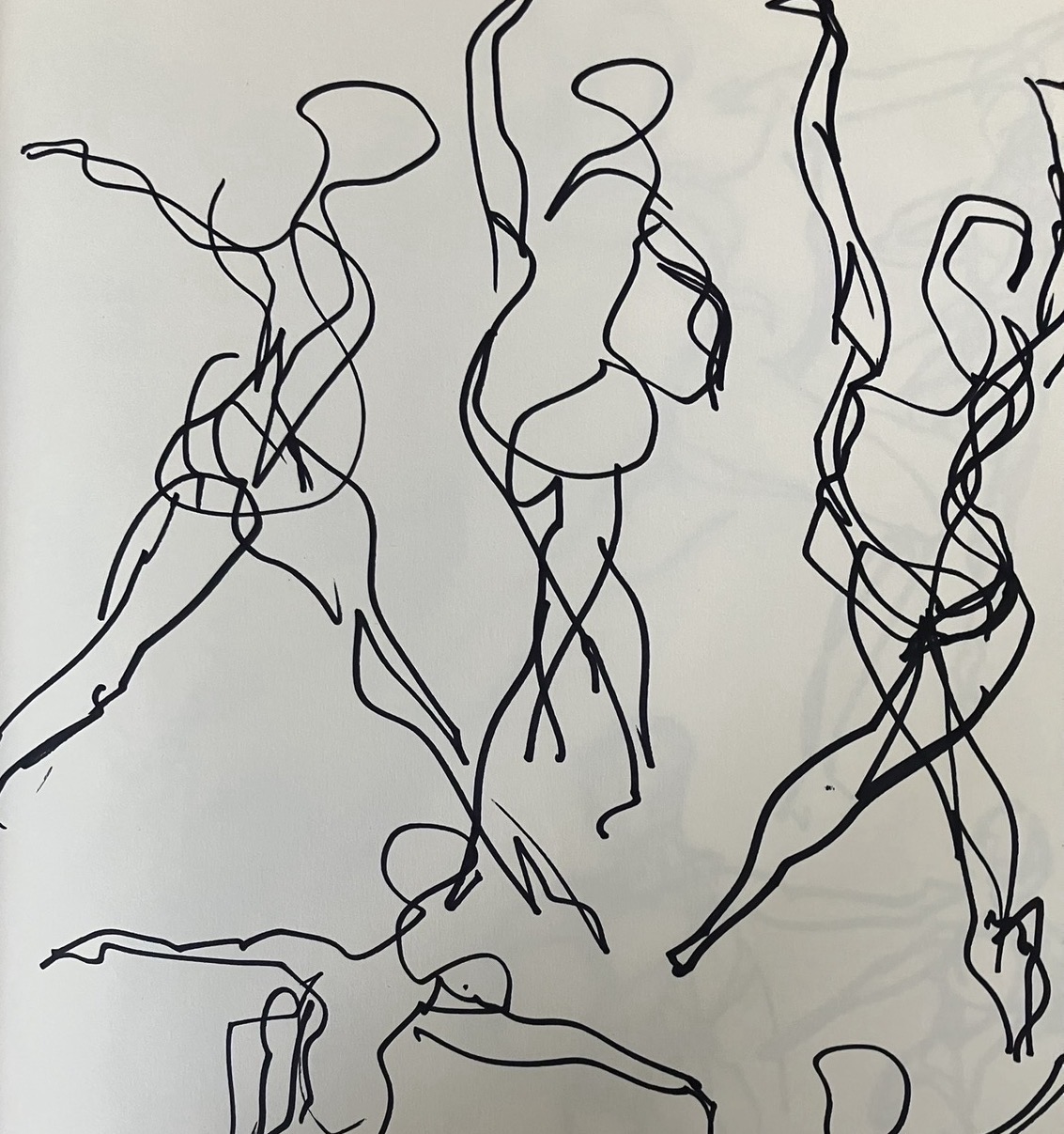
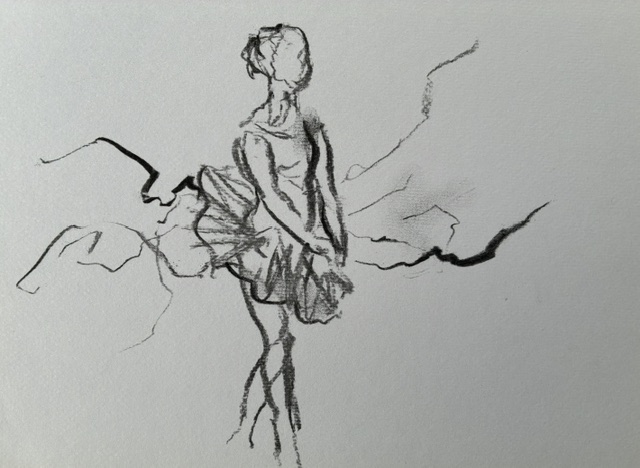
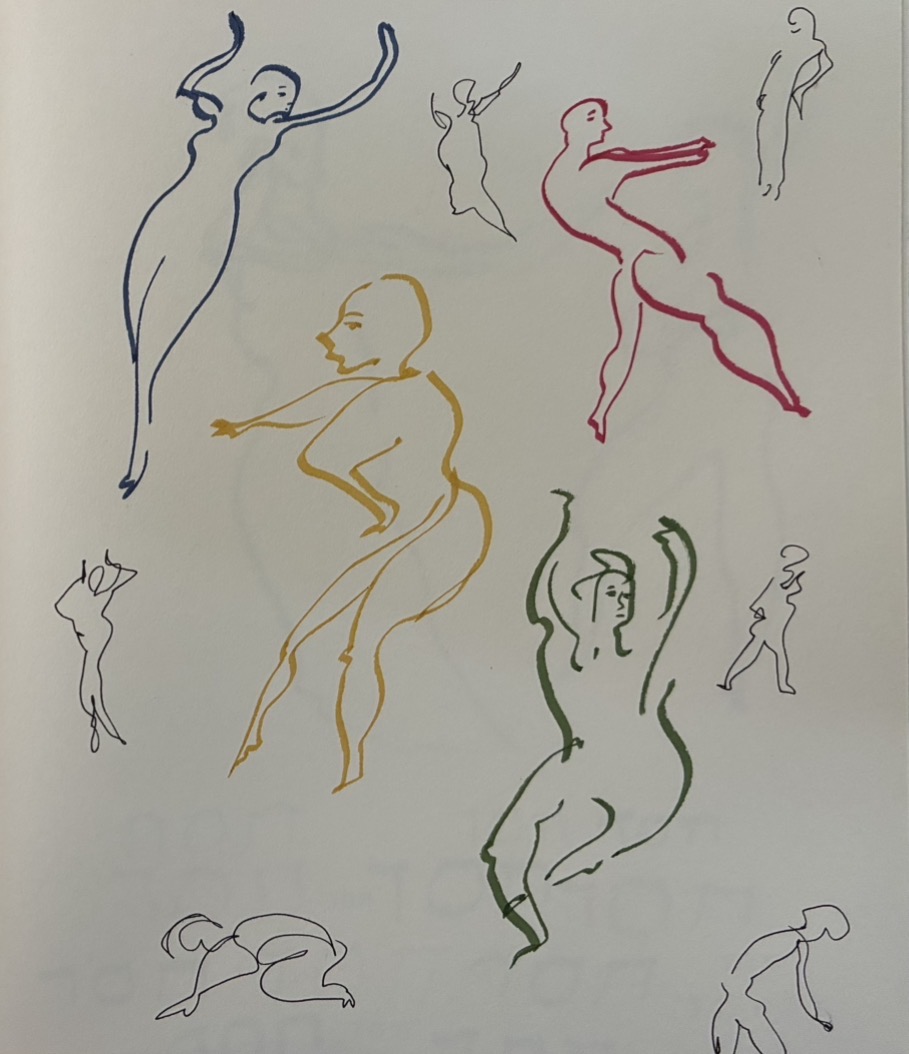
drawings: Elaine Clayton

I Never Told You This

I Never Told You This

Peter Mladinic


but one of my closest friends is someone 

I once hated. I don’t know if he hated me,

but he demonstratively disliked me. Part

of a junior college’s English Department,

he was a twenty-seven year old  PhD, 

when he arrived. I’d been there ten years. 

Everything I said was either dumb or boring, 

he knew everything, I couldn’t tell him 

anything. Eventually he became 

our department head. He said things 

so derogatory I documented a few, 

thinking to bring them to our dean.

I never did. Still, it was bad. He kept his

personal life to himself, but I learned 

he was dating a young woman.

They married, she gave birth to a daughter. 

She had a son from a previous marriage. 

I recall more than once saying 

to my partner, at the dinner table, 

“I hope he has a painful heart attack 

and dies right in front of me,” an awful wish. 

I had wanted him to like me, when he

first came, but by then I was spiteful.

Eventually I learned his young wife 

was unstable. What I learned was vague.

I’d met her, and she was always pleasant 

to me. Then I got the impression 

she was going out nights and partying.

I never heard talk of infidelity but I knew

he was having trouble with her, 

even to the point where she went away 

to a facility for behavioral counseling.

She was an artist, and the last time 

I saw her, she was grumbling about

people not appreciating her work.

I told her to keep painting, to disregard 

the criticism of her peers, something 

like that. Then, shortly after, she took

her own life, leaving him with a stepson 

and a very young daughter. His mother

came. She was with him the day I

and one other colleague walked up

and hugged him. Our colleague

and one or two others 

attended his wife’s 

funeral service, some of her art

was on display. The odd thing was 

as his personal life got chaotic 

he developed compassion, he actually 

listened to me and cared about my life 

both in and out of the classroom.

I won’t show him what I’ve written here,

but if the past came up in conversation 

I would tell him, in a tactful way, any 

of what I’ve said; at least, I’d like 

to think I would. But you never know.

Fundy Shore

Fundy Shore

Louise Carson

The sea, oh, the sea pushes white gates on to the sand land.

Words where you expected a blank.

‘What’s over there?’ pointing.

‘Take the long way round.’

Trees give and take, like us, as they must.

Distressed, throat hole, so small, closes.

A caw, rustles, flapping in the tree.

Tragedy, smaller birds gone silent.

‘I’ll be outside. Call me when it’s time to go.’

That face in the mirror, not what I expected to see,

gives way to how I feel:

pushed about, never missed,

but free. Oh yes. Free.

Tomorrow, I will guess, straight-edge, delicate.

‘How could you know?’

The waitress brings a fortunate cup of coffee

to plug my headache.

Unconcerned by any predators,

eyes close as I drink.

Hard to push on without credentials.

Nevertheless, the white gates are pulled back into the sea.

As well, and wonderfully, the trees break light on the road.