All posts by JONAHmagazine

A literary magazine about challenge and change

Journey Home

Journey Home

John Ganshaw

Finally, I’m on my way home, somewhere between Seoul and Detroit, sitting comfortably in a Delta One Pod, gazing out the window. You can see for miles and all that is below me are pure puffs of white, the sun cascading off of them and gazing back at me, highlighting the tanned fingers that type on this keyboard.  It is so hard to imagine that I am here above the clouds when I have been in the depths of hell for so long. This is different from sleeping on the floor in a Cambodian prison.  I thought that being on the way home would bring a sense of freedom to my realm, yet I am wiping away the tears of pain, hurt, and everything else that came with these past 16 months.  It wasn’t long ago that I thought my head would be resting on these clouds, using them as my pillow, but now all appears different. 

I sat there gazing out the window, dreaming of all that was, all that was still ahead of me, thinking what now?  Deep, lost in my thoughts when out of nowhere I heard a voice, “Would you like some more wine.” I was startled shitless and jumped a mile high bringing a whole new meaning to the mile-high club.  The attendant was just as startled by my reaction, but we both got a laugh out of it.  This will be my life now, being startled by the slightest noise, voice, or sighting.  I slunk back into my seat, watching my fingers move across the keyboard, effortlessly recording the thoughts running through my brain.  I did take a minute or two to notice that the attendant gave me a very healthy pour, and for that, I am more than grateful.  On the journey back, not even sure what that means anymore, I am leaving my Cambodian home to find time to recover and right this old sea-worn ship.  I had no sooner found myself and it is now in need of major repair and remodeling.  At least I have a bag of bones that can be mended, unlike one or two people I know.  

My friends are asking me how I feel now that I have started the journey back and I can best explain it like this.  The physical journey will be an easy one; I got on this plane and will be back with family and friends in a matter of 20-plus hours.  The mental and emotional journey will take a lot of time; time to adjust to the trauma, treatment, and time to come to terms with how the person you loved so much could betray you.  So, this journey will not be a Sunday walk in the park but more like a mountaineering expedition. We have only so much control over life, if you want to live life to the fullest you must accept that there may be a shit storm now and again.  I just happened to find the shit storm to end all shit storms.

Even now, as I begin my journey back, such positive experiences begin to happen, mostly the most mundane having such an impact on me.  It began last evening, which in itself seems like an eternity ago.  I was waiting for my taxi to pick me up from the hotel when I ran into the British Ambassador, a lovely lady. During my time in Cambodia, we became acquaintances. I dare say friends when a very dear friend of ours passed away.  She was a guest in my hotel, the hotel where we had the wake.  It was just the beginning of the Era of Covid and meeting her, at the wake, all brought a sense of life to such a dire situation, it was death, after all, that is probably the direst of situations ever to be encountered.  Though we had only met that one time she has been there through my entire ordeal.  Anyway, she knew that I was leaving and heading home, and she stated that she would like to keep in touch, genuinely.  It wasn’t empty words coming from her lips but heartfelt sentiment.   Christ this is a good pour of very good wine, I’m waiting for the fasten seatbelt sign to illuminate.   The second impact happened when I was going through immigration and I knew it wouldn’t be easy.  It took a few minutes and some phone calls, probably to make sure that my exit Visa was in order and that I truly was free from prison and able to leave the country.  Each one of the agents at immigration treated me with the utmost respect and I knew they read the charges, Blackmail and Sex Trafficking.   By their looks and demeanor, I could tell that they knew the charges were false and I was a victim of the common yet not-so-common scam.  Those who partake in illegal activities are pretty cunning to have others who are innocent take the fall. It was when I was walking away that the one agent looked me in the eyes, saying “Good Luck to you.” Generally, I would just chalk this up to his being nice but the smile on his face and the look in his eyes were real, you could see the emotion in his eyes, the sense of caring, and the sense of knowing.  These times have been so difficult for me, to be accused of a crime so hideous and disgusting is still so unbearable.  To know through the actions above or messages I receive from friends, messages of encouragement, friends, family, and acquaintances, reassuring me that everyone knows the truth and who was behind this.  This goes a long, long way.  Perhaps the most touching happened this morning when I was chatting with my friend, legal advisor, and confidant, Jonathon.  He said that the effect my situation has had on others is indescribable.  He was telling me how it brought people together, to rally for me during this unbearable time of Covid.  People not being able to interact or have contact with others, yet they were all coming together and, in the process, forming friendships that otherwise wouldn’t have been formed.  Jonathon shared with me the feeling that I had.  I had these same feelings when I was in prison.  I met and am now friends with some great people that I wouldn’t have met if this incident hadn’t happened to me. 

I am still looking out upon the sea of white, little mountains of cotton and though I am flying to a new place, I know I wouldn’t want to change anything that has happened to me.  What I have learned these past many months I would never have learned if this hadn’t been done to me.  How lucky am I?   You have the worst possible accusation made about you, you spend time in a third-world prison, and you live through the most unimaginable living conditions, yet I have no remorse, no hate, maybe a little contempt and I despise a certain ex-pat, but after all I am human.  Even now, I truly believe I am a better person than I was before.  This experience has provided me with the opportunity to create a new dream, a new fight for justice, and a new life to live. The dreams and nightmares won’t go away overnight, the struggle will still be there but in time, maybe I can begin to live again. 

PAPA’S iPAD

PAPA’S iPAD

by

Pamela Domonkos

“Someone has to take the iPad,” my mom said. “I’ll never use it, you know.” I am certain my eighty-year-old mom will never dabble with technology. She still calls the internet the “world-wide-web.” It’s such a shame, I think. If she just tried, a computer would really open up her small world but I know it’s futile. She seems relatively content (at least accepting) that it’s now herself, old movies on TV, and her dog for daily companionship.

I’ve learned it’s often easier just to do something you really don’t want than to say no or explain why you don’t want or need your dead father’s iPad. Taking it will make my mom feel better and allow her to check this one off her list. And to know that one of her children has it, that makes her feel good too. It really has nothing to do with pleasing me specifically, just one less responsibility my dad has left behind that she has to address.

I bring the iPad back to my apartment. Along with the iPad, my dad kept the charger and the stylus pen in a separate plastic zip-lock storage bag, properly marked “iPad accessories.” Unlike most men, his handwriting was unique and beautiful, and I skim my finger over the words, trying to feel my dad. He’s been gone six months now, and my brain has finally processed (and convinced my heart) that he truly is no longer walking on the planet. The sorrow has settled in my heart, like a boiling cup of tea that has cooled just enough to sip and elicit comfort. I can think of him now without the raw, burning pain that immediately follows death. I sip him in daily.

Reflections of my father are warring factions in my brain. Sometimes I have to remember the bad stuff: the alcoholism, the way he disappointed my mom, us kids. The Friday nights he’d walk in from a week of travel for work, not knowing if his eyes would be sharp or glazed. My mom would have the table set for seven, the kitchen capturing the warmth and smells of her careful work over the afternoon preparing dinner for her family, all together. She, too, looked right into his eyes and knew instantly, and whatever she saw reflected would set the mood for days. When I heard his car pull into the driveway, listened as the car door shut behind him, I could feel the anxiety build for that unknowing minute that passed while he approached the house, watching the knob turn as he entered. I always prayed for the sharp eyes that would bring in a man who kissed his wife, embraced and smiled at his children, so happy to be home. I knew the glazed eyes brought a dazed, sad, denying man who infuriated my mom.

But mostly during his last six months of life when a little piece of him slipped away every day never to be seen again, I thought about the good stuff. His warmth and gentleness, his intelligence and kind spirit. I think about the father who would round up his five kids on Saturday to tackle the chores assigned by my mom. They’d sit at the table, sipping their coffee, my dad with a pen and paper, jotting down the list in his scripted handwriting as my mom recited the needs of the weekend: cold cuts, the newspapers, a bottle of gin. The list didn’t change much week to week, but he enjoyed this assignment, not just to spend time with his kids but to give his wife a few hours of peace and quiet. He’d leave with a kiss good-bye to my mom (be careful, she always said), the list in his pocket along with $40 in cash—his allowance, they joked. 

During those Saturday morning adventures, he showed us that the best bologna one could buy was from a German butcher located a town away. He brought us to LaSala’s, an old-fashioned corner store that had a long, linoleum countertop and a row of swivel stools, their round, cushioned tops shiny and slippery. There we were introduced to cherry or vanilla Cokes right from the fountain. And he’d buy us each a scratch-off lottery ticket. It was as if he needed to seek out any semblance to his New York City childhood in our suburban environment. He wanted to share that piece of himself with us. The shopkeepers genuinely enjoyed talking to my dad, who always made conversation with them lighthearted but personal. He had the gift for gab, always engaging others and genuinely interested in them. He had a way of making others know he saw them.

* * *

How many times are we asked when we’re young, what do you want to do? What makes you special? What do you love? What are your talents? Questions I naively tackled before choosing a major in college, a career path. What a joke, being asked to direct your life as an eighteen-year-old. What a disservice we do to our youth. I’m good with numbers, my seventeen-year-old self deduced. I got an A in calculus last year! I will be an accountant. Oh my God, why didn’t someone speak up, stop me? Didn’t anyone know me and think to say, “That might be a pragmatic decision, Pam, but you’re a people-person. The two don’t really mesh.”

It took me fifty years and my dead father’s iPad to figure out what I am good at, what makes me “me.”

My apartment is coming together after separating from my husband six months ago. I’m getting acquainted with this new way of living on my own. No longer defined by the constant demands of a husband and three children, I feel surprised by choice…choice of what to do with each found moment that I have declared my own. What do I want for dinner, or better yet, do I want dinner at all? Read or write? Red or white? Choice feels both powerful and foreign, like winning the lottery after living paycheck to paycheck. Choice isn’t natural yet; I feel unsteady.

Although the apartment may be coming together, I’m a mixed bag of emotions—excitement for this new chapter in my life, guilt for disappointing my family, anger at my husband for not taking care of me, acceptance that my children are becoming adults, sadness that my dad is gone. My daughter tells me that her father is not coping well, the house is dusty, unopened mail is piled up, and the fridge is bare. Did I detect a small hitch in my son’s voice when we talked last week? Does he resent the forced change I have brought with my desire for a new life? What would I have felt if my mom had left the man whose eyes were glazed more than sharp?

Like a chisel on an ice block, I feel the guilt chipping at my resolve to be unmarried. I am personally responsible for redefining my family, moving ahead with no one’s permission but leaving a trail behind me of hurt and disillusionment. There is a cost to choice. 

I need a talk with my therapist, Joanna, who was more of a partner to me through some of life’s most difficult moments than my husband. She’s helped me through so many crises. But Joanna moved; her husband retired and is now in Vermont. I send her an S-O-S text. We talked about Facetime therapy sessions before she left. I’m not too keen on this idea; it feels a bit stilted, emoting to a camera lens on the computer over the “world-wide-web.” But I really need to talk.

So good to hear from you, she texts back. Should we give Facetime a try? How about Monday at 6 p.m.? 

Sounds good. Thanks, Joanna.

Where did I put that iPad? My phone will be too small for Facetime therapy. I’m pretty sure I can Facetime on the iPad. I may be good with numbers, but I’m really limited with technology: routers, IP addresses, service providers, domain names—it’s all Greek to me. Certainly not on the “Things I’m Good At” list. 

I find the iPad and plug it in. It’s completely dead, like Dad. Wonder when he used it last? I figure about a year ago, before he got so confused and incapable. I let myself feel sad for a second, remembering the very intelligent man, always trying to stay relevant even when his abilities started to fail him. That was the most difficult part to witness, watching him fail. Okay, today’s “sip o’ Dad” burns too much, back to the iPad.

The screen eventually comes to life, the battery symbol registering a red 3 percent. I let the iPad recharge, and when I look a few hours later, the full screen is relit. The usual apps appear—he has Facetime. Funny, he never used it, and I’m mad at myself that I never showed him how. Damn it! And then I laugh to myself because I’m sure he would have used it a lot and maybe not at a level appreciated by his children and grandchildren.

And then I see his e-mail icon. Do I dare? It seems unethical, looking through a dead person’s e-mail. But it’s Dad. I click on it. I can’t help myself. My palms are sweaty—I don’t expect to find anything outrageous in his e-mail, but I feel like he’s right there with me.

It’s as I would have predicted: e-mails to his children relating something he’s read in The New York Times or heard on NPR and a few to his old friend from childhood, nostalgic reflections on their childhood in Astoria. I read through a few. He writes to his sons, remembering fishing trips they took out of Rock Harbor, questioning an arcane golf rule that has come into question at this year’s Masters, the trials and tribulations of being a New York Mets fan. I realize I’m not breathing. It’s not the content that has me frozen. I’m reading his words and I can actually hear him, his voice, the unique way he talks, the cadence of his speech. He writes his e-mails like he speaks—there’s nothing formal in them or composed. It’s him. A tear runs down my cheek. DAD!!!

I only read through a little of his “Sent” folder. I feel overwhelmed with the emotion of his presence and my intrusion into communications that don’t belong to me. I do make note that the last e-mail he ever wrote was to my sister Julie—I will tell her that, it will make her feel sad but good. I turn my attention to his “In” box. I’m not reading content anymore, just scrolling, mostly. 

And then I see a note I had written to him just before he got so sick. 

I had forgotten I had written it. It was a thank-you note. I had come home after a very long day of work, exhausted footsteps to my front door, where I discovered two bottles of wine wrapped in that silver, shiny skin. Chardonnay, what I like the most. It was a busy and stressful time in my life, working six days a week, enrolled in a master’s program that demanded one day a week of internship—all on top of the jobs of a mother and wife. My life had turned upside down. I was stretched so thin and wound so tightly, like a piano string ready to snap if any additional pressure was applied. The little unexpected doorway gift lifted me instantly, and I knew who left it.

Wine Bandit!

July 29, 2015 at 4:52 p.m.

Dear Dad,

I am presuming you are the very thoughtful soul who surprised me with not one, but two (!) bottles of wine in my mailbox! Put a big smile on my face. Many thanks!!!

You should know that as I look back on my life and reflect on parenthood, I know how much love and support you have shown me through the years. You are always there with great pride and encouragement and a real interest in my life. Everyone seems to think I am this great big, strong woman, but this path I am on now is very overwhelming some days, and those bottles of wine and words of love and encouragement mean the world to me. They keep me going. Thank you.

Love,

Pam

I’m crying; the tears are running uncontrollably down my face, saturating my cheeks, washing me. I can picture him walking to my door, hunched over and frail with the full load of his own problems but set on helping me through mine. He couldn’t physically do much at that point, but he knew how to say, “I see you, I love you.” The power of that raw love washes over me, whisks me back to my childhood, the kind man who touched so many people’s lives because he took the time to see them: the pork store owner, the waitress at LaSala’s.

And there it is. When I reread my words to my dad, I realize what I do best. It was my dad who showed me how to take the time and really see others—discover, acknowledge, support, and celebrate their unique selves. He showed me how, with a few words or a small token of love, you can deeply touch another human spirit. It’s the secret of being an exceptional parent, a genuine person.

You’ll never find that on a personal inventory list, but it’s what makes me “me,” and it’s a gift from my dad.

THE END

WINTER FRAGMENTS, 2022

WINTER FRAGMENTS, 2022

by

John Ballantine

January 1

I choose a little madness to heal the dreamer warming my bed. The dervish dance puts food on the table. Crazy cool, I am here with aging heart, eyes, and ears that feel the wind in my face. I do not turn away—staring straight into the dance. We are here, we feel the hurts and hold the love. I see the broken promises, letting go the memory that holds me back.

“Who is that?” mocks the fool. “Where are you?”

Today I sit quietly, hear stories, and know that hearts pound fast, mothers die in fire, and tragedy is here. There is another dead body, etched in memory, surrounded by empty vessels, an occasional apparition. Each of us stumbles into such pits. Some never get out. The lucky few walk forward, chastened and more alive. I stand among the lucky.

The choir harmonizes an ancient tune.

I am a child, a crazed, aging man. The world spins, the sun rises, my heart beats. There is pain and love. I am awake.

January 6

Hard to believe, was it a delusion? Crazy people—tattooed, dressed in horns. Wearing army fatigues with guns in their belts—crashing through police barriers. Breaking democratic norms as they stormed the halls of power. This cannot be?

Hard to believe sitting in a quiet home with the TV filled with pictures of hate. Maybe another revolution is happening? Not the peasants rising but an insidious sickness. Are they serious? In 1968 the yippies, hippies, and protestors crashed the Democratic Convention, Mayor Daley’s police beat us back—while Russian tanks rolled into Prague. Back then the upending of that world was real. 

Raised fists, riots, and dead proclaimed that the dream is not dead. They—police, troops, and our elders—struck back. For what? Today:

“Something is happening and you don’t know what it is, do you?” 

Hard to believe as trees bend, hawks soar, and fires burn far away on flat screens. I cannot breathe, can that be true for so many? Some storm the halls of Congress, tear down what you built and learned. I cannot, will not, believe we live in such a place. Guns, pipe bombs, broken windows. This is happening on our screens over and over. We are not the enemy, but this country constructed/woven from the floss of dreams is coming apart.

It is hard to believe cruelty and hate is so close—that pillars of wisdom fall so fast. And that we, you and I, did nothing. No sword or gun as the mobs stormed our cities. It is hard to believe that we did not fight and die for the good life. For the love that surrounds and comforts. 

Hard to believe that my world is falling apart, 161 years after the first shot fired on Fort Sumter. There is no god standing on the ramparts to protect, no poet to spin tales to comfort. The food line is long, the night cold, and there is only one blanket to keep us warm

January 9

It is happening here. It has happened. Civil War—innocent dead on both sides. Reconstruction, the bondage that held so many down. And the Gilded Age, where stealing and taking was sung in parlors where so few marched for liberty, equality, and fraternity. Barricades do not fall easily. Talk at tables stops—even in my well-mannered family. Some hate FDR and the New Deal, others say this is the way. Then there are the wars, blacklists, communists, queers, Black Panthers, George Wallace, the Weathermen, Proud Boys, KKK, and Trump, who incites beyond my imaginings.

Is this the back and forth of history? Despots here, not just in Russia or in other faraway lands. Money feeds. History faints and many look away. It cannot be happening here…only over there. I sip the wine, watch romances at night, and do not fall into dystopian traps.

But it is happening here—not just the 47 percent who do not vote like me, or the 300 or more who stormed the Capitol. Too many turning away from what I learned, what I thought we believed. Hard work, opportunities, laws, courts—even justice—and conversation. I make lists. Sexism, racism, inequality, resentment. My head is full of explanations, of words. I do not understand what is happening here, today.

“Oh, the shark has pretty teeth, dear,” whispers Mack the Knife.

Stones break windows, dead lie unclaimed, and fires burn. Russian tanks advance. No chicken in every pot. The rainmaker looks to the sky for promise of better days, but the deserts are dry and dreams die. It is happening and I don’t want to know why. The candle in the cave shows no shadows flickering on the wall.

Wolves howl at night, we hide in our apartments. The screens flicker. Some cough and die, others wear masks. The trucks pass back and forth in the dark of the night, and there is no metaphor, no light to take me out. No Beatrice or trials of Job that explain. No poet in robe pointing the way.

“Something is happening and you do not know why, do you, Mr. Jones.” 

I sit in my basement, far away from the street cries. The snow muffles what we lost. The bully holds sway. I did not stand with the righteous, did not carry arms and say no. I let others die, disappear, and pretend at dinner it was all Okay.

And what did you do when democracy died? When the USA was united no more? When another country fell? What did you do to save our dreams?

January 16

The world is dark. I wake, touching the first sign of sun wrapped in the smile of romance. But there was no light. No sunrise. It happened just like that, no shots or storming of the barricades. The food on the shelves, the fires that warmed stopped. Just like that.

The resentment, the lies, and the guns have turned back the clock to 1917, 1968. I stand in Prague as tanks roll in. The out-of-wedlock, the bastard children, have no home. Those in the street—Black, White, and Brown—rich and poor—have risen like a mob disgorged from cyclops mouth screaming for more. For their fair share.

There is no god, no Ulysses or Athena to rescue us. All that stuff in my head, it is not real. Not even a dream can shield you and me from the slings and arrows of anger. They do not care; they have a long list of unreasonable demands. The reason I am here, that we sit together at the table, has evaporated as the walls of reason collapse.

It is hard to believe cruelty and hate was so close—that pillars of wisdom fell so fast. And that we, you and I, did nothing. No sword or gun as the mobs stormed our cities. It is hard to believe that we did not fight and die for the good life. For the love that surrounds and comforts. 

The pendulum of time swings back if you fight. Better to have a headstone inscribed, “He believed and died for love.” No more stories, no pictures on the wall. Stand up.

January 26

It was a long time coming. The realization that I cannot change the world. How many days did I look at the sky, imagining soft, puffy clouds when the fist punched my gut? I did look away but hit back with a knee to the chin as I charged through the line. Violence begets violence.

Solzhenitsyn survived cancer in a Siberian gulag—and let his beard grow long in a Vermont hamlet as he pried open the Russian soul. There was so much hurt that ascetism dried the tears falling. A stoic spirit moves forward. Poets stand in food lines. The tundra is frozen deep, I dream again.

Why don’t I see the world as it is? Why can I not stare into the abyss and see the pale bodies floating in the river Styx? I play with the devil, the chameleon deceiving so many. Dulcet voices sweeten the fall. I believe in good, even as witches’ brews simmer with so much sinning. I see the frolicking cherubs, I wander through dark caves with etching scratched on the walls, and I read of Rome’s fall.

No, that is not the world I know. The never-ending troubles, the storm clouds knocking down homes, and the dead bodies piled high on funeral pyres. I see the terrible armies march, the devil’s beguilements, and all the bad that you report. But my wandering knight cannot let go of dreams. The boy who said I believe in Tinkerbell will not let go.

When I die they will say, “John never did get it, did he? Never saw the world as it is, did he?” No, lucky John, he wandered with his mad dreams.

February 15

Easy to forget, to eat the fresh fruit with vanilla ice cream, followed by pink finger bowls. I stared across the table, not knowing why building more bombs and missiles was the path to peace. Some said, “Do not talk with Ruskies” or they, too, will bury us as the cherubic leader in an ill-fitting suit pounds his shoe at the UN. Really, we have to wait until hell freezes over for those two to talk. 

Seven Days in May passed, and we were not blown to smithereens. We learned to love the bomb and not see Peter Sellers when Kissinger explains why we were in Vietnam—dominoes balancing—and why oval tables were the beginning of peace talks with so many dead. Time turns and here we are again with tanks, broken windows, and women crying on the cold street, holding their dead.

I sit with the blue sky and snow—looking at the darkness. Dread rises over a land torn asunder by time while men on horses, tanks, planes strike down the courageous person standing tall. This country, this land with its centuries-long history, cannot escape its mistakes, and so we kill, burn, and maim again until someone says let’s try sitting at the round—or is it oval—table once again. 

February 23

The grandmother stood straight, staring left and right with blue-gray shawl over her shoulders. Prostitute selling her 62-year-old body—not too soft—to put food on the table in Tbilisi. Wide-eyed, I am a year older and not as tough. I look at the potholed streets, the elevators that do not go up, and the crumbling concrete steps in each apartment that they own. No communal property for the free citizens.

The patriarch in black robe and white beard murmurs prayers. A giant statute of Stalin stands guard. Here in Georgia the wine is sweet and the market full of talk as we take the bus to Ossetia, a breakaway province Russia will soon invade, just because.

Why fight the bully? I ask Thea as we climb the goat path through deep, verdant valleys locked in centuries of dialects. Do they not understand war? Some try to break free, others hide. In churches standing above the valley, frescoes of St. George on curved ceilings sit high above seven hundred years of tribulations. A calm voice soothes the afternoon as the incense drifts in with the slanting light. 

A lace curtain is drawn across each apse—a couple with white, virginal veil and black suit are married; another dark apse is quiet as the old are buried. Candles burn, heads bowed, even the unbelieving. The woven curtain, thick with history, stands like a sentinel at the entrance of the Byzantine chapel built by peasants for solace.

The Black Sea and Odessa are distant—my only connection to this world of peasants, stone, wine, and Kubdari. Natalie, one of my first loves, stood me on a pedestal I did not want. She the romantic refugee fleeing the purges of Stalin, and me some white knight full of naïve do-goodness. But Odessa is pushing back Russia’s assault, as Thea escaped Georgia. The bullies with bigger guns win the battles, and I am humbled by the war stories. Maybe the valiant will win.

The prostitute paces back and forth with the sun breaking through the clouds. St. George beats back dragons. Candles are lit in prayer. We pass through the curtain of time. The dream is resurrected.

St. George sits serenely on his mare; a rainbow of light fills the church. The choir is quiet.

A Portion of Success                                                                 

A Portion of Success                                                                 

John Zedolik

I chose the wrong trail

while ascending Angel Island

so missed the summit in my

parsed-out time though I did

glimpse the top where 

eponyms take flight or alight

whom a pilgrim might see

if in the correct loft of mind

even upon a false path, a fire

lane, only circling the crown

like a tonsure in reverse,

the eucalyptus massing

dark and dream-thick on each

side to confound the climber

on a sweating quest to the apex

commanding the attendant bay,

where near-heaven meets earth

at a sharp final edge, a port

for destinations down and up

whose node will bestow

a blessing even upon the hoofer,

head befuddled and point unachieved.

Third anniversary

Third anniversary

Louise Carson

And even after six hard frosty nights,

dry standing corn still sings with insect life.

The squirrel jerks its tail, clucks my approach,

relayed by blue jay cry and thudding grouse.

Reflecting colour up, the fallen leaves

(it’s not autumn unless I mention these),

the fallen leaves complete my metaphor:

feet grind them into finest mould.

Where is she now that time, time’s her betrayed?

The address in my hand’s too small to read.

By morning’s side then, somewhere near a farm.

In the crypt, other women keep her warm.

Did I, do I ever, visit her grave?

My heart her grave, I walk there every day.

THE CHALLENGE

THE CHALLENGE

by

Cyndy Muscatel

Okay, I admit it. We’re old. No spring chickens in our roost. Even if we didn’t realize we had passed the “forever young” age, our kids have kept us informed. Right before COVID hit they sat us down to have the power-of-attorney talk. That we’d laughed in their faces shocked them.

“We’re just trying to be helpful,” our daughter said.

“We want to make sure you’re okay,” our son said.

“We’ll let you know when we’re not,” my husband said.

He shot a seventy-one that day, beating our son by two strokes. Meanwhile our daughter had trouble keeping up with me on our walk.

Three years later the whole family came to visit us on the Big Island of Hawaii during winter break. By their solicitude we could tell our children thought we were one step away from assisted living, if not the grave. It was unnerving although, somehow, I was the only one doing the dishes.

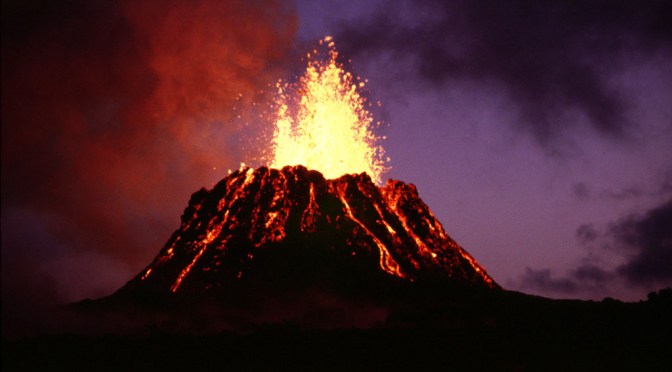
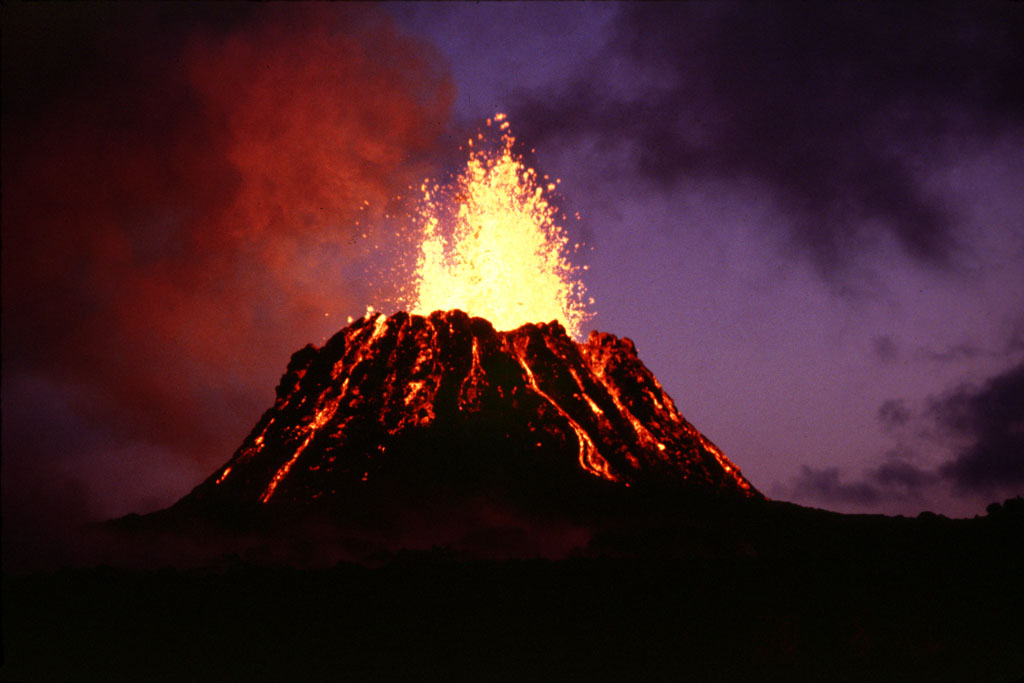
While they were there the Kilauea Volcano erupted. Newsweek calls Kilauea “one of the Earth’s most active volcanoes…and one of the most dangerous.” Our 23-year-old grandson and his girlfriend decided to go see it. They came back with a glowing report of their experience.

“You should go,” Evan said, showing us photos of golden-red ripples of lava in a lake at the bottom of the Halemaumau Crater.

“We hiked a mile into Viewing Site 3, but there’s other viewing sites you could get to easier,” Amanda assured us.

A week later my husband and I decided to go see this natural phenomenon for ourselves. It’s about a two-hour drive on the Daniel K. Inouye Highway. Since the best viewing is in the dark, we decided to stay overnight at Volcano House.

The mountain pass can be treacherous with dense fog and rain, but the day we went it was clear. The snowcapped peaks of Mauna Kea were to our left. Mauna Loa, graceful with a dusting of snow, was on our right.

We pulled into the parking lot of Volcano House at about 2:30. The hotel is right at the rim of the volcano. Mark Twain stayed at the original Volcano House in 1866, but this hotel was built in 1941. When we checked in the receptionist was very knowledgeable. She gave us advice and a map showing where the viewing sites were located.

I couldn’t help wondering what she saw when she looked at us: two old fogeys who should know better or just two people being tourists?

In the dining room, while we ate lunch, we looked over the map.

“We’re doing Viewing Site 3, the one the kids did,” he said. “The one with the hike.”

“Understood,” I said. The gauntlet had been thrown down.

After a healthy lunch of Coke, pizza, and French fries, we set out for Devastation Point. We arrived there at about 4:15. Once we were out of the car, I saw a park ranger standing in front of a huge sign that said Eruption Viewing This Way.

“Is this where we go to see the eruption?” I asked him as I got close. I have a terrible sense of direction so I thought I’d check.

He looked us over. “Yes, it is. But do you think you’re up to the hike there?”

“Isn’t it only a mile?” I asked.

“A mile each way,” he cautioned.

“Is it rocky and steep?” my husband asked.

“No, it’s a regular road until you get to the site. Then there’s some gravel.”

“No worries. We can make it and besides, we have our phones,” I assured him.

He still looked dubious but finally nodded. “Okay, I’m just checking because we had a fatality yesterday.”

I laughed as we walked around the barrier. “I think he’s just trying to discourage us old folks. He probably doesn’t want to do any kind of rescue,” I told my husband.

(Two days later I read this online: “Hawaii News Now – A visitor from Arizona died Sunday at a lava viewing area at Hawaii Volcanoes National Park, officials said. A spokeswoman said the 70-year-old died from apparent natural causes at the Keanakakoi lava viewing overlook.”)

It was an easy mile to the Keanakakoi lava overlook. When we got there we joined the small group of people who were at the edge of the viewing site, looking down at the lava lake in the center of the immense caldera. Since it was daylight you couldn’t see much of the molten lava’s color.

As the sky darkened the lava’s orange glow became more apparent until we were looking at landscape crisscrossed by deep veins of lava. Pele, the goddess of fire, had been very busy. It was as if the elements of the Earth were being revealed. I wish the word “awesome” was not so overused because that’s what the site was—awe-inspiring.

In 1866 Mark Twain described it like this: “The greater part of the vast floor of the desert under us was as black as ink…but a mile of it was ringed and streaked and striped with a thousand branching streams of liquid and gorgeously brilliant fire! It looked like a colossal railroad map of the State of Massachusetts done in chain lightning on a midnight sky.”

“It looks like Los Angeles at night when you’re coming in for landing,” my husband mused in 2023.

Then he started dialing his phone. In a moment our son appeared on the screen.

“Guess where we are,” my husband said and turned the camera so Dave could see the lava.

“Wow,” Dave said, then asked, “How did you get there?”

“We hiked here. This is the site that Amanda and Evan went to,” I said.

“Amazing,” he said.

I rolled my eyes. “We’re not decrepit yet,” I wanted to say.

When the sun set the temperature dropped quickly. Our grandkids had warned us, so we had parkas, although most of our fellow viewers were shivering with cold. But we were all mesmerized by the incredible sight.

When some people started to leave, my husband said we should join them.

“We should navigate up the gravel path while there’s still light,” he said.

I was reluctant to leave, but it was a good decision—it was completely dark by the time we made it to the road. With no moon to guide us through the forest, Mark Twain’s expression “black as ink” came to mind. Fortunately, I had a flashlight.

My husband’s knees had stiffened up in the cold, so he was having a hard time walking.

“I don’t know if I can do it,” he said.

“We can go slow and take breaks, but you are doing it,” I said in my schoolteacher’s voice. “First of all, you don’t have another choice, and secondly, we’re not going to let the kids think we can’t.”

As we walked he limbered up, but we were both glad to see the lights of the ranger station ahead of us. We drove back to Volcano House with the heater blasting.

During a dinner of seared Kona Kampachi, we looked through the photos we’d taken. We remembered that overwhelming feeling of reverence we’d experienced.

“I’m so glad we did this,” I said. “Not only because it was so incredible, but sometimes I start believing in the kids’ viewpoint of us, and I think I am on my last legs.”

My husband gave me a wink. “I love your legs,” he said and took my hand.

photo: G.E. Ulrich – pubs.usgs.gov – picture #007, GU6830A – cf. Selected Images of the Pu‘u ‘O‘o–Kupaianaha Eruption, 1983–1997

HOW DONNA GOT IN A BAD GROOVE

HOW DONNA GOT IN A BAD GROOVE

by

Louise Turan

Donna, age fourteen, moved back to the U.S. with her family to California. Her father, The Colonel, had been assigned to Ft. Ord to run the Base hospital and attend a special medical training course. For the past four years, they were living in Italy, in a villa on a hilltop overlooking sprawling vineyards and the Dolomites. The only thing she saw now, from their square, ugly, cement quarters, was a depressing view of sand, ice plant, and more cement houses. Her high school was an equally unattractive, flat building with rows of multiple green doors under flat roofs. California was like a strange planet Donna had landed on by mistake. She felt like a foreigner, especially when everyone around her, at school and otherwise, seemed obsessed with the Monkees, the Mamas and the Papas, and Flower-Power. Donna didn’t really have a clue what they were saying, singing about, or, for that matter, wearing.

Back in Italy she wore pleated skirts, sweater sets, knee socks, and comfortable shoes to school. No one dressed like that here, she observed on her first day, looking and feeling out of sorts, not to mention uncomfortable, in clothes her mother had bought her to help her fit in. Her mother wanted her daughter to be fashionable, just like her. See, her mother said, self-satisfied, now you look like the other girls. Donna was wearing a tent dress with neon stripes slashed in horizontal patterns, making her somewhat wide body look wider. And the white fishnet stockings, which matched the tight, white Capezios on her feet, hurt her legs and was the last time she wore them. No, I don’t, she wanted to tell her mother. Donna didn’t think she looked anything like the other girls in her class, who had blond hair, cheerleader legs, and wore either very short or very long skirts with flowy blouses. The only one wearing tent dresses was Twiggy, and Donna looked nothing like Twiggy. Donna looked like a girl named Carla, who became her best and only friend. Like Donna, Carla had dark hair and dark eyes, features inherited from their European ancestors, and stuck out, they realized, like sore thumbs.

Donna found herself falling into a bad groove, a word she heard frequently. She thought about her situation at school, her looks, living with overly inquisitive parents who wanted her to be happy, which only made her unhappier, and couldn’t see a way out. On top of everything else, she had to ride her bike to school, in the sand and through sticky, gluey ice plant, which left brown stains on her legs and knee socks. If misery was a friend, it was with her all the time, making her think how unlucky she was to be living in Ft. Ord and have a teacher like Mrs. Carver. 

Where was Signora Sari? Her beautiful, Italian teacher who had them reading Dante? Mrs. Carver was bony, with white stuff on her head that could barely count as hair and fake, clackity teeth. It was the despicable Mrs. Carver who pulled Donna’s mother aside at the PTA meeting and said she had serious concerns about her daughter. She laid out the details with hard evidence so that Donna’s mother would get it because so often mothers of teenage daughters don’t. Mrs. Carver had years of experience in these matters and was not to be doubted, especially about something this serious. 

Donna hated what she called Planet Ord, a confounding place so different from her idyllic Italian childhood. What she found confusing was not only how change was happening around her but also inside her; she was becoming a teenager. She and Carla huddled in her bedroom with Teen Magazine. Following the experts in the magazine, they bought Cover Girl blush in a darker tone and applied it to the contours of their cheeks and the sides of their knees to look slimmer. Disappointed, they found it didn’t work. Carla stole cigarettes from her brother, which they smoked behind her garage, spraying themselves with Windsong Carla had borrowed from her mother. The smell was harder to get rid of than the smoke and, they quickly realized, instead of hiding the fact they had been smoking, was an obvious sign they had. But the one thing in their favor had been obvious all along. No need for padded bras or falsies or wads of Kleenex. Both Donna and Carla, unlike their long-limbed classmates, had inherited ample breasts. They saw boys staring at their chests, admiringly and longingly, as they walked to class. The looks made them self-conscious at first but also grateful, if not pleased, with all the attention from the popular boys. That is how it started, when Donna’s bad groove got worse. It was all Mrs. Carver’s fault.

Donna was sitting in the kitchen doing her homework when her mother returned from the late-night meeting with Mrs. Carver. Her mother’s face was the one she wore when something in the house got broken, like a precious piece of china, or when one of Donna’s good sweaters was found in a ball on the floor, that how-could-you-do-such-a-thing-to-me-your-mother kind of face. Part of Donna knew it would be a good idea to run away, hop on a bus, and find her way back to Italy, or New York, which she had always wanted to see, as she sensed living at home now was going to get worse. The other half wanted to stay and watch disappointment contort her mother’s face in a myriad of shapes and colors and then try to return to normal again. The facial contortions seemed to be happening a lot more since she had become a teenager, which Donna found very curious as well as interesting.

A little voice spoke up, some wisdom bubbled up from a wellspring of youthful hopefulness, and told her not to worry, everything was going to be alright. But the whole mess could have been avoided if Mrs. Carver had not been so nosy and gone to the girls’ bathroom between fifth and sixth period and asked Carla what she was doing with a bra in her hand. Now her father, The Colonel, would have to be involved and God knows who else. In her future she saw a tribunal composed of her father, her mother, Mrs. Carver, the school principal, and Mrs. Jake Preston, outraged that her perfect son had been implicated in the embarrassing incident. She heard her father say, let’s just treat her like I treat my men, which no doubt meant a court martial. They’ll probably send me to a shrink, she thought, or march me off to some home for bad girls near a remote army base in Utah. 

Okay. So she had made this deal with Jake Preston. JAKE PRESTON!  

Jake Preston, one of the cutest guys in her class, had come up to her and Carla in the cafeteria at lunchtime and said that he and Charlie Summers, and bunch of other guys sitting at his table, had made a bet. Jake leaned in closely and whispered, and not in a nice way, that Donna and Carla wore falsies because no one in seventh grade had boobs that big. His sharp grin squeezed his eyes into brown slits, like a sly fox. There is only one true test you know, only one way to prove it. You have to let me feel you up. 

Carla and Donna turned to each other, horrified, then incredulous. Why, if they could prove they did indeed have the largest, most attractive boobs of the century, they’d rise to the top of the heap and be the most popular girls in school. 

It was the Ultimate Sleepover Question. How far have you gone: First Base (French Kissing), Second Base (Being Felt Up), Third Base (Everything But All the Way) and Fourth, All the Way. Extra bonus points if the guy was cute or popular. This was the question you were asked at sleepovers hosted by girls like Hilary Medway, or Mandy Clark, or Susan Whitefield, cute girls with frosty white eye shadow and tight-fitting sweaters, girls who everyone dreamed of being like, including Donna and Carla.   

Not that they had ever been invited, or would be anytime soon, because Donna and Carla’s parents had ancestors with hairy, dark genes and were from places impossible to spell, inheriting names too difficult to pronounce, with consonants and vowels that just went on and on forever. But Donna and Carla did have the curves that came along with those genes, and now, with Jake Preston’s little scheme, at least they would be prepared (in the event they were invited) when the question was put to them playing Truth and Dare. They would answer proudly in the affirmative: Second Base. And Jake Preston, no less. Bonus points! Yes, this was their chance. A passport to popularity. 

Donna glanced sideways at the huddled mass of boys’ heads when Jake returned to his table. If Jake had looked like a sly fox, Charlie Summers looked like a cat that had swallowed a mouse. It turned out that it was actually Charlie who had instigated the bet because Jake pissed him off, acting like he knew everything. Charlie had four older sisters and knew a thing or two about boobs, real and fake, and wasn’t going to lose a bet with his soon-not-to-be-best-friend Jake, but that’s how it goes in the seventh grade sometimes.

Eating the rest of her lunch slowly and deliberately, Donna knew if they hesitated, delayed too much, even by a day, they might lose their nerve or, worse yet, Jake would see their reluctance as a sign of defeat and prove him right. Donna was not about to be defeated or called a liar. For once she was in control of the truth and told Carla her plan. During study hall Donna passed a note to Jake: 

Meet me underneath the stairwell next to the gym between 5th and 6th period.  

In the girls’ bathroom at the end of fifth period, in one of the green stalls that never shut properly, Donna unhooked and removed her bra. Her large breasts were released to the wilderness beneath her sweater and bounced as she handed the bra to Carla. Donna clutched her arms over her chest and made her way to the dark space beneath the stairs.

Jake was waiting, wearing his foxy grin. So, he said, his eyes fixed on her breasts. Donna held her breath and closed her eyes, bracing for his bare hands on her bare chest. Jake took his hands and then placed them, like magnets, on each breast, giving each a firm squeeze. On top of her sweater.

Jake removed his hands quickly, as if her sweater was red hot. He stood back, surveying Donna’s chest, recognizing immediately he had not only lost the bet but had been too chicken to do what he needed to do. Jake, blushing deeply, quickly disappeared down the hall. 

Donna was crushed. She had been tricked. Jake Preston had not felt her up. Touching her breasts on top of her sweater didn’t count. She did not have the coveted sleepover bounty prize. No passport to popularity. Crestfallen, she walked back to the bathroom to retrieve her bra and tell Carla the bad news.

But neither Carla, nor her bra, were anywhere to be found. The bathroom and the hallways were silent and empty. Teachers’ voices could be heard through thick wooden doors giving short, clipped instructions, which always marked the beginning of a class. Someone had her bra. Donna had an alarming suspicion it wasn’t Carla.  

So now, according to Mrs. Carver, who handed the tightly sealed paper bag containing Donna’s bra to Donna’s mother the night she came home with the sour, how-could-you-do-this-to-me face, her daughter was a misguided teenager.

That is how Donna got into a bad groove. She had a feeling she was likely to remain that way. At least until next time.  

THE END

photo: Harry Rajchgot

PRINCESS

PRINCESS

by

Vivian Lawry

There was no road noise at the head of the holler, just the scissor-y whir of the reel mower and the soft murmur of insects. The smell of cut grass wafted up on the summer air, herby and green-smelling.

I stopped to knot a bandanna around my sweaty forehead. Roses along the critter fence bloomed pale pink, perfuming the air, smelling like no other flower. I didn’t stop long, though, lest the bees decide I was trespassing.

Beestings have laid me low ever since I was a toddler and stepped on something in the yard. Daddy said it might be a bee, but more likely a spider or suchlike. My foot swelled up four times its size, and at the hospital they said it was a good thing we got there when we did ’cause I could’ve died. They gave me a shot of something and sent me home. I don’t remember much between screaming bloody murder in the yard and lying on the couch, whimpering, begging Mommy and Daddy to rub my hot, itchy foot. Since then, insect bites of any sort swell me right up. Mosquito bites last for a week. One time I got a sweat beesting on my eyebrow, and my eye swelled shut and half my face puffed up like a circus fat lady.

So I spent as little time as possible near the roses and headed out back. It was a little cooler by the crick, or maybe I just imagined it because the water was burbling over the rocky bed. It had been right dry, so the water was running low and louder than usual.

In spite of the breeze bein’ cooler, I didn’t tarry there, either, because the cooler breeze was smelly. The outhouse sat over the crick, but when the water was running so low, it didn’t really wash the waste away.

Mowing done, I’d earned a rest. I flopped onto the wood porch swing, worn smooth by decades of butts, and made my own breeze, lazily toeing the swing back a little, breathing in time with the creak of the chains.

Great-granny sat in the ladder-back chair, the one with a woven seat made from strips of truck tire inner tubes. She’s blind but does what she can, like churn butter. Right then she was snapping green beans for supper. She seldom talked to me, and she wasn’t talking then. I yawned and went to find Granny.

She was in the backyard, her hatchet in one hand. Her other hand clamped the legs of a big, old red hen, not good for nothin’ but the stew pot. Granny brought the hatchet down true. She brushed the head off the chopping block and threw the body aside to flop around on the ground and bleed out.

Granny picked up the body from the pool of bloody mud the hen had made. I was looking at the drops of red spangling the grass when a cloud of butterflies floated in from the pasture and settled around the little pool. I ran to tell Granny.

“Oh, yes,” she said. “They puddle like that right often. They drink lots of liquid from muddy patches—though not from ponds or streams or such; their eating tubes can’t handle that.” Granny stepped to the cast-iron kettle sitting over the fire and held the hen’s feet to dunk it into the boiling water. While she plucked the hen, I watched the butterflies: little blue, white, and yellow ones, and the dramatic swallowtails and monarchs.

I eased my hand into the bloody mud and lifted it up, covered in rust red and butterflies. They stayed on my hand a right long time. That was more excitement than I’d seen since the black snake moved from the corncrib to the front porch.

A few days later, when I scraped my knee climbing the maple tree, I ran for the pasture where butterflies flitted from joe-pye weed to clover to hawkweed. I propped up my knee and soon had a rainbow mountain. It seemed that for the butterflies, blood was blood. I showed Granny my scabbed knee but didn’t mention the butterflies.

A few days later, when I went out to the meadow, I made sure Granny was in the house. Pulling out my pocket knife, I drew it up my left arm, wrist to elbow. I smeared the red line around and sat still as a stump on a big flat rock. Waiting for the first butterfly felt like forever. But the butterfly sleeve I ended up with was worth the time.

I told Granny I scratched my arm on a raspberry bramble. She swabbed it with alcohol—which burned like bejesus—and it healed with nary a sign.

The next time I fed the butterflies, I pricked all the fingers on my left hand and dripped spots along my right arm. This time, the butterflies came sooner. Each one weighed less than a safety pin.They left tiny red footprints like itsy-bitsy chicken scratches, but I imagined they were really a secret language.

I told Granny I’d pricked my fingers quilting. She inspected the quilt in progress on the frame, declared it was a good thing she found no blood stains because if she had, she’d have pinched off my arm and beat me with the bloody stump. She made that threat often, and I still had both my arms. But she likely would have tanned my butt, and sent me to get the strop to do it.

I dreaded the end of summer. As autumn approached, I fed the butterflies every day. That last day, Granny spied me on the rock and shrieked. She ran flat-out to the meadow, skirt and apron flapping around her legs. I’d never have imagined such a thing. My bloody knife had fallen from my hand and slid off the flat rock where I lay, made over into a fairy princess. Butterflies covered both arms and both legs, my bare chest, even my face. Too content to move, I just drifted.

THE END

photo: Harry Rajchgot

COUNTY FAIR

COUNTY FAIR

by

Joseph J. Dehner

Our bronze Pontiac Chieftain sped westward from Cincinnati on the annual pilgrimage to Iowa. It was 1958, when two-lane, undivided federal highways had no set speed limits. I watched Dad slam on the brakes every forty-five minutes to avoid the small-town speed traps, as Mom coached from the right. In between the traps, green and yellow fields of corn, sunflowers, and soybeans skirted the pavement. Each field looked like the last, a monotony interrupted occasionally by signs like this: 

DON’T STICK YOUR ELBOW

OUT SO FAR

IT MAY GO HOME

IN ANOTHER CAR

Burma-Shave

After a night at a motel, we’d continue on, and by afternoon we’d cross U.S. 6’s iron-girded bridge across the Mississippi River and enter Iowa. Soon we’d arrive in Iowa City.

Gramma would greet us in an apron over a flowered dress faded from Twenty Mule Team Borax washings, her face wrinkled like a sun-scorched prune, gray hair stretched into a bun. She served kolaches and tea as a welcome. Years later I would learn how her family, the Kozderkas, fled European wars to settle on farmsteads with Hungarians, Slovaks, Czechs, and Germans near where Dvořák composed the New World Symphony. There she met and married Adolph, a grandfather I never knew. They built a grand farmhouse on his earnings as a saloon owner and New York Life Insurance agent. When I visited, Gramma had been a widow almost fifty years.

Her aging, gabled house refereed a land battle between city and country as Iowa City sprawled and farms surrendered to housing plots. A damp straw odor spewed across the yard, filled with its hand-planted vegetable and blackberry patch that was home to snakes. Chickens clucked in the barn, home to spiders as big as golf balls with legs. In command of all the inhabitants was a guardian goose I’d been warned never to approach.

Gramma loved having Dad come home, and though he no longer considered this home, he loved seeing his mother. Iowa certainly wasn’t my home, and I had no plans to make it so. The week in Iowa interrupted my city library’s how-many-books-can-you-read contest, hitting tennis balls against a wall, and bicycling to a woodland park where I hunted trilobites and crinoids in a glacier-carved creek. 

Dennis Detwiler lived right across the blacktop street from Gramma’s house in a cottage built of boards with peeling paint. He and I were both nine that summer. I pictured our fathers growing up as country boys, when Teddy Roosevelt, William Howard Taft, Woodrow Wilson, and Warren Harding took turns as President. Black-and-white photo scrapbooks and a framed collection of my father’s National Rifle Association championship medals hanging in my parents’ bedroom memorialized Dad’s youth, when he shot mink and muskrats and sold their pelts for spending money. Looking for adventure, at seventeen he yearned to join the Army to chase Pancho Villa, but his parents squelched that and enrolled him at the University of Iowa. Dad left for Army service, then to Chicago, then to Cincinnati, or he wouldn’t have met my mother and I wouldn’t be here to tell you about the 1958 Johnson County Fair.

The fair highlighted the week in Iowa. While Gramma’s entry in the strawberry-rhubarb pie competition awaited judgment, my parents ambled with her through General Electric’s Wonders of Electricity exhibit, marveled in the Quilt Arcade, beheld enormous yellow tractors and harvesters, gawked at the world’s largest Statue of Liberty made entirely of butter, and learned how to use more Crisco. Dennis and I were unleashed with five dollars of tickets each until two o’clock, when we’d meet up by the Ferris wheel.

Eating our corndogs on a stick, we scanned the day’s offerings, ranging from the elocution contest semifinals to the dunking booth to the Whirligig to the strongman’s hit-the-bell stand. We headed to the swine shed, where Dennis’ classmate Pamela was vying for a prize. It cost nothing to enter but my innocence.

Pamela grinned with braces glinting and pigtails tightly wound. With my plastic Kodak I took a snapshot of Dennis standing next to but not touching Pamela. She stretched an arm toward Dodie, an enormous hog sporting a pink lace collar. On “cheese,” the sow seemed to smile but then let loose in the other direction. This was methane contributing to climate change, but not a worry back then.

Pamela boasted that Dodie weighed about eight hundred pounds.

Does Dodie sleep in your room? I asked.

Pamela giggled. Nah, she said, but sometimes I sleep in the barn.

Dennis explained that hogs wallow. No kennel, just a fence and a place to slop. And plenty of feed to get ’em plump.

Why plump? I dumbly inquired.

Doncha know?

What?

You like bacon?

Oh, I said. Death in the country—destiny for animals hugged at the fair. I pictured Dodie as an Aztec warrior like in the book I read, waiting for the high priest to cut out her beating heart as an offer to the gods of our gluttony.

Dennis and I left for the Pizza Pop Stand. We chomped on greasy slices as we passed a ten-foot-tall ear of corn emblazoned with a red company logo and an unfamiliar word—HYBRID. Behind it was the Swine Weigh-in Booth. Next came a yellow squash-like vegetable the size of a giant beach ball atop a stand in front of the Ugly Cake Contest tent. We wandered through the Bovine Barn, divided between Beef and Dairy. The milk cows mooed last rites for their neighbors.

Here today, steak tomorrow, said Dennis, pointing at a gold ribboned cow oblivious to its fate. Its cud moved from side to side. I sneezed three times.

Back outside, a barker in a peppermint jacket challenged us to hurl baseballs at bottles, while another fellow waved us toward an array of holstered water guns aimed at targets that could win a stuffed Japanese panda. But it was a tuxedoed guy with a bulging Adam’s apple waving a cane and promising a never-to-be-believed experience who won our attention. We handed him two twenty-five-cent tickets and went inside the tent.

The first spectacle shocked—a stuffed cobra in mortal combat with a mongoose. A spotlight beamed on an enormous glass jar where a two-headed calf fetus floated. Take your seats, blared a speaker. We grabbed two in the front row. Curtains parted. A human appeared in a shocking pink dress and ruby shoes. But she had a moustache and foot-long beard. And yet, she appeared to be a she.

The Bearded Queen, the announcer proclaimed. Marvel at this wonder of nature!

Freak, you mean, snickered Dennis, eyes riveted on the stage.

I was struck dumb. Girls and boys—as different as truth and falsehood. Yet, here was a challenge to that. She stroked her beard, and it didn’t come off. Years later I would learn that hirsutism is a rare condition affecting women. But then it was sheer shock. We fled.

Hey, let’s go in this one, said Dennis, pointing to an enclosure with posters of fashion models in fur coats gracing the entrance. RICHES AWAIT!—letters above the lintel boasted—NUTRIA AND YOU!

Riches—now that gets your attention. The bow-tied man at the entrance grimaced and asked if our parents were here. 

His are, said Dennis.

Bring your folks, the guardian said, they’ll thank you. Come, learn how bright your future can be.

We entered and were enraptured by beautifully shaped panels, charts, photos, and large dollar signs. A woman who looked like an aged Doris Day asked about our parents, and when she learned they were nearby, she led us around the circle. She pointed to a photo of a statuesque woman in a fur coat with the Empire State Building in the background.

Is that mink? I asked, recalling that Dad used to hunt them here, though as Dennis had told me, none remained in Iowa. 

Better than mink, she said. That’s nutria.

What’s nutria? Dennis asked.

I’ll show you, said the woman.

She led us to a pen holding cages of nutria of several colors, most a dark brown. The creatures had blazingly orange incisors. They looked like large rodents with Halloween pumpkin teeth. 

Their pelts are worth a fortune, said the woman. Look at this, she said, stroking a life-sized poster of a model posing before the Eiffel Tower. Give this to your folks, she said, handing us a dark blue folder with gold script. Opportunity of a Lifetime, it glowed. Projections trumpeted that a small investment for a breeding pair ($200 said the fine print) would multiply to thousands in months, and profits would never end.

How can that be? I asked.

They breed quickly and often, the woman said. You sell the offspring back to us, we sell them to others, and you make money every time. Or you can use the pelts and sell the meat or enjoy it for dinner. You can’t lose. You get rich. Bring your folks!

On our way to meet my parents, Dennis and I talked over this investment opportunity. 

You know, said Dennis, we could bring back hunting here in no time.

But they’re not mink, I said. They’re ugly. They’re…they’re rats.

We stopped to use our remaining tickets to buy red velvet funnel cakes, powder wafting like a cloud with each bite. Wind was picking up.

Fur’s one thing. But eating nutria. Yuck, said Dennis. 

Bacon was one thing, rat meat another, I agreed about that. Getting rich by selling rat fur and rat guts? Something’s off, I thought.

They’d be good hunting, said Dennis. We need something to shoot around here.

Okay, what about this—freedom, I blurted, unable to picture myself killing an animal. What if we let them out? Maybe they’ll skedaddle and settle here. You get your target practice, and the nutria go free.

A siren whined. An announcement sounded—tornado conditions in the area. Dennis said this happened all the time—if we see one, that’s when to take cover.

Dennis and I ran back to the nutria booth. As the saleswoman tended to a couple who were scouring the get-rich details on a wall panel shaking from the upswell outside, we sneaked into the nutrias’ lair. Remembering the story we read in Sunday School, I pictured the rodents fleeing like Moses and the Israelites from Pharoah, scampering to the exits for a new home in Iowa’s woods and streams. They’d scurry through the animal sheds. The hogs and cows would panic and stampede, providing cover for the nutrias’ escape. Perhaps all the fair’s doomed creatures would be liberated and spared execution.

I could see the future. Nutria would flourish and restore Iowa 1900. Dennis could hunt like his father and mine did. We would turn back the clock.

Years later I would learn about nutria—how Ponzi-scheme promoters sold them to farmers in the 1920s, and the rodents were abandoned when buyers couldn’t feed them or get a cent for their fur or meat as the Depression struck, how nutria native to Peru and abandoned in America as undocumented aliens invaded Louisiana and were destroying its protective delta marshes. I sensed as a boy there was something wrong with their Iowa appearance, and I knew without proof that the nutria barkers were like snake oil salesmen out to get your money. This was a fraudster invasion into farm life, the ineffable intrusion of greed disguised as commerce into the country life of honest toil.

But a siren interrupted our plot. 

Tornado conditions in the area, blared the announcer.

Dennis and I abandoned our free-the-nutria scheme and headed toward the Ferris wheel as a crowd scrambled toward the exits. Wind scattered fliers promoting Dinocide. I thought, why kill dinosaurs? I grabbed one to read how this miracle substance saved crops and could even be used to control head lice in children. Years later I would learn that Dinocide was a tradename for DDT.

Within a minute, calm and blue sky returned. The sound system announced, Tornado warning lifted.

We met the folks and Gramma on time. She grinned with two gold teeth gleaming and clutched a blue ribbon for her strawberry-rhubarb pie. A spin on the Ferris wheel capped our visit before our return to Kimball Road, the day before our long drive home to Cincinnati.

That afternoon Gramma asked me to come with her. She unlatched the barn door and glared into its dim interior. She approached the goose, who seemed to sense its fate. She grabbed the creature’s neck just below the beak and began to swing the bird. It blared a few honks as the neck seemed to stretch the width of the barn. Then she struck with a hatchet. The headless body stumbled, wings flapping briefly before collapsing in the dirt.

Just before we sat down for dinner, Gramma had me go pick eight ears of corn. Run back with them so we can get them in the pot before sugar turns to starch, she instructed. That corn was the sweetest I ever had that night. And the goose was tender. This was different—and better—than buying ready-to-roast poultry parts at Albers or Kroger back home.

Iowa, country, would never be my home, but the visits taught me how American life began with what we could make of the land and it of us. But then doing better meant leaving the farm behind, as did my father, who moved to cities in search of progress, in search of fortune, in search of Oz. Over time the land lost its magnetism and became dollars per square foot, subject to blandishments of peddlers of pesticide and nutria. Agriculture became agribusiness.

I’m a city guy, but I can feel country deep inside. County fairs persist because of their promise of America as it was, when our country was of spacious skies above a fruited plain. When we called the land home and acknowledged we live off its bounty.

THE END

photo: Harry Rajchgot

the sewist


the sewist

Marty Laura McNicol Mills

Prologue 

Inside the world that lost its way, Mary Laura McNicol Mills did not. she had no choice. not having what others had, she didn’t have the luxury of time, or the upbringing, to know the things like fine clothing or travel, languages and literature and a hundred other things besides. she had to work. yet, she was special because of her ordinariness. higher than special in her grounded-ness. we will learn about her and see that she is mostly invisible to the world. a salt of the earth soul, that by being herself, maintained integrity and goodness, a smarts better than the educated. a heart, though not untouched by sorrow, by sadness, a heart whose rhythm’s value outweighs most others. nobody would notice or laud such a character, yet the universe is creating a mystic and seer in the midst of melancholic metropolitan streets and their secular vacuity. Mary is not in tune with her times nor is she successful by societal standards. the world can’t see her. yet she is like an avatar or path lighter, whose dreams are more valid than even the harshest realities. Mary will prove to be the penultimate survivor. 

the factory is cold. the streets are colder. I wore two sweaters today under my coat. my coat is old and part of it is ripped. but the zipper still works and there is nothing wrong with it overall. sometimes Janice drives me to the bus stop. the industrial road is long. and it’s already almost completely dark by the time we punch our cards. there are horrible looking old buildings to the right on the way to the bus stop. and long empty fields to the left. I don’t know which is worse. the fields even have a path. but nobody walks it. nobody in their right mind anyhow. not at that time anyways. I am always cold lately. sometimes I shiver. I wonder if I am sick again. I don’t know. will see. for now I need to get home. Janice is a good soul. she asks me if I want a drive further along the bus line, but i don’t want to put her out. I go in the other direction. it’s raining. it nearly always rains in this town or so it seems to me. the air bus brakes and the flickering lights aggravate my headache. I take a pill and swallow it with no water because I forgot my water bottle in my locker. there aren’t a lot of people on the bus. nobody here talks to anyone. I look out the window at the darkness and the lights. I begin early and end late. I realize then I haven’t seen the sun in days.

there is a howling wind. it pulls up debris and throws it against the tenement buildings. the contrast between inside and outside is too much. yellow lights flicker here. somewhere out there the rains find their way down industrial grates. I have to mail a gift to my nephew. warm pyjamas. the design I don’t know if he will like. and a book. it is a book about the sea. stories about the sea. treasure. islands. ships. divers. I will send it tomorrow and hopefully it will all get there in time for the holidays. I drink tea. it warms me. the wind rattles the old windows. they are not much better than the single pane factory windows. I stare at them both, both sets of windows. one day, there will be something better on the other side. for now, there is physical and spiritual darkness. but there are people like Janice. I have to think of her. I have to buy her something, if even a card. or a book. but I can’t afford that. I cannot buy her a used book. I know where to get them though. I must read more. besides Bible passages. I must teach myself. i reuse the tea. there is nothing wrong with this. I wash the few dishes. i will change out of these clothes. and pray and go to bed. why can’t I warm up? I put on two pairs of socks. maybe i am sick and don’t realize it. tomorrow will come too early. I hope I dream of something nice. last time I had the recurring dream again. i am on a ship. alone. the crew and passengers had left. it was sinking. it was nighttime and the sea was lit by the moon. there was nothing I could do in the dream. I couldn’t find a life raft. hmm. I must pray. i wonder sometimes how that storm wind doesn’t break those windows right in. maybe one day it will.

Janice wants to pick me up for coffee. I’ll go. It’s the weekend. the problem is that her friend Cassandra sometimes tags along. they call her Cass actually. if she is not a demon or does not have one or some crawling around inside her then she is a good candidate anyhow and displays similar characteristics. she is manipulative, lying, self centered, spiteful, worldly, materialistic, untrustworthy. how I try and avoid looking her in the eyes, not because i am afraid of her or shy around her, but because I would rather not. i sense so much darkness about her. but I’ll go, for I need get out and maybe she won’t. it’s the weekend. the factory is closed Saturdays and Sundays. I’ll walk back home after coffee. the branches are barren since it is winter, and some of the trees have strange dark marks from pollution or disease. but I don’t mind the outline the branches make against the grey sky. they are sad and lonesome trees on the way yes, but in spring green blooms and other colours appear on them. spring. far away. but it always comes, one way or the other, doesn’t it? and I’ll stop and try and find a book to keep me company. something. plus find wrapping for my presents. I can hear the traffic outside. tires slushing through dirty street water fallen and melted. the exhaust fumes will make the little snowbanks even dirtier. a distant horn, sometimes sounded lightly, but sometimes laid upon, a horn signifying anger and even hatred.

I have wrapped the gifts and sent them. I feel good about it. my sister lives far away. I won’t see her this holiday. she has a family. I don’t. but we write letters and she calls sometime. I might take a bus there in the summer. the factory gives me two weeks holidays so that’s good. and i am allowed to take them at once or separately. and I found a book. it’s about St.Theresa the Christian Catholic mystic. it says she used to levitate but was embarrassed about it and didn’t want people to know. the reason I am interested is because my other life path would have had me out of the grim city and living as a nun at a convent somewhere in a countryside. that was my idea of life anyhow. but for now St.Theresa will have to do. I like soft cover books not hardcover. they are lighter and easier to carry. I went out with Janice this morning and her horrible friend couldn’t make it. what a nice time we had. Janice I won’t see until Monday at the factory now. she lives with her boyfriend. I don’t have anyone. it has stopped raining. the sun even came out to shine on the dirty city. but it’s cold. I long for the spring and suppose most people do. for now, work in the weeks and keep to my books on the weekends. I am okay with that mostly, but when not, that’s the way it has to be anyhow.

there is a missing girl. a teenager. I try and not watch the news, but there was posters up at the bus shelters. it’s a horrible world. I hope they find her safely but my gut tells me otherwise. I said a prayer in my head for her while I rode the bus. though this is an industrial zone, there are ravines everywhere. polluted, graffiti stained, murky air and low vibrational ravines. and as anyone knows, a city houses too many people, and makes it hard to find the bad person or persons. I am a sewist, and work at a table with other women sewing whatever they give us. sometimes emblems, patches on industrial work clothing, and sometimes putting together clothing itself. it all depends on the contracts the company gets that year. I have worked there going on nine years now. my grandmother taught me since I was a little girl. but her main thing was crochet and her hands were always busy making something by hand for someone. i am good at my work and proud of my work. I just wish they paid us more wages. in my locker which is in the lunch room, I have a prayer book, a needle work book, some mints in small metal containers, and a picture of my sister and I with my nephew from when we went to Niagara Falls a few summers ago. in the photo it is bright, sunny, and we are all genuinely smiling. sometimes I don’t notice the picture but on difficult days, especially in the middle of winter, I sometimes look at it and touch it with a finger as if to connect with that day, a time of happiness, again.

the walking foot of my sewing machine is broken. I was let off an hour early and walked halfway home before catching the bus. my boots are old, but I have begun wearing two pairs of socks. all my socks are in great shape because I can sew them, reinforce them, stitch them, anything. I can mend or even make socks that last a lifetime. I had a plan taking the foot route. I stopped past the old graveyard. it’s not far enough from the road to be very peaceful, but it is calmer than the city streets and I brought a flower to the grave of my grandmother. both grandmothers were good ones. the one there is the one that taught me to sew. she made homemade popsicles in the summer, and great stews in the winter. I am sure she made many other things but these things i remember mostly and with the greatest fondness. we used to go to the fairgrounds in the city. I recall the lights. it was cheap. this is one of the first words I learned. therefore, money was a large concern. if something was ‘cheap,’ to her, it meant good whereas it sounds like it has a bad meaning to many people. if she was angry she was ‘vex,’ and if a doctor could not fix someone, though a Catholic, she would whisper sometimes that so and so ‘…needs to go see the Obeah Man,’ which was a type of mysterious healer she knew about. so a few worlds converged in her. the main thing was crochet and sewing though. well, I left the flower and said a few words, told her I missed her and said I hoped she was doing well wherever she was. a strange wind did arrive then, and I wondered. I made my way home. a regular night. reading about St.Theresa. mending some socks. drinking tea. I just had a bowl of soup for dinner and one piece of bread. I don’t eat a lot anyhow and wasn’t very hungry. they said come back tomorrow and if the sewing machine is not fixed they will find other tasks for me to do. fine. fine with me I thought.

the sun only showed up here and there for a short periods. it’s mostly grey and dark. lately the days have been extra monotonous. some of the workers went out to eat and invited me but i didn’t go. I didn’t tell them, but I couldn’t afford it. I don’t know how they can. maybe they save better, or borrow from family members back and forth. I don’t have anyone family-wise, to borrow from. Janice would lend me, but I don’t want to. I think I dreamed of the missing girl. I feel she is deceased. there was water and she stood beside it and asked me, ‘What do I do now,’ and I didn’t have an answer. then the dream changed or ceased. soon I woke up in a sweat. I don’t know if it was real, a vision or psychic sense, or just a dream. sometimes I dream real things. I prayed the rosary for guidance. that was Wednesday night. today is Friday. I don’t feel well. I have a cough. the rains are getting to me. my sister sent me the warmest quilt ever. it has a high thread count and is green and blue, my two favourite colours. the earth and sky living together. how I love it and shall cherish it. I will wrap myself in it. there is sometimes hope, a hopeful thing from the universe. if I do dream of the missing girl again I hope I can help her cross safely to the other side if she is deceased and lost. I hope I can do that. I don’t talk about it much, but I have helped people before, lost souls transitioning. May God help us all.

I walked to the small lake in the early morning that is a few stops past the work stop. then back. I headed out early because I couldn’t sleep. the air was crisp and the area plain. I liked it. I have drank two teas to help keep me warm and I have tea in a mug. there are houses at certain points along the shoreline and ones seen in the distance. some are old from generations ago, white clapboard, hardly any brick, more like cottages than homes, with screen doors in front. but sometimes a stream of smoke comes from a chimney. then, there are monster homes, overdone, too opposite, vulgar if you ask me. I can hardly afford rent. but I wonder. what is wrong with just a structurally sound brick home? one that would be neat and comfortable and has a few rooms and a fenced yard perhaps. I don’t know. my socks are warm and guard against any problems with my boots. there are winter seagulls that saw me and flew off somewhere. two crows interested in something in the road, their black so different than the light and snow and ice. I like nature, but don’t get to see much of it. and any green space they seem to build upon. I wonder in half seriousness if someone will one day propose to fill in the lake and built a housing development upon it. 

~~~

Janice was crying in the lunchroom. I put my hand on her shoulder and asked her what was wrong. ‘They found the missing girl. Didn’t you hear? In the forest.’ and by Janice’s tears and slouch I knew they hadn’t found her alive. I sat her down and wiped her tears. ‘She is in heaven at least,’ I said, and Janice nodded. we went to the sewing tables and began our day. it was a solemn day and they talked about it once on the radio. we are allowed to listen to the radio but can’t hear much of it. in a gap or at lunch or break though one can. they caught the criminal. he will not be getting out of jail. and we are safe. from him anyways. after work I took the bus again and sat in the back, with only two or three other passengers. before I got off i had a strange feeling about the girl, like she was around. I hurt my finger at that point while mending a button to a sweater. so I put my things away and just waited for my stop like most other people. I like to keep my hands busy. like my grandmother. she was never idle. never lazy. always doing something to add to the world. I guess she is my only mentor if I had to name one. and I like St.Teresa, the mystic nun.

10. I had put down my book and stood by the window looking out. then the phone rang. it was my sister and the pyjamas and book had arrived for my nephew. he thanked me on the phone and it was the first time I’d heard his voice in a while. I hope he wasn’t being dutiful and really liked them. but overall it’s okay either way. it’s the thought that counts, right? I told her the blanket is great and that I would write her again soon. I put the phone down and closed my eyes. I suddenly saw the girl, the girl they had found. she stood in front of me it was windy around her. some of the wind lifted her long messy hair. she didn’t say anything. I told her to go upwards, to the next world, and that there was angels and light and God there. she didn’t move. I lifted her upon my back, and stood up, and her hands held my shoulders. I stood as straight as possible and told her to climb upwards into light. suddenly she was gone. but I feel she was assisted by the light. I felt a mix of puzzlement and fright and goodness- many emotions at once. I have soul rescued before and put people on my shoulders to get them to light. no angel or message arrives before or after to say whether it worked or not, though I feel it did. I received no good mark or review, and no bad mark or review. I was tired. I fell asleep right there on the couch for a few hours before waking up and moving to the bedroom. I told myself I had tried my best by her and that everything would be okay, somehow. I held my rosary in my hand tightly. I fell again into a deep dreamless sleep. 

Epilogue

Mary continued at the factory, and though Janice moved away, she remained in the city. it was her home after all. her sister took her away the next year to the sand and salt sea for a week. and for Mary, who had never seen the sea, this had been like having been taken to heaven on a tour. the memories and photos would sustain her for a long time. the factory remained the same, and she went on to read about other saints, though none resonated quite as much as her St.Teresa, the one she adopted as her own guide and spiritual mentor. and the souls. the lost souls still came for help sometimes. mostly she didn’t know who they were, but tried to assist them to the heavens or at least higher places in the astral worlds. who would think, if they saw Mary, not too tall, not too interesting looking, adorned in her torn coat and old boots, entering up the bus steps after the factory shift in the rainy city, anything much about her? who would notice her at all? and who would know that she was perhaps the best sewist in the city, and the hardest working? what’s more, who would guess she was a helper of lost souls?

RETRIEVING AN ETCHED MOTHER AND CHILD

RETRIEVING AN ETCHED MOTHER AND CHILD

by 

Margaret H. Wagner

The heavy silk navy curtains at the Hotel La Perouse in Nice, France, rustled to reveal the morning sun. I unlatched the floor-to-ceiling French glass doors and pushed the blue wooden slatted doors open. The tranquil Mediterranean met the horizon line, with the sky a lighter shade of blue. Nice’s Promenade des Anglais, a four-mile paved walkway along the beach, which began to the hotel’s right, already had pedestrians; a few souls dotted the sand beside it, near the low white surf.

I readied my room service breakfast tray to take it outside to the red-tiled deck. Birds chirped through the open door, sentinels-in-waiting for my croissant or brioche. A window fixed in front of the sky, framed by an interior. Was it worth hurrying off to see the artist Matisse when I was already inside one of his paintings, luxuriating in the mysterious spirit of color? The turquoise rug, the emerald tree, the chestnut table, the goldenrod walls.

My mother camped throughout the south of France during her seven-month trip through Europe in 1951, so I doubted she experienced a hotel with an artist’s view. Perhaps in Nice she enjoyed the scent of seaweed, plums, or apples and the sound of church bells hinting at whispered prayers? A year after her sudden death at age 86, I found a box with her 1951 trip notes and letters. That sparked my plans to retrace parts of her trip in 2017. I hoped to retrieve a piece of her.

Years ago, when I was in my twenties, a postcard of one of Matisse’s Nu Bleu cutouts graced the refrigerator in my New York City studio apartment. The deep blue shapes cut with scissors formed a curled nude woman in a yoga-like pose. I often mailed my mother cards, replicas of the art I had seen in New York City museums. I sent her Matisse’s goldfish in a bowl and one of those blue nudes, plus Renoir’s and Mary Cassatt’s idyllic depictions of the mother-daughter bond. Decades later, when I was home to help my parents move to a retirement community, I awoke at 2 a.m. to discover my mother in our guest room sorting and tossing those greeting cards. My parents were of an era that burned correspondence, much to my writerly dismay. I tried to save a bag of their letters, but my father caught me and made me put the stack back in the “to be burned” pile. It would be sweet to find a Matisse card I sent to my mother.

I was fascinated that Matisse’s daughter, Marguerite, was adopted, just like me. I doubted my mother knew that. Birthed by one of his models, Marguerite was raised by Amelie, whom Matisse married four years after Marguerite’s birth. During World War II, the Gestapo arrested both Marguerite and Amelie and charged them with Resistance activities. They subjected Marguerite to months of solitary confinement and torture; Matisse thought his daughter was dead. Eventually, Marguerite made her way to him in the south of France after she escaped from a stalled cattle car that was taking her to a concentration camp.

There was a time I felt imprisoned in my parents’ house in the early 1990s. That was the weekend my parents hired a man to deprogram me because they thought I was in a cult. I sat on my single twin bed on a Saturday night beside the cabinet with my childhood collection of dolls from the places our family traveled. The dolls represented happy vacations around the globe—I got to choose a doll from each country we visited. I surveyed the eight shelves of figures in native costumes as I considered climbing out the window, dropping from the gutter to the ground, and running. But I was in my mid-thirties, an adult after all, and decided I could handle anything.

My parents had endless advice as to what I should be doing. By that point in my life, I had stopped sharing much with them and kept conversation to the weather, museums, or other family members. Before that weekend, my parents showered me with phone calls and sounded excited to have me home. “Progress,” I thought, “maybe they are interested in my endeavors.” But they orchestrated the weekend differently—the deprogrammer arrived after breakfast on Saturday. After continued questions and interrogation, I left the living room by mid-afternoon without baggage to walk to the train station. One of my cousins, who was there at the time, came after me, and we returned home.

“I love your haircut,” my mother said to my cousin as we approached my parents and the deprogrammer in the driveway. Those four words seemed to reflect my family’s lack of connection around emotional issues. My scientist mother and I, a budding artist, looked at the world through different lenses. And at this moment, I didn’t feel any maternal relatedness, only inexplicable parental control.

I bet my mother forgot her defensive response to her parents about camping in the south of France. In a letter to her parents, she wrote: “It was so nice that we camped out every night, which is another reason this letter is so late in being written as there was no place to do anything.” Her parents must have written back with their concern about camping, as in a later epistle, my mother countered: “We stayed in organized camps several times. There are many in France, as people camp for their vacations over here.” I got the impression she tried to assure them it was safe and perfectly proper for a young woman—“everyone did it, so we did, too.” Only the “terrible mosquitos” drove them to sleep inside their Morris Minor (a small car like a Volkswagen Beetle). I was shocked by this because I grew up under the impression that my mother’s version of camping was staying at the Ritz.

Marguerite Matisse was probably glad to be bitten by mosquitos when she finally made it to her father in the south of France. Matisse seemed overwhelmed by her story of torture: “I saw in reality, materially, the atrocious scenes she described and acted out for me. I couldn’t have said if I still belonged to myself.” But he kept those feelings to himself and threw himself into his art.

One of Matisse’s last projects, the Chapel of the Rosary in Vence, a town located in the Cote d’Azur region in southeastern France between Nice and Antibes, was open a few weeks when my mother was nearby in the summer of 1951. Would she, who majored in chemistry and minored in physics, have appreciated the abstract charcoaled geometries of a body tortured on the cross? The diamond of the waist to crossed ankles. The pentagon of the torso and outstretched arms. Symmetrical eyes, a nose, and a mouth from the shroud held limply by a figure with a faceless bowed head. Matisse spent a lifetime paring faces to their barest elements, repeatedly delineating his wife, daughter, mistresses, and models. Mother, mistress, Madonna—impossible to tell who was who.

If the Chapel of the Rosary was forgettable for my mother due to its abstractness, it would be no surprise. However, I was astonished that she shrugged off the artist Picasso. So how did she meet Picasso? I’ve always imagined my mother and her travel companion, a female college friend, sitting in a café in the town of Mougins, where Picasso resided, fifteen minutes between Grasse and Cannes. They would have enjoyed the view looking back up the hill to Grasse and down the hill over terra-cotta tiled roofs to the Bay of Cannes. Sitting under olive, cypress, and pine trees, maybe they smelled stewed hare with tarragon or simmered lamb and rosemary. My mother probably ordered lemonade (lemon soda) with mint because she would have already bought Gruyère cheese, tomatoes, grapes, and chocolate at a local market to save money on the French Riviera.

Despite my insistence that she must remember more of the encounter with an icon of twentieth-century art, my mother never got more specific about Picasso. “He talked about fascism,” she said. I imagined she gave Picasso her signature face of disapproval—the arched left eyebrow in the shape of an inverted V. At my grade school, when she surveyed the cafeteria as a volunteer lunch mom, my cheeks grew hot—I studied my milk carton as her evil eye hit every table.

Politics might have bored my mother, who wanted to see the world before she got married. But since, according to another letter she sent to her home, my mother had a robust conversation about fascism with two dashing sherry magnates a few weeks before in Spain, I suspected my mother’s disdain of Picasso had to do with something else. Did my mother feel Picasso’s eyes fixed on her, taking in her white button-down blouse, calf-length dark cotton skirt, white bobby socks, and saddle shoes? At age twenty-three, she was the right age for Picasso, who then was age sixty-five. Maybe Picasso was with his twenty-five-year-old mistress, Francoise, and their two toddlers? Or fighting with the twenty-one-year-old girl he had an affair with that summer?

I was in my late fifties in 2017 and met no famous artists in the south of France. Instead, I had a heated conversation with a muscle-bound policeman outside of Nice who pulled me off a bus headed to the Musée Matisse. “Billets, billets,” (tickets, tickets) murmured the woman sitting next to me. I showed my ticket to the policeman. “Descendez, descendez, maintenant,” the policeman barked, pointing with a black-gloved thumb to the backdoor exit. “Get off, get off…now!” My mouth dropped. What had I done?

“I have a paid ticket,” I explained in the best French I could manage. The gendarme switched to English, with an accent fit for romance.

“Your ticket isn’t punched.”

“I gave my ticket to the driver.”

“It’s not validated in the machine.”

“Where’s the machine?”

“On the bus.”

The handsome man-in-uniform’s pen forcefully checked items in his notebook. He tore off the sheet, swung it in front of my face, and said: “Fifty euros. You pay me.”

Was this a sting operation over bus tickets?

My mother never had this—men rushed to assist her. The only time she encountered an official who detained her was at the border of Gibraltar. The officer on the Spanish side wouldn’t allow her into the UK territory because she didn’t have the proper paperwork to return to Spain, and he needed to stamp those forms. My mother was proud to have gotten past the Gibraltar border patrol. Was it her youthful smile and the determination that no one would stop her European grand tour? “You’ll see us in a few hours after we’ve toured the Rock,” deterred any discussion of monetary fines.

But, here on a quiet suburban bus stop in the south of France, I paid a man who towered two feet from my face fifty euros and waited another hour for the next bus to the museum.

Back at the hotel, in the evening light, I thought of Matisse’s book Jazz. One page depicted Icarus against a royal blue night sky with yellow stars. A red dot was on Icarus’s black body, approximately where the heart should be. Critics wondered if this was a response to World War II and Marguerite’s torture. Perhaps it was only a depiction of artistic yearning. Matisse wrote: “The character of a face in a drawing depends not upon its various proportions but upon a spiritual light which it reflects.”

Before I embarked on my trip, I discovered a photograph my father took when I was about eight years old. I had climbed onto the kitchen counter to reach the cupboard to put dishes away, and my mother helped me get to the floor. My arms draped around her neck; her hands clasped around my thighs. My mother’s blue-flowered shorts echoed the blue of my headband. My smile missed a front tooth; hers, beatific. Our cheeks pressed together and tilted down to the left. The outline of our round faces and the upward arc of my arm were in the same position as Matisse’s line drawing of mother and child on entrance tiles to the Chapel of the Rosary in Vence.

I etched our faces into my memory with the same awe and joy I felt seeing Matisse’s entrance tiles. My mother never felt closer.

NEW YORK CITY: A NEW HEAVEN?

NEW YORK CITY: A NEW HEAVEN?

by

Sarah A. Odishoo

My brother and I disagreed about what cities we thought conducive to living well in the United States. He loved New York City, and I adored Chicago. But we both agreed that San Francisco is a toy city. He says San Francisco is a movie set, a façade, an idea of a city rather than a real on-the-dice city like New York—a city you can bet on, one that has substance, the currency of life. New York, he said, was unique, one that had everything a soul could desire.

What I started to realize is that the city one lives in is the citizen’s windowless view of a landscape that mirrors everything in that individual that takes time, given the geography, to develop. It is the territory where the like-minded gather to observe the darkening and lightening, the dashing back and forth betwixt and between the natural world and human artifice, and how much the gathering can tolerate that darkening and lightening landscape of the soul. That’s why people move. The place stops reflecting them in the way they want to see themselves.

My brother lived in New York City for most of his adult life. He ran away from Chicago. It had started closing in on him. He and his girlfriend packed the car and headed east. It was the seventies. New York, he said, was the center of the nation, misplaced on the East Coast. 

I had visited New York with my husband in the sixties and vowed never to return. My husband was an artist, and he wanted to see the art galleries. So we came with little in our pockets, and the city of cash and compromise was haunted by poverty and the impoverished according to our budget. We stayed in the YWCA where the drug addicts, the needy, and “the wretched and the tempest-tossed” stayed. We heard them all night long in the hallways and through the walls. In the daytime the streets were glutted with trash bags and the sidewalks with the disenfranchised, begging, sitting on the curbs, wandering up and down crowded streets, watching with glazed, preoccupied eyes. We ate at storefront diners in SoHo, bought hot dogs at the street carts in front of the Metropolitan Museum of Art, and after we couldn’t see any more art, when the streetlamps lit, we took a bus to the Y and slept an obsessed sleep.

When my brother asked us to visit, I said, “No, thanks, I hate New York City.”

He said, “No, no, I’ll show you some of the most beautiful…no, stunning…parts of the city. You’ll love it, I promise.”

So we went again.

He was right. He had fallen in love with the energy of the city, its intellect, its moods, and its beauty. He found its consciousness. It was everything he didn’t know, and he wanted to track whatever vibration he felt while his attention was strong and could take it in. Attention is the task we all share, and to keep attention strong means to follow, track, trail, chase down, stalk, pursue, hunt down the vibration—be mindful so its meaning comes into focus. What he probably didn’t know consciously was that mystery he was tracking was him.

He took us to the Brooklyn Bridge, and we walked across and back and dined at one of the oldest restaurants in New York, the River Café, under the trestles that loomed outside the small windowpanes, reminding me of the industrial structure of the city. Sitting at the tiny table facing the small pane of a window, I could see us wedged in the fulcrum of the bridge’s ironworks, as well as see the world’s arc in the East River’s flow, seeing the two connected somehow. Then we walked to his tiny one-bedroom apartment on Eighty-eighth Street, across from the mayor’s Gracie Mansion on East End Avenue. 

We went to the Strand Bookstore, the writers’ hangout. We walked everywhere as we tramped from the east side of Central Park to the west side, stopping at Tavern on the Green and ordering wine as we sat at the café tables, and he told us about Balto, the snarling statue of the dog safeguarding Central Park. 

We set off for the Cathedral of St. John the Divine, whose dome rose out of the horizon long before we reached it. Inside we were transported to Europe and the holy of holies. Within the massive doors the aisles led straight through the darkened here and now, lightened by the dome’s stained glass windows, and the stories imaged in the parallel universes of a sainted time lined our journey to an altar that was circled by what seemed endless chapels in praise of the mystery the city couldn’t contain, and neither could the church, but its structure pointed up and up, just as the city did. The confluence of odd combinations struck me—the city’s glint of muscular ambition and impoverished anybodies, and the medieval mysticism of the church with its boxer’s stance reminding passersby of the city’s internal rhythms.

Then on to Columbia University and its greening campus and academic dark walls. Then to Zabar’s, the West Side’s answer to hungry rich, with its ripened fruit, exotic sauces, fractious butchers, and entranced customers—the glut of gluttony overcome with sweet thoughts.

In SoHo, after we saw enough galleries, my brother did the unthinkable. He asked if we wanted to stop and eat lunch at the Prince Street Bar. The last time we came to New York, my husband’s sense of budget and priorities meant we could neither eat nor drink in a place for which he perceived we had no currency—both materially and socially. We did not dine. We ate at noon and at 7:00 p.m. after the galleries closed. My brother said he was going in. My husband said no; he was going to look at more art. Then he stared at me. I looked at him, then at my brother, and I said, “I’m going with my brother.” 

That choice was a kind of epiphany for me. I somehow did not know that I could choose outside of my relationship with him. As my husband doggedly went on to more art galleries, my brother and I ate and drank and laughed and played as we had as children in the hour he was gone. 

In a gleam of inspiration, my world changed as the city offered itself to me. I leaped ahead of myself and justified the impossible: I managed to stand outside the messy reality of my past—my preexistent conscience—and see a new order of reality: A New York Moment.

My brother’s New York unspooled as I kept leaping until my brother’s enchanted eyes drove an industrial steel bridge into my glassed eyes, the panes unclouding.

What my brother showed me about the nature of New York City was the paradox of freedom—a freedom to choose among choices, a freedom to be audacious and address my own limitations, an energy of bustle and hustle that relies on a kind of street intellect to get to the spiritual, and a principle of discovery—the unknown, the mystery, even if you never get to the meaning, is exciting, edgy, and incautious. 

What he finally showed me was that some of the charm of New York comes from its scope and its capacity to hold the opposites in tension—its surprising, conflicted, bloated, self-inflicted, mouth-foaming license to do and be anything, alongside its guilt-inflicting moral judgments of itself and others—the leftover platters of the American pilgrims, hedonistically turned on by both food and fasting, appetite and abstinence, orgasmic delay understood as God’s delight.

When I looked down from the plane, the city’s island gave a new context—one that floated outside the mainland. It revealed a deeper structure—a city packed tight with contradictions turning in on themselves, abruptly awakening a sleeping spell-cast soul to imagination and craft, the necessary acts of transport and transcendence.

What I realized is New York is a spiritual playground. The stakes are high and the outcome? Freedom itself. Freedom to see outside accepted contexts. The caveat: You choose—Heaven or Hell?

photo: Harry Rajchgot

Boadyland

Boadyland

Jonathan B. Ferrini

The squeaky metal fan churns white noise burying me alive in a deep REM sleep suddenly shattered by a car alarm. 

I slide out of a sheet wet from perspiration and into a wrinkled wash and wear suit, out the door holding a Styrofoam cup of instant coffee tasting like battery acid.

There’s no need to join the Foreign Legion, travel the world, hang out in Paris coffee houses or drop LSD when your mind serves up a dream loaded with the ingredients of a murky, subconscious stew, rich with flavor resulting in the next story.

Consider the RSVP carefully when opening the invitation from your subconscious mind to follow it down the rabbit hole because you may be surprised what you find. 

Caution.

 Watch the highway!

Muggy morning summer air, a prelude to a monotonous job I crawl towards in heavy traffic.

Seeking distraction from the radio dial but find only missiles of rage fired at me from morning talk radio generals.

Damn, another soldier advancing towards his own war cuts me off, forcing me down an offramp named Boadyland dropping me into a neighborhood resembling purgatory.

I stop on a chewed-up street of people and dreams.

Dilapidated homes occupied by people without hope. 

Unhappy, maybe alone, and desperate for their dope.

A delicate hand waives me into a cozy house fronting a street smelling of mace, meth, and death under the concrete overpass nobody but the disenfranchised know.

I meet a beautiful single mom planning a party for her baby girl.

“What can I contribute?”

“Whatever you choose, sweetie.”

“I’ll write her a birthday poem.”

I write and the tears flow witnessing mom’s resolve to make a gift out of nothing except people filling the street, their clothes resembling festive wrapping paper, showing up to celebrate a child’s life.

Everyone chilling and catching a breath before they hit the next curve ball thrown at them.

The ethnic potpourri creating culinary delights provides an abundance of light warming the celebration like a huge candle atop a cake made for a princess.

Cops cruising by, pointing their spotlights, scoping out the delight, but only meeting a paper plate of savory treasures. They’re appreciative and confess,

“Our badges have become too heavy to wear!”

“What about winter?”

“Ah, it’s hell, man.”

“Don’t listen to that dude, baby.

It’s the same peeps, eats, just turning the metal barrel barbecues into sidewalk space heaters, and icey cold drinks become soul warming liquor laced liquid treats. 

Same vibe wearing heavy clothing.”

I was dancing, eating, and loving inside a far out, freaky fraction of urban blight.

The bass tone to the jam was the incessant din of cars racing along the superhighway above us like subatomic particles blasted through a particle accelerator designed to crash into each other revealing the God Particle.

Sweet baby mama draws me near and whispers,

“That elusive particle is ethereal and found inside every human heart.”

I shout upwards towards the overpass,

“Crawl out of the Petri dish, stand firmly on both legs, and head over to the party at Boadyland!

I heard Galileo, Hawking, and Feynman might show.”

image by Harry Rajchgot

Dolphins of the Ganges

Dolphins of the Ganges

R.P. Singletary

In the midst of the warm winter sun, we ate and slept along the waters of the Ganges, dreaming of the river’s famed, elusive inhabitants. Smartphones stowed, computers and voicemail and traffic forgotten, this trip counted a lifetime in its making. Lying there with the heat of the mid-day’s rays casting an aura around her dimmed glow, she sighed. Ananyā turned her face into the pillow that the boatman had provided. “Watch for the susu,” he’d advised yesterday. She cuddled into the blanket, away from the sunny heat. I saw my chest move, felt my lungs breathe. I was breathing again, no longer holding my breath, wondering mistakes of the past. Nights of camping stretched into days of lounging, the boatman and his pal doing all the work, cooking, cleaning, paddling. Rudra had arranged it all. He wouldn’t take a single rupee, saying only, “That’s not how we do things here.” Thousands of miles away from his one-time home of Atlanta, my old chum now back in Delhi lived the definition of Southern hospitality when he arranged our trip. I tried, got frustrated, even with the internet, over the internet. Too many choices, too many chances, and whom could I trust so far away? The ordeal of Ananyā’s sorrow had capsized my tendency to stay afloat, so I turned things over to Rudra.

“Mark!”

“Yes, I’m here. I’m right here,” I said.

“Of course you are.” She reached for my right hand, which had always been within her reach. She grasped it with her left, squeezed it, sighed, collapsed back into the blankets – a routine I knew all too well, by this point in the journey.

“The ceremony was perfect,” she said.

“I know,” I replied.

Looking out over the landscape, I envied the constancy of the blooming mustard plants. Everywhere you looked: yellow atop green, high above the riverbanks. The wind danced into nature’s colors and always returned them to their proper place, yellow atop green. I didn’t want to consider their larger cycle. Come harvest time, they too would be cut down, replaced by their offspring the following season.

“I miss him,” Ananyā said. I extended my hand again, yet held my thought to myself, caressing only her hand.

“There will never be another like your Dad, I know,” I wobbled my head sideways in the way Indians have a tendency of wanting to do. She smiled. “You love me. If I ever doubted, I can no longer remember that time. This is what I needed, exactly what we needed. Thank you.”

Svaagat hai,” I replied. She smiled, again. I leaned into her and this time, for a moment, she held me.  She smelled of peace.

While her father lived, Ananyā could only love him. Her mother died giving birth to her, bequeathing Ananyā a lifelong legacy of motherlessness and only-child syndrome. Both of Ananyā’s parents came from very large families, all of whom had turned out for our wedding. In typical Indian fashion, several festive days of marital events combined generations and centuries of secrets, traditions, colors, fragrances – altogether, sensory overload for my family’s Christian half of the extravagant party. Her cousin, trained in opera, sang ancient Sanskrit lessons. With prompting by an aunt of my bride, one of my cousins arranged flowers, four floral pillars representing four stabilizing parents. My Garden Club mother still talks about the roses, carnations, marigolds. When he saw the four pillars in the chapel, Ananyā’s father said his wife, finicky as she was about flowers and ritual, would have approved.

Ananyā never fussed. She grew into the perfect child. She knew that because of her birth, her parents’ marriage had ceased. That’s how her sensitive spirit and precocious mind worked, and she tried to simplify all things into clear-cut, cause-and-thus-effect, this-leads-to-that. At a young age, she told me, she felt immense brokenness from her father, so she set about to achieve, to make her father proud, so he, unlike her mother, would never abandon her. That was how her young mind thought, she told me. Needless to say, she far exceeded any modern father’s imagination of filial success, from son or daughter. She lived up to her father’s family name, but also to her own: Ananyā, in her ancient language, meaning having no equivalent. The daughter-father bond merely strengthened over the decades, despite the distance after we married.

“Do you want to say anything?” she asked me last week, on the flight from Delhi to Varanasi.

“About what?”

“At the ceremony.”

I had never considered this an option. In so many traditional ways, I remained the outsider here. Since the new prime minister, things were changing even faster, yet millennia of tradition lay rooted, blooming and perfuming and incensing all of life here.

“I really don’t know what’s appropriate,” I said to her.

“Oh, I think in this day and time, just about anything is.”

“Even in Varanasi?” I asked.

Oh, my God. I don’t know. I’ve never been.” We laughed. My wife had seen more of the United States than she had of her ancestral lands.

An American Southerner by birth, I had read all of Twain’s works before turning sixteen. Somehow I remembered his description of the holy Hindu city: Older than history, older than the tradition of history, older even than the dirt where the tradition started, something like that. When we’d first arrived there, I didn’t think much of the place. I kept looking for unique evidence, museum-quality proof, but living remnants to justify Twain’s assessment and locals’ claims that their city was, in fact, the world’s oldest continuously inhabited, still-active city. My silent assessment: too dirty, in broad daylight or subtle moonlight; too real, at any and every hour of day or night, when cremated smoke fluttered heavenward through birds scavenging nutrient-rich, murky waters. As with India, as with the American South, we all have our rituals. Outsiders devote lifetimes to deciphering us, or trying to–

Ever true to his claim, unseen friend Rudra had handled with aplomb every detail of our trip.  The long-haul flight from Atlanta’s Hartsfield-Jackson to Delhi’s Indira Gandhi, the shorter flight on to Varanasi and its sparkling new terminal, the polite driver with bottles of water and the comfy SUV ride into the age-old city, the stay at the guesthouse adjacent to the Manikarnika Ghat. We arrived in time to say our final good-byes, but it would all be over for us too in a few days, and we’d soon be following our earlier path, yet this time in reverse.

“Rudra, what are you doing here?” I said, startled to see him entering the lobby of the guesthouse. “We were about to go out for a stroll.”

“I decided to surprise y’all.”

Y’all sounds so quaint over here, Rudra,” Ananyā teased him before hugging him.

“This is so out of the way for you to be here,” I interjected, shaking his hand. “It’s not like Delhi is just a float down the river.”

“I had to go to Bihar for work.”

“What a lovely surprise!” Ananyā said.

“Nice to see you in such spirits, Ananyā.”

“Rudra, you didn’t have to–”

“Rudra,” I said, “really, truly, you didn’t have to do this. You’ve already done so much.”

“In all truthfulness, I’d never been to Varanasi. I couldn’t be outdone by a couple of friends from Atlanta!”

“Too funny,” my wife and I said at the same time.

On our walk, Rudra gingerly relayed rumors that the family in charge of the central fire for Varanasi cremations was Muslim. Talk of that kind living for long in this country surprised me, but as fiction often mothers truth, I wobbled my head. 

“I think you’re talking about the Muslims who hold the keys to the Holy Sepulchre church in Jerusalem,” I said.

Rudra wobbled in kind. He said he’d already arranged the priest and torch-bearers upon his arrival. Everything would be perfect, as it had been for all of our visit, no need for worry.

I thought I knew India, married one of her beauties, familiar with much of its history, a speaker of thoda thoda Hindi, and oh, I can count: shoonya, ek, do, teen, char, panch….Preparing for the cremation unveiled a side of this world still very foreign to me: “Isn’t it lovely?” seldom crossed my mind as a question during funerals back home. “Isn’t it lovely?” the erstwhile funeral director kept mumbling, while preparing the body’s shroud and stoking the nearby fire. “Isn’t it lovely.” This time as a statement. “It is time. Chalo.” We followed.

I thought I knew death, helping bury three of my grandparents and an unknown number of cousins, but the eternal flames of old Varanasi and the tears of my modern and beautifully sad Indian-American wife conspired to conjure other definitions. Life, still so precious, despite our similar shades of differing wants. The purifying body of my father-in-law burned in front of me, and all I could think of saying remained unsaid. It was true for all of us there, my wife, me, and Rudra, who had respectfully distanced himself during the cremation. I held Ananyā’s hand. We both knew he had lived a good life. This man, who moved across time zones – a full day’s journey even by plane – to try to be with his sole daughter, but eventually did not take to Western ways and returned home before it was too late for him. I now saw that he loved me, too, because I loved her. I finally got it, despite our differences and our quarrels. The beauty of life, the transcendence of generations, the lore of Kālidāsa and Shakespeare, the lure of empire, its timelessness we all seek.

Georgia so far away, the Ganges nearby, I looked at Ananyā, her bindi proudly in place, a tribute to her father. Eventually, we stepped away from one another, the immensity of the ceremony needing room to breathe, as if fanning a flame. A single tear coagulated on her left cheekbone, suspending time. Our eyes locked. She removed the red dot. Her bindi traded her father for me, a tribute to all three. The piney wafts of burning sandalwood chided me, changed me into child, back to South Carolina pine-land forest fires, the smells of pine sap mixed with charred bark. I reached for her father; I looked for my own. Ananyā’s light sobbing awakened me from my stupor. Rudra motioned. I moved closer to my wife, resplendent in the glories of her native land, her white sari billowed, her father’s saffron wrapping extinguished. Father and daughter, united until the end. Eventually, she reached for my hand again, and I clasped it before kissing her palm. Marigolds fell to the ghat, color atop dirt, life surrounding death. This incredible India, this exotic beauty I married, I loved them both like never before. We kissed.

For the final night of our stay several days after the cremation, we camped along the river, a safe and considerable distance upstream from the city and its crowds. We supped, as we could, on the usual fare of dal, rice, cucumber, paratha, veg achari, tea – but no meat, no alcohol on the holy river. The boatman reminded us of the river dolphins, ever shy those creatures, and we gazed out into the darkening water, as he waved his hands like a magician.

“They love gud people – gud people verrry, verrry much, they love. They will come ’round, e’en if you do not see them. They will feel you. You will feel them. This is gud, verrry, verrry gud, this is.”

We looked, but saw no dolphins, and later that night, we dreamt. Playful, finned creatures of the Ganges frolicked in our dreams. They consoled us. Serenading by the moonlight, they cheered us on in the modern cycle of life, in still yet more ancient and mysterious ways.

image by Jake Levinson

Becalmed

Becalmed

Suzanne Osborne

After Goethe

unblinking sun

no bird’s wing claps

no sea-swell lips the hull

sails slump

no shore in sight

no tree, no rock, no shoal

no friendly vessel

sailors gaze red-eyed

on unending glass

a shark fin would be welcome

image by Harry Rajchgot

the city beautiful

the city beautiful  

brian michael barbeito  

for Tara  

Every angel is terrifying.  

-Rainer Maria Rilke  

part one, the rabbit county and the angel that never was 

I enter the long winding roads of Prince Edward County. the destination is a house built on the water, industrial chic, and with Art Deco paintings and ornaments. I know I will pen belles lettres at some point, episodic epistolaries about the good and bad, fleshed out from napkin notes and field journals. I have to in order to frame my experience, if even for only myself. it seems that all around are dark brown rabbits. they blend at first with the summer chaparral and the shrubs, the dense thickets and the long adjacent field both. I sometimes slow to a stop for I don’t want to hurt any of them. go rabbit, go, I think and sometimes say, away from the danger of the vehicle. there is no signage and even the locals don’t know about the place. it is only for the elite but I am a guest. a guest in another world. there are eagles that fly around out back because there is a nest. in the county, there are wine vineyards and lots of space. one has to drive everywhere. I am an artist, a creative, a photographer and writer-poet, and wish that I was driven and not having to focus on the driving itself. an impossibly large turkey vulture alights and waits atop an abandoned barn. I stop to take a photograph. there is nothing for miles in every direction. the vulture flies away. they don’t eat rabbits that run through fields. they eat roadkill, dead things. I have a feeling that the county itself is a ruse or racket or empty vision. a bit of a dead thing if something could be a bit dead. but later a driver picks us up and we go for dinner at restored affluent hotel. pickerel. fresh obviously. soft lighting and clinks of glasses. but strange. these for the most part are not my friends and we have little if anything in common. I am as well read as any of them but would rather not say. some of them are bright spiritually, which surprised me, and a few are not and border on darkness. I like the rabbits and the eagles moreso. run rabbit run, i pensively wander in my mind’s eye, and fly eagle fly, over the lake pristine and somehow lonesome, yes the lonely lake in the county. on the way back the moon is shining full and brightly over an old brick movie theatre and lighted marquee, and through a series of clouds that frame it all. mysterious. whimsical. saturnine and sanguine at once. oh moon. more people have been enlightened during the full moon than at any other time. crestfallen seems the day when the night is endowed with its brand of magic. nature’s night anyhow, not the social reality of humans. soon we are travelling and I tell the driver to stop and everybody wonders why. there is a large deer in the road that nobody saw. the driver, a woman, thanks me. ‘You have the keenest of eyes and a quick word,’ says the rich man, and I tell him thanks. the industrial chic house, a mansion, has all the switches and faucets one would think of, but because of the design, everything is hidden. and there is no balcony. I don’t like it. I long for normalcy. it is far past nightfall and the rabbits must move as rabbits do, but under the moon. rabbits watching the witching hour. if there is an angel around the angel is hidden. the angel of place is absent. does not speak to me. in the wind or in the reeds or even through the rabbits. I am stuck. I have missed something or it has missed me. and if the moon knows a secret it keeps it to itself. how lonesome and spiritually vacuous seems the county that I have no affinity for. ~~~ 

part two, the rich lagoon and the angel that had to leave 

outside or the lagoon the roads travel long and straight. the sides are farm fields or forests. fields house clapboard barns atop 

concrete forms and most are the foundations for faded wood. what it was like for the generations that farmed there I know little of, but place usually has a spirit and one can sense at the least rough goodness in the terrain and air. whatever is there, good and bad, is not disingenuous but rather wholly confident in itself, in its own being. it is ironic that they say, ‘…salt of the earth,’ when there is not much actual salt around those towns. I can see the old style petroleum stations with faded signs and ways, open but soon to close and be taken over by multi national conglomerates. the two worlds old and new stand in many ways next to one another. Osho said that when it comes to people, centuries live contemporaneously. too true. and also true of places, their mise en scene and their spirit. they might create a mall and subdivisions, urban sprawl, for such things climb out of areas like a cancer spreading and take over healthy pastoral lands. all our cells and bones are susceptible. who cares for instance about the old stone walled church where some priest grey and bent over the lectern gives his exegesis? nowadays it’s the gospel of pure materialism people can only hear. inside the lagoons, past the trains and their tracks, is a large series of waterways built in the 1970’s at the same time I was borne. there can be no basements on a marshland. I used to fish there and live there sometimes. the corner store had friendliness and good prices, and next door to that, an actual ice cream place. I would walk all around with book in hand, Conrad, Heller, Steinbeck, Camus, so on, all the rest, the usual suspects, trying to teach myself. little aluminum vessels bob and away inside the light of day and receive say, the summer robust but also soon the borne autumnal air cool and its leaves orange red yellow brown green fallen but then leavened by the lee of branches over the ground in a dance of unseen but heard and discerned whimsical whistling wind winding like a spectre. phantoms in the courtyard. spirits in the far off ripples on the lake face. I want to know what is all there. too shy to talk to people, I stayed to myself. the affluent houses, some not three but four stories tall, and the sailboats and fifty, sixty foot power boats wait outside. I like instead an army type boat, something boxy and from another generation, maybe like the toys I played with as a child or the ones in comics I read. something. something soulful. rivets exposed and you can see the welds and store strong things. not this sleek fibreglass fakery of the rich. it’s precisely your figurative and literal scar that makes you interesting. show me your cicatrix. oh well. there were more square vessels before. they are disappearing. now they are a lark, ‘…oh look at that isn’t it neat?’ for a while the angel was there, this I know. in and about the books and the sandy shore and even the shore walls inside the lagoon. the goodness of a Saturday afternoon. energy. benevolent Sunday sun. sleeping. walking. reading. fishing. life worked out. but looking around the rope bridge and the canals, I can’t find the angel of place, that old angel that spoke to me in non linguistic ways. I can’t quite catch my stride or find my way. why did the angel leave and where did it go? did I do something wrong? ‘This place has changed,’ I tell the old and sagacious man, ‘you used to be able to go for a walk and buy an ice cream cone or bag of milk, but it’s all closed down due to high rent and has been for a long time now.’ he smiles and says, ‘Don’t you know everything changes? That was a long time ago.’ I just nod. but I don’t like it. maybe he is right. a long time ago it was. and everything changes. but I don’t like his answer. maybe because the simplicity and truth of it hurts somehow. I don’t know for sure, but I want to find the angel. I want to feel how I felt before. yet the angel has left. no note of explanation was provided. I was left alone to figure out what time and change, innocence and maturation, karma and providence and the fates mean. it was a tall order, w/no teacher. and all I had really wanted to do was maybe go for a walk and get an ice cream cone.  

part three, the city beautiful and the angel ever present  

immediately I can sense the angel. then she shows herself. she is in not one thing or place but in all things. I can smell and taste the Floridian air, the air of my childhood and even beyond. the angel has not left or become coy, been defeated or ignored, but is omnipresent. I look up, and breathe. the sunlight shines upon the parapets and interlock, the cement and the verdant palm leaves that sway a bit for the humid breeze. i am in Orlando. but Orlando is in me also, and that is part of the secret. like a beloved. I never stopped loving her. even when she was far away I held her close. I refused to let her go. pox to those who say let the past be the past. and pox to the entire spiritual canon and all conventional wisdom if need be. i choose only the mystic sensibility, and I love always the angel. she is in the water, for can’t you see the ripples illumined by the bright of day? she is in the conversations of the good hearted and in the dusk when the electrical lights blink on against the stormy mood ridden firmament capricious, unpredictable. what will it do? feel that wind? it is ancient. it is a spirit. it is an angel. the cab driver says, ‘If I can say one thing for sure in fifteen years of doing this, it’s that everyone wants to come here, from all over the world!’ and I nod and say simply ‘Ya.’ soon I walk the lakes and see the flora and fauna, herons and smaller birds, lizards, and even a wild alligator that is fed up with me for trying to take its picture and soon leaves under the water again. the sun warms. I see immense lands of wealth, opulence, even decadence, but that’s not my problem, for it’s the air and sense of nature ancient and hard to name atmospheric sense I am after. and I find it. in the walkways and near the indigenous trees utterly and continently green and thick with leaves that scream health and beauty. in the gates and pool pump motor sound and sometimes smiles of others. at the outdoor stores someone calls me and I turn to see. ‘You. Hey you, come here,’ and the woman looks a bit like a famous singer. ‘Me?’ ‘Ya you, I want to talk to you.’ i go over as told. she has a kiosk. ‘You want a vape?’ I tell her I have one. and cigarettes. lots nicotine. she frowns. ‘Okay then. is that all you smoke, just nicotine?’ ‘Yes.’ She gives the same frown. it’s fun and funny and in jest, telling me I am a bit of a nerd for not smoking anything stronger. she is more down than I am. soon i move on and she keeps waving at me here and there. but it’s a higher angelic presence than woman or drug, than even music or poetic word, that I listen and watch for. and it is there. it is everywhere there. thick grasses and roads and buildings have received the rains. it is hurricane season. wondrous. magical. powerful. insightful. beyond psychological sets. it is mystic. the skies are a major arcana, The Magician, manifesting much,- sun moon storm clarity cloud bird plane hope inspiration danger caution and other and all. and the grounds are wild with love. I breathe. I can breathe again for a bit. I am in the midst of the light. I am in the city beautiful and have returned to where I belonged. see, for better and worse, things are always right, if you are in the presence of the angel. 

~~~~ 

image by Brian Michael Barbeito

Postcard from the Exile

Postcard from the Exile

Michael Loyd Gray

      Aaron often sent postcards to his parents in America, Alice and Randall Wahlgren. The family traced quite a ways back to Sweden. They weren’t famers but lived in a two-story farmhouse five miles south of town at a crossroads. The postcards cost a quarter at a Winnipeg Texaco station and a Queen Elizabeth stamp cost six cents. It was easier than writing letters, didn’t require envelopes, and postcards were too small for explaining much, which was a relief to him. 

     He never quite knew what to say in his postcards and always jotted a few breezy lines about seeing the sights and even mentioned he had picked up some French. He vaguely wondered whether anyone in the two postal services read his postcards. Did they guess he was a draft dodger? He supposed there could be many postcards flowing back to the States.

     He sometimes included French expressions in the postcards but stopped after a while when he figured it would just confuse them. And he worried it might make him seem pretentious. His father mistrusted the French, even though he’d never met any. The French were certainly a rung or two above the Japanese on his ladder, but it was a ladder with many rungs. 

     Aaron never said anything in the postcards about coming home. Or when. When he could, he once wrote. But just that once, fearing it would be seen as a commitment. He always wrote that he was okay and working hard and they shouldn’t worry, but he knew they did. Mostly, he knew they didn’t quite understand why he was gone. He ended each postcard with “Your loving son Aaron.”

     Mostly, the postcards were photos taken in le Vieux Saint-Boniface, but a few times, he mailed photos of The Forks, where the Red and Assiniboine rivers mingled at the heart of the city. He liked going to The Forks on a Saturday for lunch in a café along the riverfront. He could get lost in the milling crowds and pretend he was Canadian. It was easier than pretending to be French. 

     One day he lingered in The Forks until evening and went to a bar with a stage and saw a band he’d heard of – The Guess Who. The song that made him reflect on his life so far was “No Time Left for You.” He hadn’t known the band was from Winnipeg. The song stayed in his head for days and he heard it on the radio. Sometimes he sang the lyrics to himself.

     But on Saturdays when he felt like being alone, when maybe a little homesickness crept in, and uncertainty, too, he would walk across the Esplanade Riel bridge spanning the Red River and stop to look down and wave to himself reflected in the water. If the river was rippled from a breeze, he would look wavy, indistinct – rubbery. Faceless, too. The Red River, he learned, was deceptive: it looked placid – tame — but had dangerous, swift undercurrents. 

     Once, he sent his parents a postcard of Lake Manitoba, a large lake northwest of Winnipeg. Quite a hike out from the city. But he’d never been there. He didn’t have a car, didn’t need one, and figured he’d never get up to the lake anyway. But the lake’s water was deep blue in the postcard, and he thought his mother would appreciate the color. He could picture it fastened on her fridge with a magnet. She collected them. Her favorite was a road runner magnet she got in Phoenix, Arizona, when she was a teenager on a school trip. 

     Aaron believed that his mother understood his absence better than his father, a World War II Navy veteran who was at the Battle of Iron Bottom Sound off Guadalcanal. He had the ribbons to prove his patriotism, kept in shiny cases on the mantle. The ribbons and medals rested in velvet, and he often showed them to guests. He’d won the Navy Cross and even Aaron knew that was a big deal. He kept the Navy Cross in a case on an end table next to his favorite easy chair, within reach. His father once absently said the Navy Cross was the biggest thing that would ever happen in his whole life. 

     His father’s dress unform, neatly pressed, still hung in a closet, and he kept several empty 20mm shell casings on the mantle. The casing came from rounds fired from his destroyer at a Japanese Zero. His father had manned the gun and the crew cheered, he said, when he brought the plane down. It was not the first one he’d shot down. There was a framed photo of the ship on the mantle. The words “Dead Jap” were painted on each casing. Aaron assumed his father painted them, but he never asked. He didn’t think it would be useful to know. Or desirable.

     His father’s destroyer had passed by the Zero’s floating wreckage and the red meatball insignia was still visible on the plane’s sinking fuselage. It was a story Aaron heard his father tell guests many times. Some of the ship’s crew lined up at the railing and saw the Japanese pilot floating face down in the ocean, his flying cap still on his head. His father said they felt nothing but contempt for him. He got what was coming to him. The sharks were welcome to the maggot bastard. He was just a damn Jap. A dead damn Jap. The best kind. The only kind worth a tinker’s damn. 

      Aaron had never met any Japanese, but he always hated his father’s story about the pilot. He knew the war had been just, necessary, but he couldn’t connect to the hatred. He figured part of that was because there had been no Pearl Harbor for Vietnam. Vietnam seemed more like a campfire no one paid attention to until it somehow grew into a forest fire, and no one could quite explain why. 

     During good weather, his father made a point every morning of running the stars and stripes up a small flagpole next to the front door of their house. He would stand very erect and salute it instead of merely placing his hand over his heart. But sometimes, he did both. He didn’t allow his family to speak during the ceremony. His father wasn’t a churchgoer, but Aaron suspected the flag ceremony was worship.

     He retrieved the flag at dusk and made Aaron help him fold it according to proper regulations. It was always a solemn ceremony, taking down the colors. It reminded his father of serving aboard his destroyer. He said he preferred the regimented life aboard ship. Things were clear-cut. Black and white. Civilian life had too many gray areas for him. He had the same factory job making farm equipment since he got out of the Navy in 1945. But to Aaron it always seemed like he’d never left his ship. Aaron and his mother were his crew. His father wore gray overhauls with his name on a breast pocket to work every day. It was a uniform.   

     Aaron’s mother respected the flag ceremony but was otherwise indifferent. To Aaron, folding the flag was like mowing the lawn, a task he had to do and disliked, but his father saw it as essential elements to building his character. He had a teacher, Mr. Small, who said people were born with whatever character they were capable of. He didn’t much believe in character building. Mr. Small had never gone to war, his father said, and there was a lesson in that. Aaron never knew just what the lesson was. It wasn’t like his father to explain things. It was always his way or the highway.

     Aaron’s mother sent him handwritten letters instead of postcards, explaining that the few postcards at the drug store were mostly about barns and farmland, or flocks of geese and ducks, things he had already seen and knew, and anyway she preferred the extra space of a letter. She kept him abreast of family doings, of what his favorite cousin, Jack, was up to — farming. She said she wasn’t sure what hippies were, but they sounded like mostly gentle people who didn’t shower enough. The year before there had been a big concert in New York, she said, at a place called Woodstock. People still missed The Beatles. 

     She said she did, too.

mage coutesy The Forks (Manitoba) image gallery

THE PIGEONS

THE PIGEONS

John Grey

There are no songbirds

for what’s there to sing about.

Only pigeons remain,

in the rafters

or under the eaves

of every building in town.

There are few trees

and the intermittent crack of rifles

is enough to drive every curious

finch or sparrow or starling

back into the distant woods.

And an explosion can come

any time, any place.

Even the churches

provide no sanctuary.

Nor is the sky itself

safe from stray bullets.

Most measure wars

in the number killed,

the graves sprouting like crocuses

on battlegrounds more wintery

than winter itself

But some tally up the cost

by listening to what’s not there.

Ears attuned to the lark,

they hear only the

squabble-like coo of the pigeons

Amidst the war,

the dove of peace

is merely the dove

that knows no better.

image by Harry Rajchgot

MADRUGADA

MADRUGADA

by

Maryanne Chrisant

I.

We stayed at the old Hotel Colon that overlooked the Barcelona Cathedral, two hundred paces across the square, as we waited out the contagion. We had come for an international medicine meeting, or at least we had told that story—he to his wife, me to my sons and their reluctant father, my ex. We’d be in Spain for just a week. We slipped in just before the virus, but then it came quickly and we waited to leave, quarantined in the hotel. The cathedral was closed, the shops shuttered. The square was curfewed after sunset.

Quarantine, from the Italian, “quarantina”—a forty-day period of isolation marking time for latent cases of infection to exhaust their virulence. Forty days.

Our corner room was near the top of the hotel. It had a small Juliet balcony where we would stand, huddled together naked under the same blanket, to watch the stars over the now-dark city. We’d arise at madrugada—dawn—when the square held only stray cats, lean in their desire, and the old priest walking slowly to an empty cathedral.

I watched my lover—standing at our perch, the blanket robed his shoulders as he leaned his hands on the wrought iron balustrade. The air was moist, cool. He pulled the blanket around him, leaned out further. His face half turned. His lips moved.

Madrugada. The light that isn’t yet,” he said, and returned to our bed.

I curled under his arm, under the blanket. He pulled me to him.

“You are my—Madrugada.” 

II.

I held out a cup of coffee.

“The hotel is running out of food,” I said. “I overheard the kitchen staff.”

“Are you sure?”

“I know the difference between hay comida and no hay comida.”

“As long as they have coffee.” He smiled. 

Except in our room, we wore masks—indoors and on the street. We ate outside on the patio beneath the locust tree at the table that had become “ours.” 

“Is there any truth,” he asked in Spanish of the maître d’hotel who showed us to our table, “that the restaurant is running out of food?”

“Yes, but no. We have less of many things, like butter, like milk. We have plenty of other things, like flour, like soup. So no, we are not running out. Today we have grapes.” 

We were masked until our food came. Coffee—hot, strong, black—bread, cheese, and round, tart grapes.

We recognized the same twenty people stranded in the hotel. We nodded, we smiled. We kept to ourselves. 

We’d known one another for thirty years. He didn’t want to calculate my age. People would look at us, holding hands, our public kisses deep as we sat alone in the twilight. It was hardly worth hiding as the world was being overtaken by this virus that no one yet understood. 

Our rooms were our own territory. We changed our own sheets, cleaned our own toilets, all to avoid contact. We couldn’t leave the city. There were no cars to let, no buses, no taxis, no flights out.

We made love. We wrote. We read and re-read each other’s stories and day-old newspapers. We walked around the square and sometimes down empty, hidden streets. We made love. The quarantine was tolerable, in the absence of milk.

III.

My sons and I texted. 

“Are you eating?” 

“Yes, we’re eating.”

“More than ice cream and chips?”

A yellow smiley face. A thumbs-up.

“Is your father taking care of you?”

My sons—in high school and nearly grown. Back home, their grudging father kept a vague eye on their activities as I waited out the contagion.

In the afternoon the French doors were shaded with green painted shutters covered with ivy. Dappled sunlight fell on us, on the bed fragrant with our scents. This room, this place, this bed, our sex. 

Occasionally his wife would call. He would stand on the balcony and talk, his reassuring lies rolled like soft thunder through the French doors. 

“You’re angry,” he said, coming back in. He stripped out of his jeans and lay down on the bed. 

“I’m not angry,” I said. “But this will never change.” 

I moved to the other side of the bed to get up. He held my leg.

“I’ve been with her too long. She’s, we’re—old.”

“I was young when I met you.” I laughed.

“You still are.”

I laid a hand on his bare chest.

IV.

Viral coils tied a noose around the city. There were no hospital beds for the sick. The dead were waiting in trucks. 

For the healthy few at the hotel, the lack was progressive. One day, no soap. The next, no shampoo. Then the flour. No bread. At least there was coffee. And grapes. 

At the embassy we stood in line. Our turn was futile. There was no pressure from the United States to return their citizens. The president’s bluster could not wish this virus away. The nearing readiness of a vaccine whispered to us like the promise of milk. BBC news projected December. Could we live seven months more without milk?

We wandered the Via Laietana looking for open shops. Down the Carrer dels Mercaders, Merchants Street, we found a small store that sold local produce out of a back window. Given the mandatory closings this was likely illegal, but we willingly paid too much for a bag of oranges, a day-old loaf of bread, lemon soap, olive oil, and a wedge of Manchego. As we paid, I saw an old mercury thermometer that hung in a dusty package next to the toothbrushes. 

“Most people, they don’t know what this is,” the shopkeeper told us. He was sturdy; his face was flushed. He wore a mask and dirty latex gloves. He coughed.

V.

A few days later, we heard the tienda had gotten twelve bottles of milk from a local farm. He headed back for milk. I watched him from the balcony. Waving as he smiled up at me, his jaunty walk leading the sidewalk by the empty street. 

We’d just made love. Each time was like the first, thirty years ago. Each time—we were swimming under warm water but breathing—and the sunlight, the dappling shadows surrounded us in confused patterns.

I thought of this and him, his walk, his smile. 

It was then I realized he’d forgotten his mask.

VI.

Two days later he awoke, sweating and hot. I fed him two antipyretics and cold water. He slept fitfully, then awoke with chills. I had steroids and antibiotics, an inhaler, a stethoscope, and an oxygen monitor. Just in case. Something about being a doctor. Something about this virus. Something about love.

I stood alone on the balcony watching madrugada. Watching the stray cats. 

Where was the priest? 

Who would say mass? 

A thousand prayers swirled in this city already lost.

He moaned. I held his hand. 

“No,” he said, pulling it away.

“Yes,” I said, taking it again. “What hurts?”

“Everything,” he coughed. “My back, my legs. I think I have to pee…”

“Under your tongue, first,” I said, putting the thermometer in his mouth. Three minutes later it read 103. 

I helped him stand and walk a few wobbling steps to the toilet.

“I got it.”

“No, baby,” I said. “If you fall you’ll have to stay where you lay. Sit. Pee.”

He obeyed. 

“I can’t,” he said. 

“You need water and salt,” I said. “Let’s get you back to bed.”

He pulled at the blanket. 

“No covers,” I said. I placed a cold, wet cloth on his head and chest.

I called the kitchen. I asked that they leave a tray with a pot of hot water, honey, lemon, salt, and some food. Anything. A short time later the waiter delivered the tray, apologizing through the door for the absence of tea bags and the meager meal. I mixed the salt, the honey, the lemon with the warm water, and poured it over ice. 

I made him drink.

“That’s a lot of salt.” He almost smiled, but coughed. “Tastes awful.”

“Volume expansion,” I said. 

He was pale. His eyes were hollow. I put my head to his chest, listening to his heart beat. 

“Well?” he said. 

“Fast. But you have a fever and you’re dehydrated.”

He was breathing fast from the exertion of sitting up in bed, drinking, talking. 

I took the stethoscope from my bag. I listened to his lungs. Coarse crackles, like paper rumpling, took the place of the gentle “swoosh” of breath.

He watched my face. 

I dug the sat monitor out of my bag and clipped it to his finger. We waited, staring at the blinking blue light that finally settled on ninety-four. I wrote this down on a hotel pad, with the day, the time.

“You’ll live,” I said. 

“For now.” He smiled. “I—don’t want—to go to a hospital.”

“I know.”

“Use—everything you brought,” he said.

VII.

We managed. 

I fed him doses of antipyretics and steroids as he drank salty honey water, and slowly ate cut oranges. We watched the news on BBC and some Spanish program only he could understand. We slept.

I called to the kitchen for food. Half an hour later it appeared on the floor outside the door. Vegetable soup, biscuits, cheese, and grapes. I fed him the soup. We shared bottles of orange Fanta.

His mouth was less dry. His heart rate was slower. Every two hours—temperature, heart rate, oxygen saturation, respiratory rate. Simple numbers. The first page on the hotel notepad filled. I started the next. And the next.

Nights passed. Cough, fever. Saltwater brew. Vegetable soup. 

After four hotel pad pages, the fever was lower. His urine was not as dark. His eyes weren’t as hollow. 

Standing at the balcony I watched the growing daylight. Only cats walked the square. 

“What is it?” he coughed out from the bed.

“You may make it,” I said. “As long as your fever goes down and your lungs hold.”

“They’re one of my best organs,” he coughed.

VIII.

In the night he awoke, calling my name. 

“I have to throw up,” he said.

I pushed the trash can under him. All that came up was water and the little bit of soup. The sheets suffered. We hobbled, cobbled together, to the bathroom, where he sat on a towel on the floor, next to the toilet. I held his head. Unremitting vomiting.

We slept on the bathroom floor, on towels, a pillow. 

A night light. Ice in a bucket. I gave him sips of salty broth and kept him from drowning. 

I dreamed I was drowning, different from our water dreams. My head laid back on the tile wall, his head on the pillow beside me. Cool-water washcloths on his head, his chest, turned hot too fast. I didn’t want to measure his temperature. 

He talked as he slept. He talked. His eyes open but not seeing. 

He awoke. He vomited. 

He slept in his delirium. 

Each time sleep replaced my awake, I drowned. The oppressive weight of the water against my chest. I slipped deeper. I couldn’t breathe. I’d been like this before, not breathing under the weight. I struggled to follow the light that came from—up.

Sunlight, through the bathroom door. 

I awoke. I had slipped down to the floor, his head on my chest as he slept. His fever had broken; his forehead was cool. We were both wet with his sweat.

He opened his eyes.

“My fever is gone,” he said. 

I nodded, my hand on his cool skin.

“Was I awful?”

“You called me by her name,” I said.

“I was delirious.”

“Yes. But—”

“I don’t love her that way.”

“And yet you called for her.”

“Did I know you, at all?”

“Yes. In your sightless seeing—you knew me.”

I held his hand to my cheek and kissed it. 

“Now sleep.” He put his head on my chest. “Word came. We have a plane.”

“When?”

“A week. You must be well enough. We must be. We have to be tested at the airport before boarding.”

“How long have I been—”

“Days. Days and days. A week.”

“Why aren’t you sick?”

“Children.”

“What?”

“My boys. We were all sick—a few weeks before I left. That’s my best guess.”

“Acquired immunity because you’re a mother.”

“Yes. And luck.”

Madrugada?”

“Yes?”

“Is quarantina over?”

“Yes. Almost.”

Forty. Forty days in the desert spent the Christ. Forty weeks’ gestation grows the fetus into a baby. Forty days passing quarantine in a hotel in Barça.

IX.

We flew back sitting next to each other. We held hands, my arm linked through his, his head on my shoulder. Descending into JFK and the half-turn over the western edge of Brooklyn—

“She’ll be there,” he said.

He looked at me, above his mask. There were tears. 

I couldn’t see through my own.

Our faces touched, the last intimate contact. 

“I love you,” I said.

“Shhhh, Madrugada,” he answered.

X.

In the airport, at baggage claim, my sons, ever casual, embraced me tighter than I expected. The ex-husband looked relieved. Seven weeks without alimony. Seven weeks as a parent.

Across the carousel I saw him embraced by a dark-haired, slender woman. I saw only her back. His arm around her, he looked at me over her shoulder. He didn’t stop looking at me—

My sons—were speaking. I—

I pointed to my bags, unwinding slowly down the main. 

I took a breath and looked again. 

He was gone.

I never saw him again.

image by Harry Rajchgot

SHAME

SHAME

Laurel Peterson

Charlene slouches into yet another 

poetry reading, because the guy’s a friend

and that’s what you do, even as she knows

she’s doing it to look good.

After, the moderator always lets

the group read their own poems,

but Charlene doesn’t want to stay

for their small, sorry expulsions of words

like the popping of zits, even if, once in a while,

someone captures a line 

as beautiful as a caged leopard. 

But tonight she sits in the wrong place,

and the needy woman whom she avoids like the flu

wants Charlene to read her poem, holds it up like a flag,

and Charlene’s exit explodes into a circus with her 

as the performing elephant. Even the next morning 

she feels the weight of it beneath her heart,

lonely and hard like fossilized bone. 

(Laurel Peterson)

image by Wendy Thomas

A Person of No Interest

A Person of No Interest

I’m walking down a street in my neighborhood when I spy, out of the corner of my eye, two policemen inspecting a car across the street. Looking more closely I see one of them is talking on the phone, calling in to headquarters, I guess. It could be that they’re issuing a parking ticket, but then maybe not. Maybe it’s something far worse, requiring more than just filing a routine report. Maybe they’re calling for backup. I’m curious and watch some more. Before I know it, the cop who’s on the phone picks up his head, stares at me, and then seemingly points in my direction. The two of them abruptly drop what they’re doing and move toward me, forgetting about the parking ticket, the driver, and whatever infraction the guy might have committed. I don’t understand what they could want from me, an average citizen, an honest taxpayer, but I’m not asking questions. I pick up the pace of my walk, glancing back every once in a while to see if they’re behind me, following. I know every inch of my little neighborhood in Queens, every street, alleyway, nook and cranny, just in case I need to duck out of sight. I don’t want to panic, and I shouldn’t panic, because what after all did I do? 

Maybe I did something improper and don’t know it.  

I could be unaware of a thousand things I’ve done wrong. Maybe I unconsciously committed a jaywalking offense, who knows? But that’s nothing—nothing for New York’s finest to get excited about. They wouldn’t waste their precious time. Mostly I’ve been minding my own business. Going to the post office to buy stamps. That’s all. It’s no crime. I have a slew of bills to pay and if I don’t get them in the mail in time my electric could be cut off and then my phone line, my gas, water, and God knows what else. Then, right after my visit to the post office, I have in mind to get a long overdue haircut.  I realize I don’t have much hair on my head, just on the sides, where it gets a bit unruly sometimes. Mostly my hair grows out of my nostrils and ears, but those hairs need trimming too, don’t they? As anyone can see, I lead a fairly normal life, going about my daily business like every other person, so why should I have anything to fear?

Perhaps they’ve mistaken me for someone else, a suspect in a crime or what they call a person of interest. I don’t know how I could interest them. All I know is that they’re headed in my direction and because of that I’m now jogging down the street. I gave up jogging years ago and never thought I’d be doing it again. But I see I have no choice. These two fresh-faced rookies, looking diligent and respectable as all hell, their blue uniforms clean and perfectly ironed, want to nail me for something, I just know it. I only hope it’s a big mistake, some wild coincidence, and if I slow up they’ll walk right past me, follow some other person, or perhaps hurry into a donut shop or wherever cops go when hunger suddenly hits them. But the fact is, I don’t want to take any chances. And so I speed up, turn a corner, go down the street, and then another.  

I’m practically sprinting now. I couldn’t care less about my old knee injury, the one I got from jogging barefoot on the beach one summer, on the hard sand incline just above where the water laps onto the shore. The hell with my knee, I say. I have pretty good instincts and know when I’m being followed, and, what’s more, I know the police can’t always be trusted. They’re coming and obviously they don’t want to lose track of me, so they move faster. I’m not sure why I don’t simply turn around and say, “Okay, fellows. I give up. Whatever I did wrong, please, don’t shoot.” But then again, maybe I just don’t want to know. Or I don’t want the humiliation of being asked a bunch of senseless questions by freshmen cops who most likely only want to win brownie points at the precinct, their real concern being not me but getting a pat on the back from their superior and possibly, down the road, a big fat promotion. They have their quotas for issuing parking tickets, so why not a quota for arrests? I’m an easy target, with my usual mild manner. So they think. They probably didn’t expect me to make such a getaway.   

I’m now far ahead of them. If I go down a side street perhaps I can lose them altogether. I can disappear into a store, slip out the back way and find myself in a safe alley where they could never capture me. Never. If I sound confident about my moves, my maneuvering, nothing can be further from the truth. I’m actually shivering with nervousness. I’m still boggled by what all this means, still scratching my head trying to comprehend what it is I’m being accused of, and I start to recall everything I did or failed to do most recently. One of my students, I know, got upset about a grade she received on a composition. I wouldn’t be surprised if she filed a complaint. She came to my office this past Wednesday, demanding an explanation about her low grade. I remember it well. I was leaning over the desk, leaning over perhaps a little too much, in order to point out her grammatical errors, not to mention all her abysmal mistakes in logic and organization. She could have assumed I was trying to get too close, that I was eyeing her inappropriately—peering, as she might have thought, down at her breasts, two ripe peaches half exposed beneath a tightly fitting red spandex shirt. And so there it was: her perfect opportunity to retaliate, to get back at an overly strict instructor, an unfair grader. That’ll show him. She could have easily dreamt up a story about me, about some lecherous old man preying on innocent youth. An elaborate story, no doubt. And now, well, now that I think about it, she probably does deserve a higher grade—for her vivid imagination, her creativity. Maybe I should explain to her that, yes, yes, she will be getting her grade boosted a notch or two, no problem there. I might indeed tell her, if I didn’t believe it was too late. For almost certainly she’s already reported me to the dean of student affairs, who probably in turn contacted the local authorities, and very likely that’s why two rookie cops are now chasing me, relentlessly, down the block. 

As I reach the row of shops I can hear them closing in. I’m sure they plan to nab me, wrestle me to the ground, cuff me, and then throw me in the slammer, not only for whatever they have against me but also for running away, resisting arrest. They probably have evidence, piles of it, for whatever I’ve done. I know I had not been a perfect man, far from it. My former wife, Bernice, could easily attest to that. And I haven’t been the best of friends to those who once considered me a friend. I realize I curse out loud too much. And often I say terrible things about politicians. I once wrote a scathing review of an NPR show I heard while driving on the Grand Central, and sent it to an editor. But can you be arrested for that? I’ve also done a good job annoying city councilmen about the bus noise in my neighborhood, the way the new buses continue to screech while turning corners or stopping at lights. That couldn’t have won me any friends in high places. And let’s not, of course, forget how I regularly pilfer boxes of chalk and Scotch tape from the English department supply room. It’s terrible, I know. And then, finally, there are my very thoughts to consider. Many of them could not be more poisonous. I don’t know any longer what you can say or not say, think or not think, without getting into legal trouble. Yes, I’m guilty of many things. I won’t deny it. 

All of this runs through my head as I sidle down a gravel path between two stores that leads to the back door of the barbershop, the same one I was about to visit after going to the post office. I’ve made it. Made it there in one piece, despite all the throbbing in my knee. Oh, that damn knee. I’ve outsmarted the two cops on my tail. They’ve no idea where I could have disappeared to, but they won’t exactly give up their search, will they, no, not a chance, they’ll be clever, they’ll hand out my description to residents in the neighborhood, post signs with a pencil drawing of my picture on it and, sure enough, someone, a person I know, will recognize me and tell the police my address and soon the same two cops, those young rookies, will buzz my door, climb the stairs to my cramped, second-floor bachelor apartment, the place I’ve lived in ever since Bernice and I split up for good, and they’ll ask me, politely, to “step out, sir, and come with us, please,” as they size me up and lead me down the stairs, out the building, and into a patrol car sitting by the curb. I can almost guarantee this will happen, and in the near future.  

But right now I hear a police siren and then some commotion from inside the barbershop and I realize the two cops on the beat are closer than I think. And while they wait for backup (more cops, more sirens) I guess they’re interviewing local shopkeepers, collecting more information. They’re probably, this minute, questioning the head barber and his assistants about whether they’ve seen anyone suspicious, anyone fitting my description—a middle-aged man, average height and weight, wearing an old pair of khaki jeans, a blue knit short sleeve shirt, and a New York Yankees baseball cap, which the suspect sometimes takes off to mop the perspiration from his balding head.

If that’s indeed what the police are doing in there, questioning the barbers, I don’t understand why there’s such a ruckus. Anyway I know it’s best to stay put, not try to escape down the gravel path, because I’d surely be caught coming out of this hiding place, or maybe on the way out, clumsy me, I’d bump into an aluminum garbage can and make all kinds of crashing noises, calling attention to myself. For a moment I think of jumping inside the garbage can, but as luck would have it, it’s filled to the top with hair cuttings. So I don’t move an inch. Try not to breathe. But it’s no help. The two policemen, the ones pursuing me, are now opening up the back door of the barbershop and I see there’s no way out. I’m caught. They stand there, eyes squinting. They’re looking at me curiously, surprised somebody’s in back of the store, and I figure my time is up. I wait for them to approach, to grab me and throw me to the ground and read me my rights. I surrender, my white flag waving. I realize I’ve nowhere to go but into the hands of law enforcement. Stretching my arms out in front of me, I bend my wrists, and invite them to slap the cuffs on. “Here, here, take me already.”

But, strangely enough, they don’t come closer. There’s not, as I now understand, any hint of suspicion in the way they stare at me. It’s only curiosity, pure and simple—unless I’m reading them wrong. It’s obvious something else has occurred, something that turns everything upside down. After they start talking, and I pick up bits and pieces of the story, I discover they were only interested to go into the barbershop to handle a dispute. A dispute between the owner, the head barber, and a customer who’s been raving about a bad haircut he received and who, purportedly wielding a razor, began threatening the barber. The police, it turns out, were responding to a 9-1-1 call, a call put in by a witness, also a customer, who was apparently very satisfied with his haircut and thought it totally unjustified for anyone to attack a barber with his own professional instruments. “It’s an outrage,” he said. That’s what the witness kept repeating.  

I have a different view, though. I actually sympathize with the man who got the bad haircut. Once a barber cuts off your hair, it’s impossible to put it back. Everybody knows that. Even if you haven’t got much hair on your head to begin with, if you’re mostly bald, every little strand is precious, and so to overcut is a plain outrage, a pure injustice. No question about it. It’s perfectly natural to want to kill your barber. If he cuts off too much, you’re done for. Forget about any favorable impression you might have hoped to make, on a new boss, on a new client, on a young lady who happens your way. It’s now utterly doomed. If it were up to me I’d arrest the barber on the spot. But, sadly, I haven’t the authority to do that.  

The two policemen don’t take sides. Morality, not to mention aesthetics, is beside the point. They care only about the law. They deal with the straight facts, comparing notes with each other. Their primary reason for checking out the back of the building is to follow the routine procedure, until a detective shows up. Nothing more. They open the lid of the trashcan, peak in, and close the lid. They look around. Shrug their shoulders. And when they question me as to why I’m sitting on the ground, huddled there and looking pathetic, I answer their question with my own question. “So am I a suspect?” That’s mainly what I want to know. But they only smile and then shake their heads. “No, not really,” one officer says. And when I ask if I’m a person of interest, if I’m at least that, they both look at me oddly and again shake their heads and one goes back inside the barbershop to file his report, shutting the door behind him. The other policeman, now also about to go inside, turns to me at the last second and says, very matter-of-factly, that I shouldn’t worry because they have no interest in me, none whatsoever, and as he leaves all I can do is ask, in my desperation, in my loneliness, why not.

Tornado Weather

Tornado Weather

Michael Loyd Gray

     Zach Thompson nudged Wanda, a skinny blond cashier with a ponytail and flat chest. She was counting money at Wally’s Food Mart on the main drag of Argus, Illinois.

     “Quit it,” she says, shaking a wad of bills at him. “You made me lose count.”

     Zach was a meat cutter apprentice. He joked with the cashiers that apprentice meant he was still learning how to beat his meat. None of them thought it was funny except Wanda, who wasn’t too bright to begin with. Zach nudged her again.ic

     “Look here,” Zach says. “Right here in the National Examiner it says rural men have a higher suicide rate. I’m not making that up. Says so right here in black and white.”

     Heather, a cute brunette with long wavy hair working the next register peeked around the magazine rack.

     “Maybe you should go give it a try, Zach,” she says. You wouldn’t want to make a liar out of the National Examiner, would you?

     Zach and Heather had gone out once and ever since, she had a mean streak toward him.

    “Don’t you just wish,” he says, flipping her the bird.

     “A girl can always wish,” Heather says. “Especially when it’s someone as crude as you, Zach Thompson.”

     He stood defiant, hands on his hips.

     “I’m not crude – I’m colorful.”

     “Oh, sure you are,” Heather says. “Don’t you have to go do something with your meat?”

     “I’m off for the day,” Zach says. “Just catching up on my reading. But if you want to give me a hand, I can stick around.”

     “Start without me,” Heather says. “I bet you always do.”

     “I’ll think of you, Heather.”

     “I’m so honored.”

     Zach attempted what he figured to be a seductive smile and pose, an arm dangling nonchalantly across the magazine rack.

     “You’d miss me if I was gone,” he says. “What if I was one of those rural men who couldn’t take it anymore? What if I just plunged into the deep end?”

     “The deep end of what?” Heather says, wiping strands of hair from the corner of her mouth.

     “The Sangamon River,” Zach says. “That’s the only place round here where any rural men could off themselves by drowning.”

     “Don’t forget Beverley Patterson’s new pool,” Heather says. “It’s supposed to be nine feet in the deep end. That would work just fine, Zach, and it’s a lot closer than the river.”

     “I heard it wasn’t filled yet,” Zach says, glancing at his shoes.

     “It was when I was there yesterday,” Heather says. “Why don’t you go over and practice plunging into the deep end? It ain’t like you’ve got anything to do, Zachary.”

     “Yeah?” Zach says. “Well, it just so happens there’s a good reason why I can’t go down to the river. Or that pool. And drowning ain’t the only way to go, Miss Heather Smarty Pants.”

     Wanda abruptly whacked her drawer shut with a loud bang.

     “Yeah, but drowning has flair,” she says. “And it’s not messy.”

     “Honey,” Heather says, “your basic rural man ain’t got any flair. They can’t even leave the toilet seat down, so why should they be tidy when they kill themselves?”

     Heather and Wanda high-fived each other and the smack of their colliding palms reverberated. 

     “You’re right,” Wanda says. “But the Patterson pool would still be a lot cleaner than that muddy old Sangamon, if you don’t mind chlorine, that is.” 

     Zach threw his hands up.

     “Somebody trying to off himself wouldn’t care about chlorine one way or another,” he says. “Don’t you know anything, Wanda?”

     Wanda looked puzzled.

     “Could someone die from too much chlorine?” she says.  

     “I have no idea,” Heather says. “But it sure sounds like a job for Zach.”

     Zach smirked.

     “I’ve got more important stuff to do than stand around yakking with retards,” he says.

     Heather popped the gum she’d been chewing.

     “Look who’s talking about retards. What could you do, Zach, that could possibly count as important?”

     Zach shrugged.

     “Oh, nothing much, I suppose – except there’s a huge weather front ready to roar in here. It’s tornado weather, for God’s sake.”

     “Where’d you hear that?” Heather says. “You’re making it up.”

     “I heard it on the radio. Weather cells and all that.”

     “And your point would be what, Mister Rural Man?”

     “I just might go chase one of those suckers, like those guys do on TV.” 

     “You’re shitting me,” Heather says. “You’re suicidal after all.”

     But Zach felt he was on to something. It had come to him real sudden-like.

     “All I need is experience chasing a tornado here and then I can go out to Oklahoma and join one of those teams. I could get on TV. I could become a famous tornado chaser.”

     “How do you list that on your resume?” Wanda said. “And what do you do once you’ve caught up to the tornado?”

     Zach frowned and then appeared confused.

     “What do you mean?”

     “I mean, what’s the point?” Wanda says. “What’s the reason for all the chasing?”

     Zach didn’t want to admit he wasn’t sure about that part of it. He had the vague notion that it was about experiencing a tornado and being somehow changed by it. And to be on TV, to do it as a job that people looked up to and even admired. Like being an actor in a sitcom. A celebrity. Somebody.

     “To become something, of course,” he says quietly.

     Heather couldn’t keep a straight face.

     “You’re something alright,” she says. “I can just see you on TV now, Zach.”

     “Can you?” he says hopefully.

     “Oh, sure. You’d have a reality series – Zach the Incredible Pinhead and Tornado Groupie. Guest morons would join you each week and fly through the air in your crappy old pickup in the center of a tornado and wave bye at cameras before getting squished into pulp. Wheeee!”

     “Doesn’t sound like a series,” Wanda says. “More like a one-shot deal.”

     Wanda and Heather high five each other again.

     Zach felt queasy.

     “Well, I wouldn’t be famous right off,” he says. “I’d break in and work my way up to maybe wind velocity guy.”

     “What the crap is a wind velocity guy?” Heather says. “You’re an apprentice meat cutter, Zach. Not even the real deal yet. Before that, you were an apprentice high school dropout. What makes you believe you’ll ever be on TV?”

     Wicked smirks passed between the two girls. Zach felt like knives had passed through his shins. The kind of big, heavy knives he used in the store’s meat locker on carcasses of hanging meat. The sort of blades that could strip flesh with just a flick of the wrist. That could split bone.

     Heather blew a big bubble and popped it loudly. It jumpstarted Zach, suddenly aware he’d stood there a long time without a word. A galling, sickening realization washed over him. He’d never done a damn thing in his whole wretched life. He’d never finished anything, not high school, not his GED, not even an appointment he failed to keep once with an Army recruiter. He’d even failed to acquire the knack for selling drugs for an old high school buddy and that sure didn’t require a high school diploma. Zach was already 25 and hadn’t done anything worth bragging about. He was an apprentice meat cutter, only a month into his training, because his uncle owned the store and worried Zach might drift into oblivion.

     “Earth to Zach,” Wanda says. “You just going to stand there all day?”

     Zach wished he could just disappear in a flash of smoke. He longed to be immediately beamed up to the Starship Enterprise, his molecules snatched off the planet and reassembled elsewhere into a much wiser man – a man of action. Any action. And anywhere but where he was, which was certainly nowhere, and now, just plain old pathetic as he realized he had staked his notion of redemption on chasing tornadoes and living to go on TV to tell the tale.

     His head was abuzz with random thoughts and paper-thin plots to appear less of a fool when suddenly, the Argus Civil Defense siren went off, signaling a tornado warning. The siren wailed obscenely. It was mounted on the water tower just down the block. It was so loud that Zach thought it sounded like the ominous death wail of impending nuclear attack everybody knew from movies. 

     The siren drowned out everything and made thinking nearly impossible. Everyone in the store stopped in their tracks. Then customers went to windows and looked up into the sky. Heather and Wanda calmly removed their cash drawers and headed for the store’s basement. 

     Zach refused to go. He stood on the sidewalk with a knot of people, scanning the sky, shading bis eyes with a hand. He hoped for a funnel spinning crazily out of very cloud he saw.  He wished for a big old goober of a black funnel, twisting madly like a giant top. But if one was up there, it was hidden by clouds.

     But one could be there. Everybody knew a tornado could simply appear out of nowhere, in an instant. Zach began to believe one was coming. Don’t panic, he told himself, because this really is happening. It all stated low-key. That’s the way it was on the TV show, just folk sitting around having a smoke and shooting the shit, and then, boom – off to the races in a flash, tires squealing, motors racing wildly, people pointing and gawking out their car windows, pulses racing, sweat beads skiing down their foreheads.

     And then nobody was ever the same after they’d chased one and caught up to it. Sort of like in school when they read about Ahab and Moby Dick, he supposed. Zach was certain nobody could possibly be the same after feeling a tornado’s power and witnessing its strength. Yeah, it was a hell of a lot like Moby Dick, for sure.

     Zach felt pulled and pushed by an unseen force. He got in his pickup and sped down Main Street, frantically twisting the radio dial for a station with weather news. Doppler radar over in Bloomington had picked up a possible tornado just outside Argus, near the river, and Zach floored it. He made it to the river in record time, most of the way with his head stuck out the window, wind howling like a banshee and blasting his face like God himself had reached down from the heavens to playfully slap him around. Zach tingled all over. He knew it had to be like this out in Oklahoma with the real tornado chasers. Just like this. He was one of them now.

     At the river, the wind became vicious, violently shoving his truck toward a ditch several times, Zach fighting to keep control, but loving every second of it. It rained hard, about as hard and fast and thick as anyone could ever recall. More than two inches an hour, according to a TV meteorologist in Champaign. 

     The Sangamon River jumped its banks and Zach tried to plow through a deep pool on River Road, but instead stalled his truck and had to wade to high ground. He walked halfway back to Argus in cold rain and wind before he got a ride from a county sheriffs deputy, who tuned out to be a guy he’d gone to high school with. The weather service decided it had been a bad storm alright, and record rainfall, but not really a tornado. All that turbulence eventually just fell apart and became normal air again. 

     For a few days, Zach swore to everybody he met that he would empty his savings account of exactly $847.58 and drive out to Oklahoma to hook up with the tornado people. But when the tornado siren went off again, just a week later, Zach trudged wordlessly to the store’s basement with Wanda and Heather. He sat quietly by himself in a corner with his eyes closed tight and waited for the all-clear.

photomontage image by Jason Weingart (Wikimedia images)

Midnight Mud Cruise

Moonlight Mud Cruise

Bill Diamond

The plan was to make indelible memories. The unspoken expectation was the memories would be the positive kind. Expectations don’t always work out.

I would soon depart Washington, DC for a life in the Rocky Mountains of Colorado. A camping trip to Assateague Island National Seashore was on my pre-move Bucket List. Early May before the tourist crowds seemed to be a propitious time. The weather forecast was clear.

On arrival, the island was sunny and warm. There was no need to track down the Chincoteague wild ponies that are the island’s main attraction. They are EVERYWHERE from the moment you enter the Park. Although these feral horses are legally wild, their behavior belies that fact. They are not averse to human contact and many of the ponies are aggressive beggars. Park brochures warn you to stay a safe distance from the beasts because they can charge, kick and bite. Apparently, no one informed the ponies to similarly keep away. They readily approach cars, picnic tables, camping tents, and anyplace they darn well please. It’s a simple life. The horses spend their days eating; begging for food; eating; causing traffic jams; eating; mating; and eating.  

A full day of touring the island, photographing the horses and hiking the beach was capped off with a fortifying crab stew dinner at the Globe Theater restaurant in nearby Berlin. It was dusk when I returned to my site in the Bayside Campground. A ruddy orange, near full moon was just breaching the horizon.

My campsite backed up to the tidal marshes adjacent to Sinepuxent Bay separating the island from the mainland. The moonlight was bright enough to cast a slight shadow and illuminate the wispy clouds. I made a spontaneous decision to take a short moonlight kayak cruise through the wetlands before enjoying the campfire. It was custom made for creating a timeless recollection. What could possibly go wrong?  

Pulling the kayak off the truck, I realized it was an act of faith that it was still seaworthy. It spent the winter hanging beneath the deck. The sky blue bottom was marred with ugly brown drip marks where the deck above had been re-stained last Fall. When I had lifted it from the hanging straps, a squirrel nest had dislodged from the inside and tumbled onto my head. I dropped the boat and beat my skull to ensure no vermin were relocating to my hair. My father taught me, “If you take care of your equipment, it will take care of you.”. If true, I am soooo up shit creek.

When I put it in the water, I was relieved the kayak was watertight. Buoyed by the good omen, I secured my life jacket and launched before second thoughts could arrive. The scene was idyllic.  The moon was luminous and reflected off the tentacles of water meandering through the marsh. Calls and responses of the night birds drifted from the trees.

The nearby woods sheltered me from the freshening breeze. It also protected the bugs from dispersal. While my repellent kept them from biting, they swarmed annoyingly. I kept my mouth closed to avoid inadvertently ingesting a serving of bugs for dessert.

To steer clear of the choppy water of the open Bay, I wended my way among the narrow channels of the wetland. Paddling in and out of small tributaries, I worked a good distance across the bog before feeling a chill and turning for home. As I started to head South, so did the excursion. When I ran aground the second time, I realized that at low tide these wetlands turn into mud flats.

Using the paddle as a pole, I pushed off the bottom and moved with more urgency down the narrowing canals to keep pace with the rapidly retreating water. The water was winning the race. As luck would have it, the night was also turning darker. It was an inconvenient time for the moon to choose to play hide and seek. Note to self: even ‘wispy’ clouds can significantly block the moonlight. While I’d had the foresight to bring a headlamp on the camping trip, that foresight didn’t extend to bringing it in the kayak.

Stuck on another mudbar, I couldn’t discern a path forward. Well, … if not prepared, the explorer must be flexible. I decided to exit the boat and haul it overland a short distance to a wide channel with access back to the campsite. Good plan, but the topography wouldn’t cooperate. The first sign of this was when I stepped out and my foot sunk into the muck. While this wetland floor was adequate to support saltmarsh grass, my body clearly exceeded it’s carrying capacity.  

The alternative of spending the night in the kayak until the tide turned was unappealing. I resigned myself to my legs receiving an unexpected mud spa treatment and trudged through the ooze. Something that should have been common sense, only now came home to me.  May is still early in the warm season. There had not been time for the water to heat to it’s comfortable Summer temperature. The ocean liquid that was pleasant to paddle across was damn near frigid to wade in at night.

Mostly, the mud was shallow and topped at my ankles. But, occasionally, it reached my calf. At those times, the swamp grabbed tight and tried mightily to remove my Teva sandals. As reluctant as I already was about this unexpected ramble, the idea of a barefoot stroll through this quagmire was intolerable. I struggled to free my legs and footwear intact and tried to chart a course across firmer ground that would support my weight. I had limited success.

Dragging a kayak across land constitutes a portage. Portage is a French word and sounds exotic and adventurous. It conjures images of Lewis and Clark on the Corps of Discovery Expedition. In reality, it translates in English as ‘slog’. An equally rare term, but one with far less glamorous associations.

Scanning the dewatered swamp, I abandoned the notion of returning to camp by a wetlands water route. My new plan was to traverse the bog and use the open Bay to paddle back toward the campground. Although my legs were cold, my slow progress had me sweating. Trying to be optimistic, I told myself this effort would count toward my weekly aerobic exercise regime. Small satisfaction.  

Sitting in tedious meetings at work, I would glance out the window at the Potomac River and daydream about spending the day paddling. Right now, the warmth of the boring conference room seemed an enticing alternative. It proves the grass is always greener. To divert my mind from the muck sucking endeavor, I tried to distill lessons learned from this misadventure. At work, while evaluating whether to launch a new project, I would counsel staff not to jump in without thinking it through because things are always easier to get into, than out of. This fiasco seemed an apt example for that precept. It brought another cliche to mind: that I should practice what I preach.

The uneven terrain, mud holes and slashing vegetation made the crossing seem like a marathon. Eventually, I reached a sandbar at the edge of the Bay. Pausing to catch my breath, I imagined that for any rational stranger passing by, I presented the suspicious image of an ancient smuggler: dragging a cargo across an uninviting swamp in the dark without any lights. Not to worry, there were no sensible people out and about.

With the cold returning to my body, there was no advantage in further delay. Rinsing the mud from my legs, I was thankful that I retained my two sandals. Pushing the kayak into the open water, the stiff breeze was no longer blocked by the onshore trees and began to push back. The good news was that it scattered the bugs. The bad news was that it was blowing from the direction I had to travel. Deciding a straight line was a quicker path than hugging the beach with potential snags, I aimed straight across the inlet. While better than schlepping the boat across the mud, the paddle home would be no piece of cake. Heading into the wind meant each wave I cut through sent a chill and salty spray toward my face. I must have offended Poseidon in a previous life.   

To my right, there were blinking green lights on channel buoys. Farther away to the North, red lights marked the Park access bridge. Beyond that lay the dim glow of Ocean City. None of that was helpful to me as I headed in the opposite direction toward the dark Park. It was probably only fifteen minutes of paddling, but it seemed longer. I finally reached the shore near where the campground should be. 

The land was an undifferentiated black smudge. The wind had brought in thicker clouds and the moon only intermittently peaked through to shed some minor light. The tops of the trees were silhouetted against the sky. That was of little assistance as I wasn’t landing in the treetops, but in the unwelcoming abyss below.

With nothing to recommend one spot over another, I picked a random patch, landed and debarked. My eyes adjusted only slightly to the gloom. It was enough to see there was no obvious path through the thicket. Rallying my tired limbs, I lifted the kayak onto my shoulders with my head inside. Using it as a battering ram to protect my face from the tangle of branches, I plunged into the undergrowth. Low bushes scraped at my legs. Where was the protective mud layer when I needed it? 

Each time I stopped, the woods were silent, but for a few birds. However, once, I heard a footfall ahead. It was impossible to see in the dark, but from the sound, it was too big for a rabbit and too small for a wild pony. I heard it again. The thought bubbled up that the only animals that size are nasty or carnivorous.  

I told myself I shouldn’t be concerned. After all, I did have a 12 foot kayak on my head. However, it was unclear how great a defensive weapon it would be in the underbrush where I could barely move. To bastardize Robert Frost, the woods now seemed “hungry, dark and deep”.  

Of its own accord, my mind did a hypothetical analysis on whether it was better to be sprayed by a skunk or attacked by a rabid fox. Neither was attractive. Emboldened by my exhaustion, I determined to assert my rightful place on the food chain. I let out a roar to warn off any potential predators. Even to my ears, it sounded like an asthmatic clearing his throat. Despite that weak effort, I persisted with the concept that making noise should deter wild beasts.  

Talking would probably be even less effective than my pitiful roar. Screaming could convey eatable weakness. Since I never learned to whistle properly, my last recourse was singing. I have a limited repertoire. It was the wrong season for Jingle Bells. I can’t do justice to the Star Spangled Banner.  So I settled on Toby Keith’s “Red Solo Cup”. I loudly launched into the redneck anthem:

    “Red Solo cup, I fill you up

     Let’s have a party, let’s have a party

     I love you, red Solo cup, I lift you up

     Proceed to party, proceed to party.”

If the beer-soaked words didn’t intimidate any wild beasts, perhaps my off-key caterwauling would. With the lyrics reverberating inside the kayak, I continued thrashing through the woods.  When I ran out of the words I remembered, I listened for my visitors.  Silence.  Good news.

However, in the quiet, my imagination offered up an unwanted image of a snake lurking near my open toed sandals. It was likely because I’d seen a number throughout the day. At the moment, I couldn’t remember whether these reptiles were nocturnal. Not wanting to dwell on it, I told myself, ‘don’t even think about snakes’. Inevitably, the minute you say that, all you can think about is snakes. I had to get out of the woods. After some quick charging, I burst panting into a grassy field.  

Breathing heavily and with my chest heaving, I forgot about snakes. Not because they don’t slither in grass, but because a new thought erased them from my consciousness. It was replaced by the idea that if anything is more ubiquitous on the island than ponies, it is their droppings. This was triggered because my left foot stepped into a squishy pile of … something. I was momentarily hopeful it was merely a misplaced mound of mud. However, a pungent and undeniable aroma reaching my nose told me that was wishful thinking. “Shit!”, a loud and descriptive curse escaped by lips and echoed across the land.

I dropped the kayak from my head and rubbed my foot vigorously back and forth on the grass while trying to avoid any more piles. I was only partially successful in knocking the dung from between my toes.

Looking around, I realized I’d made it back to the campground. My site was a hundred yards away. Fed up with the evening, I grabbed the handle of the boat and began pulling it along the grass. At this point, my lightweight craft embodied the proverbial ton of bricks. I  motivated myself with the notion of a hot shower to warm up.   

As I dragged the kayak past the few occupied sites, I had that sixth sense feeling of being the object of strange looks. The other campers probably wondered whether I was stealing a boat in the dark; or, had been the source of the bizarre singing from the nearby woods; or, the rude curser. Or, all of the above. Regardless, I was in no mood to allay their misgivings with a friendly greeting.

Reaching the truck, I quickly grabbed a towel and warm clothes and headed to the shower to ward off what I imagined was incipient hypothermia. There, I received the coup de grace for the evening. No hot water. Great! Since, I was covered in salt and muck and manure, I steeled myself for the chilling soak. How bad could a cold shower be? Pretty freezing bad! I swear the water had to be pumped directly from the nearest glacier. If the military is looking for a replacement for waterboarding, I know the ideal substitute. Managing to survive, I got moderately clean. I will be making a submission to the Guinness Book of Records for the world’s shortest shower.

At least the campfire started quickly. As the flames defrosted my toes and tea warmed my entrails, I spotted ponies grazing near the water’s edge. I had a greater empathy for the chilly downside of their daily existence. Together, we enjoyed the sight of the timeless moon peeking through the clouds.  

END

Photo by Gabriele Motter on Unsplash

Backwater

Backwater

Bill Bilverstone

When he finally came back, he came back with a woman and—clinging to each other, leaning into the warm, slow current—they crossed the river from the opposite shore. 

“Hey!” she called after they’d scrambled onto a low island and crawled thirty or forty yards through thumb-thick willows that shut out much of the twilight, clamped in most of the heat.

Cody glanced back over his shoulder. A disassembled fishing pole thrust from the bulky yellow pack that occulted much of his grimy face. “Just a little farther,” he said. “Just another sixty or seventy yards.”

Donna could barely hear him for the crackle of what must have been eons of drifted leaves, while those that still hung from the willows rattled like tiny bones in the fusty air.

“Damn it!” She shouted when he began crawling again. “Stop!”

Cody fell back on his haunches, turned and fixed her in eyes shining with desperation.

“I know I’ve been asking a lot,” he said. “But I’m not insane. Bear with me, Donna. I can’t afford distractions until we get this over.”

“Help me,” Donna said without pleading. “I know I promised not to ask questions, but I followed you across half the freaking state with you shut up in yourself like a stone. Bear with you until we get what over?”

When she went on looking at him expectantly, Cody crawled back down the tunnel he’d forced in the willows and took her hand

“It begins,” he said, “or close enough, when I was thirteen and we lived in a trailer park a couple of miles upstream from where we are now. My mom gave me her old Discman and a box of CD’s and—especially when they’d scream at each other—I’d lie in the dark listening to the tunes.  

“Anyway,” he said, “This one summer evening after a screaming match with Mom, the old man came bursting into my room, wanting me to take off with him the next day fishing. When I didn’t move fast enough, didn’t answer him quick enough, he tore the Discman out of my hands and hauled me off the bed by the front of my shirt.

 “‘Hey! That’s mine!’ I hollered at this whiskey-smelling jerk with ‘Hotel California’ boiling out of his mitts. And just for that, the bastard smashed my Walkman against the wall.

“For about a second-and-a-half we stood there glaring at each other in the light that fell in from the hallway, and then I lost it big time and gave him this mighty shove. He bounced off the bed, slammed into the wall, and when he went sliding and cursing down between the wall and the bed, I had the good sense to run. I tore through the mudroom, snatched up a pack that I knew held a water bottle and a box of chocolate-covered raisins, and blasted out into the dusk.

“I headed downstream, splashing across an irrigation ditch and loping along the lower end of a misty hayfield until I heard my old man yelling and threw myself into the brush. After thrashing for maybe forty yards, I broke out on the river and ran hard along the bank I couldn’t hear my old man yelling, and then I ran some more. Eventually, I kind of collapsed, still clutching my pack, and when I finally caught my breath, it was so dark I could barely make out an island covered in stunted willows and way-off the silhouettes of ancient trees.  

“I waded across from the opposite shore that we just did, and after a long, dark, claustrophobic crawl through the willows, I came to a clearing with these monstrous old trees. The clearing was mostly bright sand with a few tufts of coarse grass, and way over on the far side where the cottonwoods were clumped together, a pool of black water shimmered in the light of a three-quarter moon and first stars.

“I was just sitting there next to the funky-smelling pool, wondering what-in-the-hell to do next, when something humped up out there, glistening for a moment like the back of a huge lunker fish.

“I right away checked the pack and sure enough, besides the water bottle and box of raisins, there was my cheapo, telescoping fishing pole

“What-the-heck, I thought as I hooked on three or four chocolate covered raisins and plopped them in. Even if it was just my imagination, the casting and reeling will warm me up.

“Right away something big started bumping at the bait, and I got all excited and gave a yank and zzzizzzz here comes hook, line and sinker but half the chocolate covered raisins whipping out of that black star reflecting pool.

“Whatever it was—and I say whatever it was because no trout could live in conditions like that—it must have been spooked, because when I got the hook rebaited and cast back in, it took a while before it began to bite. When it finally did, I waited until it swallowed the hook and then I gave the rod a good stiff jerk. That motherhunper reared back and went plunging all over hell with me reeling and the drag shrieking until all of a sudden it charged up to the surface and stopped. It gave me the willies the way it seemed to peer at me from just beneath the black water. And then it dove. It went straight down, I swear it. With me reeling again and the drag shrieking again, until finally the line broke with a .22-loud Thwack.  

“I got pretty bummed then. I wanted to run home and tell my dad about the humongous fish, but I couldn’t very well do that. What with me being out there in the cold and the creepiness hiding from him. 

“After a while I trudged on back to the willows and scooped a nest in the mass of leaves. I didn’t sleep very well, though, what with these upsetting dreams of hiding and fighting, and in the morning, I felt wrung out. I got up before sunligh reached the clearing, tramped on home and there was my old man sitting on the steps.  

“‘How’d you sleep?’ he says with this shit-eating grin on his big pitted face.  

“‘Not worth a damn.’

“‘Well,’ he says, ‘let’s run on into town and get you a new music machine. That piece of crap your mom gave you was practically an antique.’

“And that was that, not another word said. Except that he liked to brag to his cronies about the night his skinny kid knocked him on his ass.

Cody sucked a breath and wiped his eyes with the back of a gritty hand.

“Probably out of spite, I never did tell him about the huge lunker fish.”

“Well, thank you” Donna said, more heartsick than appeased, “at least I know why you’re toting enough tackle to land Moby Dick. But I still don’t understand why you decided to come back after all this time.”

 “You know how I’ve been jumpy and short-tempered these last few weeks? With you all the time bugging me with, “Talk to me, Cody. Cody, what’s wrong?’ Well, every night I’ve been having those very same dreams of hiding from and fighting with something I can’t make out. 

“I guess,” he said through a tortured laugh, “I’ve gone and caught myself an obsession.”

Somehow during his tale they’d got themselves switched around so that Donna was holding him as he stared off into the cankered scrub. And that was how they remained, blank-faced with no birds singing, until Donna roused herself, planted a sloppy silly kiss on his neck and said, “C’mon, Cody. If we’ve caught ourselves an obsession, we’d best see it through.”


Despite their common purpose and much dusty crawling, an orange froth lathered the west when they broke at last into the clearing. They threw off their packs in the dense, Silurian dusk, and Cody stepped back into the leaves to dig for bait while Donna looked around. It was pretty much as he’d described, monstrous trees and mat-black water, except that one of the cottonwoods had toppled across the pool, its leafless crown shattered like a line drawing of a tree on the trackless sand.

When Cody had his pole rigged and baited, they bellied up to the pool to avoid spooking their quarry and halted just back from the torpid water. Right away Donna noticed that the pool seemed to suck as much light as it reflected, and when something stirred out there, she shuddered at the thought of a boy confronting this place alone. It was then— just as she sensed its rank sterility and vain fecundity and was wanting to drag him away whispering the urgent conviction that this pool had nothing to do with them—that he turned on her his desperate eyes. All she could do was smile and nod and give him up to relentless casting and muttered cursing while the moon rose and the cold seeped in. 

When, after an hour, there was nothing, not a single bite, Donna stood up, shivering, and said, “I’m going to start a fire.”

“What fricking ever” he snapped.

Frustrated as he was, Cody flung down armloads of splintered cottonwood while Donna used her pocketknife to shave kindling before erecting a shock. Flames were licking against the stars and half a dozen white grubs squirmed on the hook as clambered out onto the fallen tree and—balanced two feet above the fire-reflecting pool—flipped the bait out into the water.      

Almost immediately there came a tentative bump and he glanced over his shoulder, eager to whisper, “Hey, Donna, watch this,” but she was already up and stalking out from behind the wall of fire.

Bump Bump Bump the thing persisted. Cody set the hook with a vicious tug and the thing struck back like a barracuda. It plunged and writhed and slammed and jerked, but this time he was man-strong, with a man’s hard-earned skill and reckless determination, and the creature soon ceased its frenzied plunging, rose to a spot not fifteen feet from the log where, once again, it held and seemed to watch.

“Go on, you sucker,” he muttered. “Dive away, you big ugly brute.”

Instead, it rushed straight at him, rising and swimming faster and faster so that a great surging bow wave passed beneath the log where Cody never stopped reeling until the pole was jerked down, curled under and pitched him off with a tremendous splash of the blood warm water.

By the scarlet light of the prancing fire, through the wincing facets of shattered water, it banked and came storming back, long as a man but fisted into a head. He clubbed it with the butt of the rod and kneed it with slow-motion knees while the slack line wrapped them sinking together with the slimy gray eyeless head mashed against his face. 

Cody’s mouth burst open and the brackish water filled his throat as a backlit Donna came stroking down, gripped him under the chin and scissor-kicked them to the bank, where she was on them like a Valkyrie, knife glinting, slashing away the stinging line, while “Kill it,” he gagged. “Kill it,” he gasped. “Kill it before it gets away.”

Very calmly, very firmly, Donna said, “Let it go, Cody. Please let it go”

When he flung himself up, enraged, on one elbow, Donna dropped to her knees and wrapped him in a sinewy embrace. The harder he struggled the tighter she held him, whispering, “Leave it, Cody, leave it alone,” until he ran out of steam, fell back and unknotted his fisted hands.  

At the sound of a grinding slither, they turned and watched the creature—long as a man and toothless with a brow like a sperm whale—flop out into the black and scarlet pool and sink slowly away.

                                                      END

photo by Harry Rajchgot

Taquile Island

Taquile Island

William Cass

At an elevation of 13,000 feet, Taquile Island sat alone, as if dropped by the gods, in the middle of Lake Titicaca.  Puno, Peru, the closest town, was twenty miles away.  At that time, 1983, several hundred families lived there, all of them Quechua Indians.  Most of the island was covered in terraces that began at the water’s edge and climbed steeply among stone footpaths and scattered huts to the ruins on the mountaintop at its center.  No electricity, no running water, no vehicles.  It took less than an hour to walk across it in any direction.

Xavier, the youngest boy of one of the families, descended a primary footpath to the island’s main well carrying two empty clay jugs by their rope handles.  Like all males on the island, he was dressed in a loose white blouse under a black vest, black pants, sandals, with a wide red sash around his waist.  He wore a red woolen cap that had tasseled earflaps; the flaps were still tied up in the relative warmth of the dwindling late-May day, but later, after nightfall when the temperature fell towards freezing, he’d drop them.  His clothes had been woven by his mother and grandmother; the sash and cap had been knitted by his father.  The sky on the western horizon mixed vermillion with yellow.  

The well was a hole between two small boulders on the side of the path.  Another clay jug with a long rope tethered to a stake perched next to it.  Xavier set down his own jugs and lowered the roped-one into the hole until he felt it tip over into the water at the bottom.  When it had filled, he retrieved it and poured it into one of his jugs, then repeated the sequence until both of those were filled.  Next, he stood and hoisted them to his side where their heaviness dangled almost to the ground.  He began the climb back to where his family lived near the mountaintop.  He was perhaps nine-years old.  On his way, he passed several other children with empty jugs of their own.

At that same time, his sister was on the other side of the island collecting firewood, sticks and thin branches, in a shawl slung over her shoulders, a load that would become nearly as big as her.  Her twin brother had gone to bring in the family’s sheep; the two of them were a few years older than Xavier.  They’d all left the family work project they’d been helping with that day: the construction of a new hut.  It was for their older sister, Maria, who was in her late teens, and Diego, the boy she’d just married.

The sheep that Xavier’s brother followed were small, black and white.  All of them had red and blue ribbons strung through one of their ears.  Most of the bigger ones also had a front and rear leg tied loosely together to keep them from trying to scamper away; they moved awkwardly and sometimes slipped momentarily over the edge of the terraced pathway.  The sun inched lower, and it began to grow colder.  The dim shapes of slowly moving cows were visible in some terraces, as were other residents completing the same tasks along the pathways.  Here and there across the mountainside, fires and candlelight began to dot the interiors of huts.

Xavier was the first to arrive back at the terrace just below his family’s where three sides of the new hut had already been assembled in a cleared patch beside two scraggly manzanita trees.  Long shadows covered the final wall that his father and Diego had started building with adobe bricks.  In their black dresses, his mother and Maria were using rectangular wooden molds to form new bricks, which they added to the rows they’d set aside to dry.  A mark at the hem of Maria’s dress showed where the embroidered flower indicating unmarried status had recently been removed.  No one spoke.  

Xavier set down his jugs, then reclaimed his place in what was left of the pit they’d been digging and irrigating all day.  He used the spade next to it to break up several new feet of earth, poured water over the spot, kicked off his sandals, and began stomping again on the thick mud he created.  His mother came over and squatted next where he stomped.  She used her hands to scoop mud into her mold and mixed it with bits of straw from a pile next to her.  She shook and turned the mold until the wetted mixture hardly moved.  Then she carried the mold over to the collection of stiffening bricks near the new hut, carefully flipped it over, shook out the new brick, and turned it on one of its short sides to dry.  Maria was turning over other bricks that had stiffened adequately so their remaining sides would dry.  The dark, wet bricks that had first come out of the molds turned a pinkish, chalky color as they hardened.

Diego set a dry brick for the new wall in the next spot Xavier’s father had lined with wet mud mixed with straw, then tapped and straightened it into place with the heel of his hand.  They coated both sides of the new brick and its seams with more wet mud and straw, smoothing the surface with their palms.  The walls at their highest point stood short of six feet, but were taller than each of them.

The family continued to work as light fell further towards gloaming.  Eventually, Xavier’s younger sister, bent under her load, came down a path and dumped her firewood outside their hut’s open door, then joined him in the stomping pit.  Their grandmother came out of the hut and gathered a few scraps of wood for the fire inside that was cooking their dinner of vegetables simmering in a pot.

When the sky on the western horizon had become the color of a bruise, Xavier’s father shouted once, and as they all looked at him, made an “X” with his arms.  They stopped working.  Xavier’s brother was just coming over the nearest rise, his sheep’s cloven hooves clicking softly on the stones, and his father went to help with corralling them.  Xavier’s mother used water from a jug to wash the bottoms of his legs and feet, as well as his sister’s and her own hands, then the three of them walked up to their hut.  Maria and Diego stepped inside the three walls of their new home, looked around it, and embraced briefly before Diego went off to his own family’s hut several terraces away and Maria followed her family into theirs.  Xavier’s father and brother were the last to enter the hut where his grandmother was passing out clay bowls of soup and hunks of brown bread for dinner.  The fire and candles inside provided just enough light to show their faces where they sat on the earth floor and began to eat.

I opened my rucksack, took out a plastic bag of trail mix, an orange, a partially eaten chocolate bar, and the water bottle I’d brought with me on the boat from Puno that morning and began to eat, too.  I was hidden behind a clump of brush under another twisted manzanita tree perhaps twenty yards away and a little higher up the mountainside.  From there, I had a clear vista of their hut, the one they’d been building, and most of that side of the island all the way to the water’s edge at the eastern end where a full moon was just rising.  It threw a cone of shimmering silver across the dark surface of the lake.  I’d walked most of the island earlier that day after arriving on the boat, and then settled into my spot in the middle of the afternoon and began watching the family.  Around that same time, I saw the boat leave on its single daily return trip to Puno.  It was just an old converted fishing boat with benches built into the back for a dozen or so passengers; if they missed me or were concerned about my not being on the return voyage, I had no way of knowing.  I hadn’t asked if there were regulations preventing visitors from staying the night.

While I ate and watched the family finish their meal, I thought about things.  I’d only been able to make out Xavier’s, Maria’s, and Diego’s names when they’d responded to the father’s specific directions to them, but I wondered what the other family members’ names might be.  I thought about the lives they’d fashioned there together, their simple rhythms, their history, their future.  I thought about Maria and Diego’s new life together as a couple and of the woman back home in Juneau I was no longer certain I loved.  I thought about taking the boat back to Puno that next afternoon, the bus to Lima the following day, and then the plane home ending my summer’s travels where she’d be waiting to pick me up at the airport.  I thought about our own embrace there, of returning to our apartment, about starting another term at the elementary school where I taught.  She worked as a graphic artist.  We were both twenty-eight and had been together for two years. 

Full darkness had almost fallen when Xavier and his younger sister came outside the hut carrying the family’s empty bowls.  They used water from a jug to clean the bowls, shook them, and leaned them against the hut on a mat just outside the door. Next to them were the beans, carrots, and onions their grandmother had harvested earlier and sprinkled into a kind of carpet.  While they worked, those inside the hut blew out candles, spread similar mats, and begin stretching out on them under thick woollen blankets.  The mother and father moved into the darkness of the farthest corner, the grandmother next to what was left of the fire, and Maria and the brother to opposite sides of the hut.  I pulled my down sleeping bag out of my rucksack, unrolled it, and climbed into it, too, but stayed sitting up.  A small, cold breeze lifted the acrid smell of collective fires.

Xavier’s sister went back into the hut and crawled under the blanket next to Maria.  Before he went inside himself, Xavier lowered the flaps of his cap over his ears and tied its tassels under his chin.  In the moonlight, his breath came in short clouds.  He looked around him, then his gaze went up to the stars overhead, a canopy so vast it seemed impossible.  From a hut down the mountainside, the notes of a wooden flute broke the silence, a lonely, lovely sound.  For several moments, Xavier stood still, listening,  Finally, he went inside and curled up under the blanket next to his brother.  I lay down then myself, listened to the flute’s mournful song, and waited for sleep to come.

END

Photo by Thomas Quine, courtesy of Wikimedia Commons 

The Flower Lady

The Flower Lady

Jonathan B. Ferrini

“The Flores Family Flower Shop” was founded by my grandfather at a road side stand and grew to become a fifty-year-old favorite within San Diego.

I drive the truck to the wholesale flower market at 4:30 in the morning six days per week, purchase the flowers for the day, and unload them at the store. I also do the flower deliveries.

My pop handles the office, my mom and sister are expert flower arrangers, and we all work the phone orders and the counter. 

The “cycle of life” is inherent within the florist business; birth, birthdays, graduations, marriages, sickness, and death. We do our best to provide cheer or empathy to our clients depending upon the circumstances.

We are “first responders” to the savagery of Covid, working tirelessly to accommodate the multitude of funeral arrangements required. 

Covid didn’t “discriminate” when choosing victims. So was the case of “June”, a “soccer mom” whose thriving home-based bookkeeping service failed due to the many restaurant and bar clients shuttered by regulatory closures. The loss of a second source of income, the distractions associated with the children seeking assistance with their home-based on-line school instruction, a husband working overtime at work and with his mistress, placed pressures upon an already crumbling marriage. 

June could no longer afford the stress relieving personal athletic trainer and yoga instruction, and sought stress relief from drinking wine. The increasing wine consumption ceased relieving the stress, and June turned to Oxy found within the medicine cabinet. When the Oxy ran out, she sought sedatives from her physicians based upon fabricated ailments. When the pharmacies and physicians caught wind of the medical charade, June was cut off from her daily “fix”.

The substance abuse interfered with June’s responsibilities as a mom resulting in her husband divorcing June, taking the home and custody of their pre-teen son and daughter. The judge ruled June to be an “unfit mother”.

June found herself homeless with her sole possessions being her minivan and clothes. Her friends and family weren’t keen on helping a “substance abuser” and abandoned her.

June took to living in an inexpensive motel room, subsisting on unemployment insurance until it was exhausted and she was forced to live in her minivan. The stress of living in a car, seeking different places to park each evening, often told to leave by security or police, led to the need for heavier sedation which she found in heroin. June looked into her rear-view mirror and saw a prematurely aging junkie staring back at her.

Seeking a quick nap on a comfortable couch inside an art museum, June marvelled at the beautiful flowers painted by Van Gogh. She dreamed of running free and happy through a field of sunflowers. She was awoken by the security guard and ejected but developed an idea. 

Word spread throughout town. A “Flower Lady” was wandering about giving out flowers to strangers in hopes of a handout. We suspected the source of her flowers were the waste bins behind flower shops. 

As I returned one morning from the wholesale flower mart, I saw a beat-up minivan with a person sleeping inside. I flashed my lights at the car, awakening what appeared to be a female occupant, who sped away.

I opened the trash bin, and noticed all of the discarded slightly fresh flowers had been picked through, necessitating a lock. 

Pop said, “Let ‘em have them. Better giving pleasure to somebody than landing at the dump.”

Every morning, over the course of a week, the trash dumpster was picked through. I parked the truck down the block, and hid to find the woman with the minivan carefully assembling bouquets of discarded flowers. She was quick and demonstrated a skill at arranging beautiful sets of flowers. I let her finish and leave, before bringing the delivery truck around. 

I told Pop who suggested we set a “trap” by leaving a fast-food breakfast, coffee, orange juice, and a dozen roses with an invitation to come inside and meet pop. 

June “took the bait”. She entered the store carefully as if fearing arrest. Pop greeted her and invited her inside his office to sit, handing her a cup of coffee she grasped and savored. 

Pop had an instinct about people. I think it was June’s eyes which won him over. Her eyes were dark orbits with tired red pupils, teary, frightened, craving love and understanding. They spoke to Pop’s emotions.

June was about 5’2’’ inches tall, emaciated, with long, stringy, dirty blond hair becoming gray.  The substance abuse and stress of living in a minivan made a woman in her mid-thirties look to be in her late forties.

Ferrini/Flower/3

June’s clothing and shoes were thrift store cast offs. There was a faint scent of urine about her suggesting the lack of a shower and toilet facilities for days. The lines and wrinkles in her face resembled deep, raging rivers leading to her soul, eventually drowning her, alone in an alley, with the only mourners being garbage cans.  

“Don’t be afraid, ma’am. What’s your name?”

“June. I’m sorry for taking your flowers. I won’t return. Please don’t call the police!”

“My name is Hernan, June, and I won’t call the police. I want to help you.”

After hearing June’s circumstances, Pop recanted,

“When I came to San Diego, I was broke and lived inside my beat-up station wagon parked next to my roadside flower stand. I understand hard times, June. I need extra help today. We’re slammed with customers, as it’s prom season. I’ll pay you $100 cash. We close at 7:00.”

June cleaned up in the bathroom and we provided her a clean shirt and florist apron to cover her disheveled clothing. She immediately went to work at the counter and taking phone orders.

June related to the emotional suffering of a teenage girl without a date requiring a corsage to the prom,

“This corsage is beautiful, darling. I’m certain you’ll attract many gentlemen to dance with you.”

June was empathetic with a young man selecting flowers for a first date,

“What’s your budget, Sir?”

“I was hoping to spend under $10.”

“I suggest a single rose. It will include a beautiful fern, lovely wrapping, and I’ll tie a ribbon around it for $5.00. She’ll love it!”

June began to sob, and retreated to the restroom. My mother knocked on the door and asked to be let in to console her.

“Why are your crying, June? You’re doing a wonderful job!”

“The teenage girl and young man are the age of my children taken from me. I haven’t seen them in months and may never will!”

“June, honey, there’s a nightly non-denominational substance abuse meeting run by a female pastor named “Sunny Dominguez”. Many of my son’s friends have benefited from these meetings. Between your hard work here, and your meetings, we’ll have a lawyer convince the judge to grant you visitation rights.

“You’re about the same size of my daughter. The three of us we’ll go through her closet and I’m certain Lupe will be pleased to have you pick out and keep any clothing she no longer wears.

“Sunday dinner is a big deal around our house. Please consider yourself a permanent guest.”

Mom held June tightly until she could resume work.

June had a glow on her face, bolstered by pride in a good day’s work, $100 bill, and a new found confidence in seeing her children. 

Pop offered June a full-time job, and use of a cot in the store room where she could live until she got back on her feet. 

In the ensuing weeks, June was always pleasant, upbeat, and hard working. The work around the store, combined with the opportunity to meet similarly situated people of all ages at the sobriety meetings, brought June happiness and sobriety.

June mastered all facets of the business including the register, taking phone orders, creating flower designs, and even making deliveries and pick ups when I wasn’t available. Customers would call and ask for June by name.

About three months into the job, June was excited to report she had been granted a visitation hearing and hoped her regular substance abuse meetings and Pop’s testimony would win visitation rights with her children.

Pop attended the visitation hearing, sadly reporting the judge denied visitation rights citing “unproven sobriety”. 

June never returned to work. 

We hadn’t seen June for months until I arrived one morning and saw her minivan. She was slumped across the steering wheel, a hypodermic needle within her arm, and an envelope marked for Pop. Alongside her body were opened photo albums showing her family; likely her last moments together with those she loved.

Pop opened the envelope, and found a cashier’s check payable to a funeral home for a cremation and scattering of ashes at sea. There was a second cashier’s check made payable to our flower shop, requesting the creation of a simple spray of tropical flowers.

Mom and my sister immediately went to work on the funeral “spray”. We charged no fee for the “spray” choosing instead to donate the check to Sunny’s substance abuse center. The funeral home provided a 50% discount and donated the remainder to the same cause.

It was sunset when the boat sailed around Point Loma and into the Pacific Ocean. All of our family was aboard. June’s family chose not to attend.

Sunny Dominguez eulogized, 

“The world is full of fragile souls with loving hearts who become lost on their journey through life. When faced with adversity, and despite valiant efforts to recover, they succumb. June was one such soul.

She was fortunate to have met your family and receive your love and compassion. She will always be a member of your family, and you’ll find solace in the belief you were chosen to help June.”

June’s ashes were placed inside a water proof floating container along with her photo albums. The beautiful tropical spray was attached to the container and placed into the ocean by Pop. 

We watched June’s “vessel” quickly carried by the ocean current west towards tropical paradise as the sun set into the ocean. 

We shouted,

“Bon Voyage, Flower Lady.” 

“We love you!”

END

photo by Harry Rajchgot

World Travellers


World Travellers

J L Higgs

The airplane descended through the field of dark gray clouds into dazzling sunlight.  Asha leaned forward in her window seat, raised her camera, and pointed it at the dense jungle o

f ancient Banyan and Silk Cottonwood trees.

As the plane’s wheels bumped against the tarmac, she thought,  Air Force.  The takeoffs and landings by each branch of the armed forces were as different as signatures.

Removing her chewing gum, Asha wrapped it in paper and placed it in her shoulder bag next to a small, thick plastic bag.  “We’ll be there soon, Jabir,” she said. 

Traveling North on Sivutha Boulevard, the tuk-tuk moved through the encroaching untamed forest land with a determined steadiness, leaving Siem Reap behind.  After about 20 minutes, it had reached the sandstone causeway.  From there, the towers built to represent Mount Meru could be seen.   

Asha and Jabir were world travellers.  In the last three years, they’d been to Stonehenge, Chichen Itza, Petra, Machu Picchu, the Taj Mahal, and Easter Island.  All of those places had been impressive,  but this trip was special.

o

After moving into a condominium complex without having done her normal due diligence, Asha had had a sleepless night.  Were there other single older women?  What about other black residents?  She’d often been “the only one,” and found interacting only with people lacking experience and an understanding of people of color uncomfortable.  

As she returned from her early morning walk, she saw a dark-skinned man outside the door of the unit diagonal to hers.  He had salt and pepper colored hair, a graying moustache, and was wearing a well-tailored suit.  With one arm, he was pinning a set of file folders against his side.  In his other hand, he held a commuter cup as he attempted to lock his door. 

“Good morning,” called out Asha.  

  Spinning in her direction, the folders slipped, and the cup’s contents spilled onto his hand and clothing.  “Shit,” he said, shoving the door open with his shoulder.  Then he kicked it shut behind him, his keys left dangling in the lock. 

That evening, as Asha continued unpacking her moving boxes, she heard a knock at her door.  Through its peephole, she saw the man from across the hall.  Sighing, she opened the door the length of its safety chain.   

“Can I help you?” 

“An apology.  For this morning,” he said, holding out a bottle of wine.

“That’s not necessary.” She started to close the door. 

“Then a welcoming gift from one neighbor to another,” he added.  

She hesitated.  His warm brown eyes appeared sincerely apologetic.  “Would you like to come in?”  she asked, unhooking the chain and accepting the wine bottle.

“Maybe for a minute or two,” he answered.

After they exchanged names and basic pleasantries, he explained that he’d been running late for a morning appointment with a client.  She then asked if he’d like to join her in a glass of wine?  He said he didn’t want to interrupt whatever she’d been doing. 

“No worries,” she said.  “I know where the wine glasses are.”  Walking over to a stack of moving boxes, she slid the top box aside and opened the lids of the one beneath it.  “Voilà.”

After pouring the wine, Asha went over to her couch and plopped down cross-legged.  Jabir looked around for a place to sit.  Boxes and unpacked items occupied all the other furniture in the room, so he joined her on the couch.

As she took a sip from her glass, he noted her high cheekbones, cropped hair, and large gold hoop earrings.  She possessed a unique sculptured beauty.  Smiling, her dimples surfaced, making her look playfully mischievous.

“Where are you from?”  he asked.  “You don’t sound like you’re from around here.” “Air Force brat.” She stretched an arm along the top of the couch.  “I was born in South Korea.  My father was stationed at Osan Air Force Base at the time.  You?”

  “Born and raised right here,”  he said, shaking his head.  “What was it like?”

“South Korea or being an Air Force brat?”

“Either…  both?”

“Ever been to South Korea?”

“No.  Always wanted to travel, but never had the opportunity.”

“We moved around.  Ramstein in Germany.  Lakenheath in the UK.  You go where you’re sent.”

“Must’ve been hard.”

“You adapt., though constantly being the new kid isn’t great,” she said, pausing momentarily.  “The hard part is making sure not to form attachments, since your living situation is temporary.  Now that I’ve retired, I’m looking forward to some stability.”

“What’d you do before retirement?”

“Air traffic control.  Same as my father.  I joined the Air Force after high school. Completed my tech training in Biloxi, and was assigned to Aviano, Italy.  Got transferred a few times after that and when I left the Air Force, I got a job across the river, at JFK.” 

“You always wanted to be an air traffic controller?”

“No.”  She laughed and lithely stretched out her legs.  “I will say that keeping all the moving pieces on the ground and in the air in sync is exciting.  That’s why controllers and pilots rely on a shorthand language for communication.  You’ve got to be flexible, creative, and decisive.”    

“Sounds intense.” 

“It can be stressful,” she said, then took another sip of wine.  “I wanted to be a photojournalist, but my folks weren’t too keen on the idea.  They didn’t think that was a realistic career goal for a black girl.”  She shook her head.  “I mentioned Gordon Parks to them and they said one exception was exactly that, and he was a man.  How ‘bout you?”

“Insurance?”  He shook his head.  Necessity had dictated his life decisions.   “Pure accident.”  

“Life is what happens to you while you’re busy making other plans,” she said, raising her glass in a toast.

“John Lennon.” He returned the gesture, then took a sip from his glass.

They drank in silence, both lost in their thoughts.  At times, their eyes made contact, and they shyly smiled at one another.  

“Ever miss it?” he asked, breaking the silence. 

“What?”

“The Air Force?  JFK?”

“Sometimes I miss being an air traffic controller,” she said.  “It’s like you’re conducting a symphony but with real life and death implications.  The Air Force or JFK?  Never.  In every workplace, there’s someone who causes infighting.  And there’s also usually some white guy in upper management making everyone’s lives miserable.  Know what I mean?”

“Definitely,” he said, nodding.  “And they’re always spouting their unasked for opinions no matter how offensive they may be.”

“Exactly.”

“What’s that saying?  The higher a monkey climbs, the more you see just a behind.”  

They both laughed. 

“I can’t count how many times I’ve had to hold my tongue,” he said.  “If I ever said what I truly think of them or what they say, I couldn’t keep a job.”

Grimacing, she nodded.  “Well, at least we can commiserate among ourselves.”

“Yeah.  It’s one of the rare times we don’t have to be on our guard.”

With the atmosphere having once again turned somber, Asha and Jabir sat silently, contemplating their own thoughts, and sipping the wine in their glasses.

Suddenly, Asha sprang to her feet.  She went over to one of the moving boxes and removed a thick photo album.  Returning to the couch, she set the album down on the coffee table in front of it.  As she paged through the album, Jabir slid forward to get a better look, his thigh inadvertently touching hers.  He looked down.  She’d stopped on a page of sunlit, whitewashed buildings with blue-domed rooftops.

After staring at the arresting image for a few moments, he turned the page.  There was a photo of The Great Wall of China with morning mist rising from its rough-hewn stones toward snow-capped mountains. 

  “Did you take these?” he asked, turning back to the first photo.  “What’s this one?” “It’s of some homes overlooking the Aegean Sea in Santorini, Greece at sunset.” “They’re amazing.”

“Well, thanks to the US Air Force, I traveled extensively while I was in the service.  I’ve got a bunch of albums like this one…  if you’re interested?”

“I’d love to see them.” 

After that, Asha and Jabir began taking turns hosting each other at dinner once a week.  Following dessert, they’d look at her photos.  He’d ask questions about each country’s food, customs, and inhabitants.  She found his inquisitiveness and attentiveness to her responses uniquely refreshing.  He was consistently impressed by the depth of her knowledge.

  As the months passed, their dinners became more elaborate, the bottles of wine more expensive, and that evening’s attire in line with that of a special occasion.  It was during one such dinner that Jabir told Asha what had led to his lifelong fascination with foreign places.

  Excited by the opportunity to see bare-breasted indigenous women in the Amazon Rainforest, a childhood friend had snuck a copy of The National Geographic magazine from his home.  In that same issue, there’d been an article about the Angkor Vat temple complex in Cambodia.  The photos of the multi-tiered sandstone buildings adorned with images from Hindu mythology had so captivated Jabir that he requested a subscription for his 12th birthday. 

From then on, he’d devoured every page of the yellow-covered monthly magazine when it arrived.  And while his adolescent peers decorated their bedroom walls with photos of star athletes and hot cars, he covered his with pictures of places he dreamed of visiting.  

On another evening, as they looked at some of Asha’s earliest photos, she went into her bedroom and emerged with a small cube-shaped camera.  It was a 243 Baby Brownie Special.  Her very first camera.  She told Jabir her maternal grandmother had given it to her when her father received his first overseas assignment.  She and her grandmother had been very close and agreed that Asha would send her photos of the places they lived.  But photography soon became an obsession.  Over the years, Asha had acquired more sophisticated equipment and taken courses covering everything from shooting techniques and photo composition to darkroom skills. 

With their ages, lived experience as black people, and interest in travel in common, Asha and Jabir’s relationship flourished. In addition to their dinners, they began spending time together attending movies, going for sunset walks, and watching television.  Being in each other’s company so often also led them to share their life stories. 

Asha learned a stroke had partially paralyzed Jabir’s father the summer he graduated from high school.  Because of that, he’d foregone college and gotten a job to help his family financially. When the last of his four much younger siblings completed high school, he was studying for his insurance licensing exam.  After that, he’d married, subsequently gotten divorced, then spent years caring for his aging parents.

“I’ve lived alone since their deaths,” he said.  “I’m not that close to my brothers and sisters.” 

“That can be a good thing,”  she said, “Provided that it doesn’t lead to loneliness.” 

Jabir learned Asha was an only child and never married, despite twice coming close.  In both instances, her prospective husband had wanted her to leave the service and be a stay-at-home mother.  Jabir asked her if she ever regretted not marrying.  

“I’ve grown accustomed to having my own personal space and things as I want,” she said.  “Sometimes when I was doing a lot of traveling, it would have been nice to have had someone with me, but things just didn’t work out that way.”  

“That sounds a bit lonely.”

Looking thoughtful, she then said, “Well, during the day, you’re normally busy sightseeing.  It’s the constant dinners and nights alone in a foreign country with no one to talk with that are hard.”

That night, for the first time in a very long time, they spent the night with one another.  Theirs was not the sexually charged passion of youths.  Instead, each of them took simple comfort in knowing someone understood and deeply cared for them. 

   In the morning, when Jabir awakened, he lay there watching Asha sleep peacefully.  When she finally opened her eyes, he smiled at her and said, “I’ve been thinking.  We could travel together.” 

She stared at him, the silence discomforting.  Then he noticed the warmth in her eyes. Feeling reassured, he said, “I’ve been thinking of retiring.  We’re both in good health.  I’ve never been sick a day in my life.”

“I’d like that,” she said, moving closer until their bodies touched.  “You only live once.” After that, Asha and Jabir often spent the night together.  The focus and purpose of their dinners became deciding what places they’d like to visit.  First to make the list was Angkor Wat. When the places and their potential travel schedule had been settled upon, Jabir asked Asha if she thought they should purchase travel insurance.

“Why?” she asked.

“For protection.” 

She laughed.  “Once an insurance salesman, always an insurance salesman.  You do realize there’s no such thing as unlimited protection or an absolute guarantee.” 

He joined her in laughter.

o

Now,  late in the day, as the sunlight was waning, most of the tourists had departed.   Asha’s thoughts returned to the present as she set her shoulder bag on the ground, knelt down, and pretended to tie her shoe.  Digging in the ground with her forefinger, she created a shallow trough.  Then, she reached inside the shoulder bag, pulled out the plastic bag, and poured its coarse, white, sand-like contents into the trough.  

Jabir’s strokes and heart attack had been sudden and unexpected.  In the three years since his death, Asha had done her best to fulfill their plans.  His siblings, not having kept in contact with their brother, had actually appeared relieved when she asked for some of his cremated remains.  

Task done, Asha swept the loose dirt back in place with her hand and stood up.  She placed the now-empty plastic bag inside the shoulder bag and draped its strap over her shoulder.

  “Angkor Wat is beautiful, Jabir.,” she said.  “You’d have loved it.”  Then, after kissing her fingertips and touching them to her heart, she raised her camera toward the temple and pressed the shutter release button.      

END

Photo attribution: Termer, CC BY-SA 3.0 <https://creativecommons.org/licenses/by-sa/3.0&gt;, via Wikimedia Commons

Poems from the Loo

Poems from the Loo

Catherine A. Coundjeris

I thought it was important.

Zoom, zoom far away and long ago

when I was flying high above the clouds

on a journey to England from 

my home in Maryland.

Head full of old English poetry

and visions of plum pudding

and clotted cream dancing in my head.

I thought it was important

my first flight ever and I packed 

all the poetry I had ever written

in a white plastic bag that I carried

without a care in the world with my grey purse

on board the airplane.

Mother said, Careful, you will lose it all,

but I didn’t believe her.

I thought it was important

on a six-hour flight.

Dinner in a basket and  

I tucked the basket and green apple 

into the white plastic bag 

to keep for later

and then landed at Heathrow

Zoom, zoom onto Victoria station.

I thought it was important.

Bags and all

picked up by George and Maureen

And whisked off to their London flat.

A nap and a holy dream

of stone castles and grey skies.

Then a trip to the fish market

to buy our salmon dinner

and to get some fresh air.

After a bowl of olives

I thought it was important.

My appetite turned to the apple

as I realized the white bag was gone.

All my poetry was lost!

George took me to Victoria Station

and there in the loo the

Jamaican caregiver told me

I thought it was important.

She had tucked it into her

cleaning closet for safe keeping.

Basket and apple and poems.

George more knowing than I

gave her a large tip

and I was forever grateful

to George and that beautiful woman

and her lovely words.

I thought it was important.

What was lost was found again!

Those lyrics echoed in song

 forever in my mind:

Poems from the Loo.

photo by Harry Rajchgot

TRICKS

TRICKS

John Grey

Pick a card.
Any card.
Let me guess.
It’s the sunlit oak trunk
of Canadian forests.
No wait,
I see red-shelled bedbugs
and the suit…
the flag of storms.
Now put it back
among the tender people
and the loudmouths,
the revolutionaries
and the computers.
Let me shuffle.
Pick another card.
It’s the black misted canyon
of New York hotels.
Am I right?
Stop shaking your head like that.
I know it’s thousands of people in pain
of the metal finger cymbals.
I’m sorry.
You were expecting
the ten of clubs or something.
But I’m not a magician.
You don’t even need
to pick a card.
I can tell you it’s
the penumbra of reckless cancers
or the weakened eye
of Capitalism’s forefathers.
Okay, no more tricks.
I’ll just hand you
the last thing I wrote about you.
No, don’t shuffle it.
Don’t ask me to pick a card.
If you know it’s the
white-capped waters
of love long passed,
then what’s left for me to say?

photo by Harry Rajchgot

Of Autumn

Of Autumn

for Josephine

Rose Maloukis

light—

days when the wind

floats branches on the far

side of the park, 

pushes slow and rolls 

light onto leaves—

they bow, turn, lift 

their shoulders I

I cannot look away

your shoulders

light brightens—

naked yellow lapping 

the last warmth 

before stepping 

into cold corridors

little little girl in light

determined, walks

with her father—

he glances at me

you glance at me

light—    

photo by Harry Rajchgot