
My Grandmother’s Twentieth Century
Elissa Greenwald
I read a newspaper article recently about life and death in Lviv, the westernmost city in Ukraine. There babies continue to be born while traffic stops for the funerals of soldiers who died in other parts of Ukraine fighting Russian invaders. Increasingly, Lviv too is under attack.
When my courage flags in the face of recent catastrophes, I think of my grandmother. Born outside Lviv in 1894, she spent her twentieth year hiding in a basement there with her infant daughter and younger sister after World War I drove them from their home. It is excruciating to see so much of her experience repeated in Ukraine and the Middle East today: war, civilians under fire, prejudice leading to violence.
My grandmother’s life spanned the twentieth century. If my nephew, born in 1999, lives as long as his great-grandmother, he will live through the entire 21st century.
When the pandemic began, I told my nephew, “You are living through a historic time.” “I’m too young to be living through a historic time,” he protested. At 20, he was then a college sophomore. At that age, my grandmother, along with her sister and daughter, was making her way across war-torn Europe with no resources except her wits and strength.
My grandmother was born in what humorist Calvin Trillin describes as “a suburb” of what was then Lvov, Poland–a shtetl known in Yiddish as Boyberke, which today is Bibrka, Ukraine. The man whose stories inspired Fiddler on the Roof lived nearby. His pen name, “Sholom Aleichem” (peace be with you), was ironic given the poverty and pogroms that oppressed Jews in the nineteenth century in the narrow region of Eastern Europe, the Pale of Settlement, to which they were confined by law. Sholom Aleichem’s stories and the musical based on them show how the lives of impoverished Eastern European Jews were enriched by music, religion, and family ties. Almost overnight, my grandmother lost all but the music.
My grandfather fled Poland for the United States soon after his daughter’s birth in 1913, on the eve of World War I, to avoid being conscripted into the Austro-Hungarian army like my grandmother’s four older brothers. I believe they all perished in the war. My grandfather promised to send for his wife and daughter to join him in the United States when he had earned enough to pay for their passage.
A few years earlier, my great-grandmother had died and my great-grandfather remarried. His new wife treated my grandmother and her younger sister with hostility, favoring her own children. My grandmother continued to live with her parents after her baby was born.
Then the First World War broke out. My 20-year-old grandmother, taking her baby and 12-year-old sister, fled Boyberke for nearby Lvov in 1914. My aunt once told me her earliest memory was of gazing out a window from a basement to glimpse the sun. Penniless, they were probably squatters in an abandoned building.
Every morning, my grandmother went to the town square to buy fruit at the market. Then she walked miles to the train station in Lvov–now Lviv–, the same station I have seen on television recently. She sold fruit at higher prices to soldiers passing through Lvov heading to the front. While my grandmother worked, her sister took care of my year-old aunt.
Because Lviv has been in the news over the past several years while war in Ukraine continues to rage, I have seen pictures of the places my grandmother frequented–the train station and the cobblestoned town square surrounded by medieval buildings. Knowing how beautiful the city is, I find it easier to contemplate my grandmother, her sister, and my aunt struggling to survive there.
The opera house is ornate, white with gold trim. As a teenager, my grandmother would sometimes sneak away from home and walk five miles to hear opera from the standing room section. I like to imagine that sometimes, after a long day selling fruit, she caught strains of music as she walked past the opera house to the basement where she lived.
A temporary haven for my grandmother over a century ago, Lviv became a haven in recent years for thousands of Ukrainians fleeing the Russian occupation and war in eastern Ukraine that began in 2022. For a while, every day, refugees streamed off trains into Lviv. Since 2024, however, Lviv too has been the target of Russian bombing.
The Russian invaders of Ukraine have been merciless. Tales of atrocities in eastern Ukraine have filtered out: rapes of women by Russian soldiers, for example.
My grandmother was nearly raped by a Russian soldier on a train leaving Lvov over a century ago.
That is the story I’ve heard from my mother. Lvov must have become unsafe or unsustainable, so my grandmother must have fled by train. How could she afford train tickets for herself, her child, and her sister? Did they sneak onto the train? Maybe that was why they became endangered. How could a soldier try to rape a woman traveling with her younger sister and her baby? That is the least puzzling question, for brutality is inherent to war. Did my grandmother escape rape or even murder by bribing the soldier to leave her alone?
That encounter wasn’t the first time my grandmother escaped disaster. It wouldn’t be the last. She ended up in Paris, more than a thousand miles from her birthplace. How did she know Paris would be a good place to escape to, when she had never traveled further from her shtetl than the five miles to Lvov? Perhaps she had heard that Paris was a magnet for refugees, including Jews, from all over Europe. My grandmother stayed there, and her sister and daughter grew up there, for six years.
I made a possible connection to my grandmother when I visited Paris twenty years ago. At the end of the twentieth century, the Museum of the Art and History of Judaism in Paris, housed in a mansion in the Marais district, opened. Posted on the building’s iron gates are photographs of Jewish tailors who lived in the mansion when it was cut up into apartments early in the twentieth century. When I saw those pictures, I imagined that my grandmother, a talented seamstress, lived there, supporting herself and her family. Though the Marais was impoverished then, with ancient, crumbling buildings, it is now fashionable. Although it once housed a burgeoning Jewish community, almost all the Jews in the Marais were taken away and murdered during the Holocaust. Today the only remnant of Jewish presence in the Marais besides the museum is a single street of Jewish shops, several tiny synagogues, and many blue markers indicating the places from which Jewish people were taken.
Luck saved my grandmother from the fate which engulfed six million European Jews. Eight years after parting from her husband, seven years after losing contact with him when she left her village, one day in 1920 she was walking down the Champs Elysées when someone called her name.
“Sarah? Sarah Teichman?” She turned around and saw a former neighbor from Boyberke. “I just left your husband in New York,” he said.
Through that chance encounter, my grandparents were reunited. The path to their reunion was not smooth. The first crisis occurred when my seven-year-old aunt fell off the train which she, my grandmother, and my great-aunt were taking to Rotterdam to board a ship to New York. My aunt, exploring the train on her own, fell off the platform at the back.
It took my grandmother a moment to realize what had happened. She alerted the conductor, who stopped the train so they could get off. My grandmother and great-aunt walked back along the tracks through a forest until they found my aunt, who had twisted her ankle. My grandmother carried her daughter on her back for miles to get medical treatment. Her sister must have walked beside them, bearing all their earthly possessions.
My grandfather had sent enough money for second-class tickets for their passage to the United States, but the delay caused by my aunt’s injury created new hazards. By the time they reached Rotterdam, the port was closed, probably because of an outbreak of Spanish flu. My grandmother bribed a ship’s captain to take them on his vessel, the last one allowed to leave the port, in steerage.
My 103-year-old mother still wonders why my grandfather sent only enough money for two tickets. Perhaps he did not have enough money for three. Or maybe, after my grandmother bribed the ship’s captain, the money for three second-class tickets could only buy two in steerage. In that case, my aunt’s wandering on the train and subsequent injury might have indirectly caused the death of the woman who raised her.
My grandmother corresponded with her sister, who returned to Boyberke, until World War II began in Europe in 1939, when my mother was 17. After that, my grandmother received no response to her letters. She never knew what happened to the sister she left behind. My great-aunt was probably one of the six million Jews who died in the Holocaust.
My grandmother parted from her sister, my aunt from her surrogate mother, at the port in Rotterdam, though my grandmother couldn’t have known then that she would never see her sister again. There must have been tumultuous tears on both sides when they parted.
My mother, like my aunt, loved to wander as a child–once she fell off a billboard she climbed when my aunt was supposed to be watching her. My grandmother’s extreme reaction to that event, beating my mother, may have been related to what happened when her daughter fell off the train and, as a consequence, her younger sister was left behind in Europe.
I never learned my great-aunt’s name. Now there is no evidence that she lived except in the stories my mother tells. I have not yet summoned the courage to find out the precise fate of the Jews of Boyberke, my grandmother’s shtetl, which was predominantly Jewish before World War II. When I learned that a student of mine from Ukraine was born in the same village as my grandmother, I asked if she knew of my grandmother’s family, the Golds. She told me there were no Jews left, nor any trace of them, in Bibrka.
My aunt and grandmother did not know in 1920 that they were escaping nearly certain death by leaving Europe. Perhaps my grandmother felt ambivalent about leaving Paris for an uncertain future in New York. They had a rough crossing in steerage, the crowded belly of the boat. My aunt was seasick throughout the weeks-long crossing.
In the photograph my mother has of my grandmother and aunt when they arrived at Ellis Island, my well-dressed grandmother stares unsmiling at the camera, formidable at 27. My aunt, despite the fashionable bow in her hair, looks fragile and bewildered at eight. No wonder: she had already lost her primary caregiver, her home (three times), her language, and even her name: Polish Manya became American Mildred.
When they reached Ellis Island, along with throngs of other immigrants, they had to undergo a medical examination. Because my aunt had an eye infection, she was quarantined apart from her mother for a week. Most people with such infections were sent back on the next ship. Did my grandmother, despite not knowing English, convince the person doing medical inspections at Ellis Island not to send her daughter back to Europe without her?
When I try to imagine my aunt’s experience in her first week in this country, I think of the scene in The Godfather, Part Two when the godfather arrives at Ellis Island alone as a boy and sings to himself in a solitary, white-walled room. Perhaps my grandmother, waiting for a week for my aunt to be released from quarantine, slept on the floor of the Great Hall, using her few belongings as a pillow.
When the newcomers were allowed into this country at last, my grandfather stood on the Hoboken dock to meet “der griener” (the greenhorn, the newcomer). Searching for the Polish peasant girl he married, my grandfather at first didn’t recognize the fashionably dressed Parisian woman with the seven-year-old girl in a sailor suit. My grandfather had left Europe when my aunt was an infant. When my grandmother introduced my aunt to her father, my aunt squirmed away in fear of the strange man.
My aunt never developed a good relationship with her father, though she remained close to her mother until my grandmother died at 102. Not surprisingly, my aunt developed a fear of abandonment which led her to remarry an abusive husband, but that is another story.
It is miraculous that my grandmother and aunt got into the United States. They arrived in 1920; my mother was born in 1922. Had they tried to enter a few years later, I would not be around to tell this story. That is because, four years later, the United States passed legislation restricting immigration for people from Eastern Europe and other areas, including Asia. Those restrictions, which stayed in place for decades, are one reason millions of Jews, probably including my great-aunt, perished in the Holocaust. Many could have been saved if the United States had accepted them. After the war, in 1945, President Truman finally admitted thousands of displaced persons, primarily survivors of the death camps.
My grandmother continued to reinvent herself from the moment she landed in the New World. Through the hard work and entrepreneurial skills she first demonstrated by selling fruit in Lvov, she became the owner of a candy store in North Bergen, New Jersey, and again supported her family. She worked seven days a week even after her second child, my mother, was born two years after my grandparents reunited.
My grandfather, with a heart weakened by childhood rheumatic fever, couldn’t help much in the store. During the seven years he was in the New World by himself, working as a waiter, he had developed a gambling habit. Sometimes he robbed the till of the candy store for gambling money. My grandmother fumed, but nonetheless nursed her husband as his heart weakened. Two years after he died, she retired at 66.
She moved to Miami Beach, where she lived for nearly four decades. She sent my brother and me letters enclosing her winnings from gambling on greyhound races she attended with her new boyfriend. Her letters were well-written except for spelling errors; in the 1920s, she had attended free night classes in English offered in the public schools. She was a great fan of the United States, where decades of hard work enabled her to raise two daughters–my mother is 103, while my aunt lived to 91–, to cherish four grandchildren, and to find peace in sunny Miami, as far from war-torn Poland as the sun is from the moon.
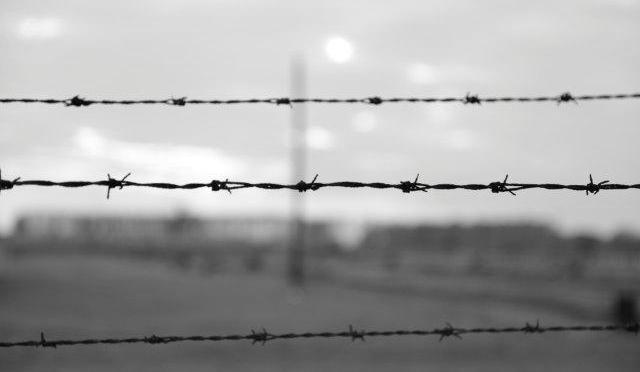
photo: barbed wire, Dr Fred Leitner

