
THE SALAMANDER’S PATH
Nadine Kraman
It’s a two-hour drive to Deerfield, Massachusetts, plenty of time to think about my intention to go inward after my healing circle, alone in a cabin for five days, no running water, a two-burner hot plate and wood stove for warmth as cities and strip malls give way to rolling hills and fewer houses, four lanes become two, then a narrow dirt road . . . things start to slow down.
* * * * *
The first thing that catches my attention as I pull out of the Fresh Pond shopping mall parking lot after buying a few last-minute groceries: some fish, more garlic, something to munch on while I drive, is how beautiful everything looks when I decide I am getting away. The clouds look almost luminous. Is it because I am headed out on an adventure? Because I am leaving my daily responsibilities, my schedule, commitments, the responses others expect of me, my expectations of how I should behave, how I should be available.
Then I’m blindsided with a moment of panic, “Why am I doing this? What good will being alone for a week do? Why am I so self-focused? Old, internalized doubts and fears, old tapes. Then the reality of the situation becomes clear. I know I am headed in the right direction, due west, keep the sun on your left, to let go of my mundane self by making things simpler: haul water, make fire, eat food, rest (maybe even write). I am craving the caw of a crow in the distance, the starkness of trees barren of leaves, dark clouds curtaining in over a mountain. And so, the miles roll by and there are more miles behind me than in front of me.
The cabin is a simple one room wooden structure with a slanted roof. A single bed and bunk bed at the far end, a broken-down couch and wooden coffee table, a chair and square wooden table in front of a large window: bedroom, living room, kitchen in one rectangular space.
Once I unpack my gear from numerous canvas bags, I turn my attention to the wood stove. It is cold and damp inside the cabin. The person who laid the fire in preparation of my arrival must have been in a hurry. The lighted match is useless. The newspaper feels damp and is simply folded in half and the wood badly stacked. I take everything out of the firebox and start over.
Crumping single sheets of newspaper, I lay a good foundation with plenty of room for air to circulate. I place small twigs and kindling, which I find in the wood bin, in a crisscross pattern on top of the paper and then lay some slightly larger pieces of wood, then a couple of quartered logs, their splintered facets facing inward to catch the flame from underneath.
Time for the one-match test. The wooden match ignites as I run it along the rough edge of the matchbox, hold it steady and apply the flame to the edges of newspaper closest to me. I watch as the fire moves slowly at first, drying out the dampness from the paper and then gathering momentum, igniting the kindling and smaller pieces of wood, a crackling sound; flames –– blue and orange –– lick around the quartered logs as the fire takes off. I close the heavy cast iron door and adjust the flue.
Soon the cabin feels toasty, and it won’t take much more than coals to keep the temperature quite cozy. I sit on the couch and stare out the window. It is a peaceful scene, a bit of grass browned in November, a large swarth of tall straw-colored grasses waving in the wind, the dark trees behind, the mountain off to the right. The sky is gray with a wall of clouds.
I become aware of my mind shutting down. I am observing my mind and thinking “there is no chatter, my mind feels blank.” Except for this awareness there are no other thoughts. I am aware of not thinking. It is so pleasant to just be with this stillness. The magic has begun, it feels like a miracle.
Suddenly I’m sad. I feel the darkness descending. I am alone, this is how death comes, the dimming of the light. My eyes fill with tears. My next thought is “where is the lemon for dinner?” I had been envisioning fish smothered in lemon slices, and I don’t remember seeing the lemon when I unpacked. Did the lemon roll out of the bag? Clearly, I am not dying but very much alive and hungry.
I step into my boots and climb the now partially frozen muddy path to where my car is parked. And there is the next miracle. Above the dark gray undulating outline of the mountains in the distance, the setting sun has created a rainbow of the fog. The first layer has a tinge of yellow to green-blue. There is a definite band of purple between the blue and rose bands of color, and above the rose is a peach-colored fog. The setting sun has cast the clouds on the horizon as a rainbow, like layers of fluff in a parfait glass.
The colors dissolve and disappear within a few moments. I realize that if I hadn’t gone in search of the lemon at that exact moment, I would never have caught the transitory and highly unusual refraction of light.
I find the lemon in the cooler. I cook the fish in a cast iron pan on the wood stove that I’ve stoked hot. After enjoying a delicious dinner, I clean up a bit. I sleep in my sleeping bag and the pillow I brought from home. I wake up in the middle of the night cold, coax the fire back from embers. And so, the days pass: haul more water from the main house in plastic jugs, eat, sleep, keep the fire going.
On the third night I pull back the curtain and peek out of the small window over the counter where I’ve been washing dishes in a plastic tub. The night is dark. There is an abundance of stars. There is a hint of light on the horizon. I step into my boots and fling on my jacket, bounding up the path.
As I stand, legs astride, a sliver of white emerges over the mountains. As it continues to grow, I have a new awareness that the moon is stationary, and it is the earth that is rotating on its axis, moving fast enough to be perceived as a moonrise! As minutes tick by, the earth turns, and the moon appears round and full and very BIG above the mountains! Another unexpected miracle.
On the day before I am scheduled to leave, I take a walk in the late afternoon. I walk around the field to watch the weather move off the mountains into the valley, west to east. Dark clouds roil in and with them a chill and the rustle of raindrops on dry grasses parched of color by an early frost.
I walk by purple brambles, thorny blackberry patch, and spears of plush red sumac candelabra above a thicket of wild, wild rose. I squish a rose hip between thumb and forefinger to lick the juice, sweet and perfumy on my tongue. The rain is the fine mist New Englanders call spitting rain.
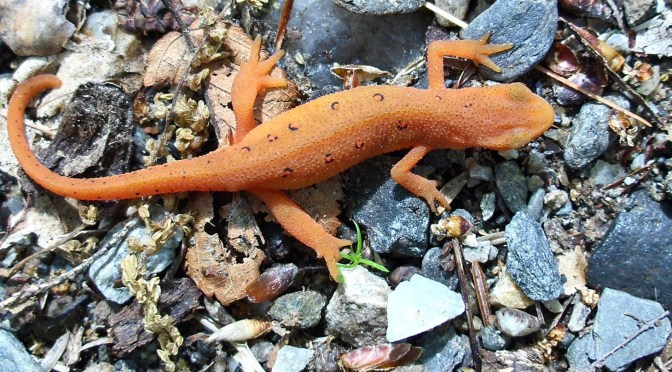
And then I see her. A bit of orange against the dark brown of pine needles and leaf litter, a small salamander, the type I’d seen as a child but never since. We used to go for a walk after the rain when everything was wet and dripping, summers in the country in New York State when I was a child. When the heavy downpour of a sudden thunder shower had let up and our cooped up indoor play energy got to go outside again.
My cousin Suzanne, my sister, and I, accompanied by our mother and aunt Dossie, would go off on an expedition carrying a gallon sized glass jar. We were collecting specimens of a certain very prolific salamander that littered the roadside after the rain. They must have lived in low places under rocks and leaves and emerged when the earth was temporarily soggy with water. These weren’t your brown or green newts. These were your bright orange salamanders with two rows of six or seven red dots encircled by a dark perimeter, which ran along either side of their delicate spines.
Each salamander, though similar in shape, long and narrow, around three inches in length with three toes on each of its four crooked legs, was different and had a character all its own. By the time we’d circled around and headed for home, we’d have the gallon jar half full of writhing orange amphibians, a wonder that the ones at the bottom didn’t get crushed or asphyxiated.
At home, we’d sort through the salamanders for the liveliest and race them across the cement steps in front of the house, never thinking about the fragility of their skin against the rough surface of the cement. We’d push and prod them to move in the direction of the race. Finally, we’d dump the rest of them out on the grass. Hundreds of orange salamanders would take off down the hill, making haste toward their new homes.
Today, on my retreat, the salamander is the lone amphibian out for a stroll. After I carefully pick her up by her tail, she continues striding along the palm of my hand. I put one hand in front of the other to keep up with her pace. She never realizes she is on a treadmill. She is focused on the terrain under her feet, unaware of the enormity of the forest, the trees towering above her, the wind sending shivers in the topmost branches of the pines.
The sky begins to lighten. I can only wonder if her tiny amphibian brain knows in some incredibly direct way that the storm has passed and that the sun is trying to come out. Occasionally, she stops and cocks her small fragile head to one side as if to check out the environment which has shifted.
I am mesmerized by her every move. She seems so vulnerable and yet, I am struck by her strength and resolve to keep going forward. After giving her a soft kiss, I put her back on the mass of dark brown leaves from which I had plucked her. She keeps up her pace by reaching one front leg forward while swinging her opposite crooked hind leg in a large arc until her rear toes almost touch the toes of her front leg on the same side. Then she repeats this maneuver on the other side. Her posterior end, including her tail that is as long as her body, switches from side to side as she walks, while her head and shoulders moved fluidly forward without the lightest trace of the intense shifting going on in her hindquarters.
I watch for a long time. She keeps moving straight ahead, putting one foot in front of the other. She seems undaunted when she tumbles over the edge of an upturned leaf and nearly falls on her back. Her forward movement continues without skipping a beat, her head held high. At last, she disappears under a log.
I am aware of how still I have become while watching this diminutive but dynamic drama unfold. As I turn to go, I glimpse a bit of orange striding from under the fallen tree, “The salamander’s path,” I say out loud, hoping I can integrate some small part of what I have learned from my time alone in nature as I prepare to return to the challenges of my busy, cluttered life at home.

