All posts by JONAHmagazine

A literary magazine about challenge and change

The circle

The circle

Ivan de Monbrison

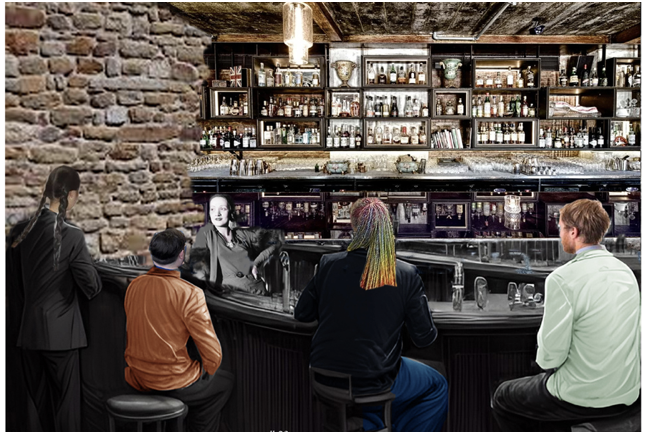
The face is placed upside down on a corner of the table and you spill ink on a sheet of paper you would like to say something but you can no longer speak any language you are sitting mute without a name there is also near to the sheet an ashtray full of cigarette butts and a deck of cards turned upside down you turn one card right side up it’s the queen of hearts then another it’s the queen of spades this time there is also a heart  still beating and torn from your chest and left in the pocket of the shirt that you are wearing now and this heart is totally covering you up with blood yesterday you went for a bit of a walk in the old downtown area that you know so well it has a lot changed over the years the faces seated on the terraces are no longer quite the same as before but the young people still laugh as they used to drinking alcohol wasting their time their faces are all different and yet they all resemble each other in all sorts of ways all these individuals all the women all the men are only one in fact unique and anonymous today there is in front of you in addition to the deck of cards a cup of coffee placed on the table right next to the ashtray and the card of the ace of spades turns over by itself and that of the two of clubs also today you have some heartburns in your belly due to smoking too much and you have painted a canvas all in black you don’t speak with anbody anymore and you no longer have a name of your own you have turned bald and you keep telling yourself that you should change all of your teeth three times a day at least and change also once a week your head and once a month your face yesterday in the street you saw on a sidewalk death walking between the tables of the cafe terraces where young people were seated and by this beautiful late afternoon you saw her staring at them smiling and counting them all with her fingertips one by one as they keep laughing and exchanging among themselves meaningless and trivial words  on the boulevard the cars went speeding up noisily and the young people as they laugh keep showing their white teeth to each others and their words are nothing more than unintelligible sounds as if they had once again turned into the animals that they have never really stopped being as if they were removing this false skin made of clothes and their shoes too and all this while still mechanically bringing their lips to the brim of the glasses filled with alcohol most of the time some smoking cigarettes too with the smoke coming out of their mouths and death passes between the tables and carefully observing them, one after the other, but they do not see it

photo Harry Rajchgot

April 21, 2024, Marseille.

April 21, 2024, Marseille.

Ivan de Monbrison

In the meantime, this morning the wind has finally died down, and no longer makes the large plane trees that line the main street of the town, called La Canebière, shiver. A little further up, by a large church called Les Réformés, although it is Catholic and not Protestant, some hackberry trees have been planted, with darker foliage and gnarlier trunks. Yesterday morning, like every Saturday, it was flea market day along this street, there were old dusty books, obsolete trinkets, old-fashioned paintings; and me, I wanted to find an old wooden pipe for myself, but those proposed being a little expensive,  I gave up. And yes! There’s no denying that I’m truly a man of our times…I smoke the pipe, I play chess by myself for no clear reason, I badly strum my guitar, and recently, I have started to read “The Tales of the Vampire”, translated from Sanskrit by Louis Renou, more than sixty years ago now. Here, there is no computer, no television, only scores of paintings vainly hanging on the walls, in rows, and outside, through the window, the imperturbable view of the old roofs of Marseille. I live on rue Mazagran, right next to the famous Thiers high school and the Gymnase theater. If ones goes down La Canebière, it’s easy to quickly get to the harbor and the sea. Sometimes, when the weather is bad, it also rains in the old attic where I live, so then I put a plastic bucket on the floor to catch the drops, and when I’m not present, there’s inevitably a puddle that grows there but which, fortunately, dries out quite quickly, due to the arid air of this southern land. The old attic, turned into an apartment, still a little rickety, is inhabited mainly by my past, by passing through women whom I’ve slept with there, or by visitors who might have visited me, from time to time. One day, I can imagine, I too will finally leave this place, having broken my pipe, as we say for passing away in French, in my turn, for good. Then, the old attic will remain vacant, with only canvases as sole guests, those which I have been clumsily painting on relentlessly, while waiting for death for so many years, with but shadows of my poor unconscious usually casted over them. They will stay all alone in here, probably waiting for  a last  late visit, forever postponed.

hot Wikimedia Commons

It’s Too Late, Baby, Now It’s Too Late

photo Wikimedia Commons

Songs for a Mad Woman

Songs for a Mad Woman

William Miller

The police car pulled up and then I was 

in hand cuffs, in disbelief, driven with two vagrants.

But I protested, cursed, screamed—“Don’t you know 

who I am?”  For those words, not all the ones

I published for thirty years, the books and magazines

that burned in the apartment fire, I was taken

to a place Kafka never dreamed worse.  A psych ward,

a treatment center where you were kept

without a phone call, a release date. 

A girl was raped in there, not by an inmate but two

attendants who took their pick from the gurney

they wheeled in daily, hourly.  An Aryan with 

a swastika tattooed across his back told me 

to stay quiet, play the game, nod and smile.

In the dayroom, the damned colored in coloring books.

For an hour, we sat in the shade of a wall topped

with concertina wire.  A woman with long silver hair

conjured birds with tiny wing-like hands—an old “traiteur”,

someone told me.  There was another woman,

“Gwen,” lost in her own shadows, eyes like

burned-out fuses. I needed a purpose and spoke

to her, made faces, sang songs she might know.

Her eyes lit up at “Yesterday”.  And then she said:

“I see many soldiers”.  The light in her eyes

went out and never came back.  I hoped she was

in a better place, soldiers all around, where someone 

tried to sing to her, at least knew her name.

Katrina Brick

Katrina Brick

William Miller

                                 I knew this woman, old New Orleans

                                 in her light graceful manners, 

                                 slightly dark humor. Her family house on Laurel Street

                                 had stood for over two-hundred years.

                                 Sarah gently told stories of disasters—

                                 a slave woman who burned her mistress to death,

                                 set her dress on fire with a coal pulled from 

                                 the kitchen fire with a pair of iron tongs.

                                 And one about her planter third great-grandfather

                                 who hanged himself in the attic with a cord

                                 from his Chinese dressing gown. 

                                “No ghosts,” she said, laughing.”  “No ghosts.”

                                But I wanted more, tourist-hungry and new

                                in town.  They all had them:  year-long flights

                                to California, dead bodies floating in the canals,

                                whole families stranded on rooftops.

                                She walked me through the wrought-iron gate 

                                into the shade of a cypress tree, pointed to an odd brick,

                                new among the moss-covered old.

                                “Eight dollars,” she said.  “That’s what Katrina

                                cost my family.  “A single brick blown down the street.”

                                There was guilt in the lines of her face, a survivor’s mask

                                of stoic charm.  And she was waiting for the next

                                African wind, a furry wheel in the gulf.

                                Once more, she’d risk a storm even if it meant

                                blown-out dormer windows, a caved-in mansard roof,

                                the death of an old family’s last daughter.  “A brick,”

                                she said sadly.  “The price of a single brick.”

Death of a Pirate

Death of a Pirate

William Miller 

For two hot weeks he had pinned tourists

to the walls of charming old houses,

threatened locals with his sword outside

their favorite bars, the Lucky Dog stand.

One nutty eye leered beneath 

the pulled-down brim of his cockade hat.

He had no name, was just “the pirate”

or that “crazy pirate bastard”.  

Harmless enough, even though he wore

in a black and gold scabbard

a real honed, cutting sword.  On the hottest day

ever recorded in New Orleans,

he hectored the wrong homeless man

who stabbed him to death with three

quick thrusts of a prison shank.

Garbage men muttered, Japanese couples

snapped pics.  A pirate in a town where pirates

prospered and kept alive with smuggled rum

slaves from banned countries, he kept some kind

of faith.  Like all street performers, he gave

the crowd what they came to see,

traveled so far to post to their friends

back home.  His blood was extra,

more than what they paid for.

Retirement

Retirement

Richard Dinges Jr.

Just when I left the stupor 

and stilted air of an office 

chair buried in a room

with no shadows, lit

by sterile fluorescence

and dim monitor flicker,

just at that moment

the world shrank, 

people retreated into 

small home-bound rooms,

hid behind masks, 

a world with no smiles, 

only shrill shrieks of loss 

and no protection from ghosts

that float in air to infect 

our breath, and I still stare out

through dirty window panes

at freedom yet to be had.

Leftovers

Leftovers

Richard Dinges Jr.

An open can of olives,

shelled shrimp in ziplock

bags, smoked salmon 

that smells of yesterday,

my refrigerator casts

doubts on today,

with a cool waft of air

when I open the door,

a shock of bright light

on memories

that idle on shelves

after holidays pass 

and gently decompose

into tomorrow.

Tomorrow Is Wednesday

Tomorrow Is Wednesday

by

David Halliday

Tomorrow is Wednesday. That’s a certainty. I stared at my alarm clock. The alarm clock stared back. I put it to my ear. It wasn’t running. I shook it. No success. Perhaps the battery had run out, I thought to myself. All this time the cat was looking at me with a strange sense of wonder. Or disdain. I threw my shoe at him. He didn’t move. I missed. I got up and retreated into the kitchen to check my calendar. I had an itch. And there it was written on July 2, Tuesday. Dentist. I had to get my false teeth tightened. They kept falling into my soup.

As you get older you no longer appreciate people who are peppy. They are exhausting to be around.   And that was Amy, the receptionist in Dr. Quinn’s office. Bouncing around like a French Bulldog trying to lick your nose. Someone shook me. I’d fallen asleep. I opened my eyes and there was the cheerful face of Amy. 

“Mr. Martin, The doctor will see you now.” 

“Something is wrong with your clock,” I said.

 Dr. Quinn

Dr. Quinn was an odd sort of bloke. He had bangs and coke bottle glasses. And he spoke with a broken German accent. 

“Now, lets see those choppers,” he said.

I took my teeth out and placed them in his hand. He was wearing plastic gloves.

“These are antiques,” he said. “Have you ever considered dental implants, Mr. Martin? We’re having a sale on them this month so your timing couldn’t be better.”

“I’ll stick with the antiques.”

The doctor took a set of small tools out and began working on the teeth.

“I never asked you how you lost all your teeth.”

“That’s correct.”

“Its very unusual for your generation to have lost all their teeth. The war generation on the other hand was another story.”

I nodded. He put my teeth back in my hand. I put them back in my mouth. They fit beautifully. I thanked him and was on my way.

Brewer’s Cafe

I sat outside at Brewer’s Cafe enjoying a coffee. Across the street a city crew was working on the clock in the Peace Tower. The Peace Tower celebrated all those who had lost their lives in war. Those in our town. I did serve in Korea, a wretched excuse for a war. One of the workers came over to the cafe to pick up coffee for his mates. I asked him what the problem with the Peace Tower might be.

“I don’t want to get too technical,” he said. “But it appears to be broken.”

I looked at my pocket watch and it was working perfectly. And then I wound it.

A handsome woman sat down at the table next to me. She must have been in her forties or fifties. Her hair was bundled on top of her head. The waiter arrived and placed a cup, a pot of tea, and a biscuit in front of her. There was sugar and cream on the table but apparently she took her tea black.

“You’re very nosy, aren’t you,” she said without looking at me.

“I’m interested in how the world works.” I responded.

“I don’t work well when I’m being watched,” she replied.

I turned away.

“Don’t pout,” she said. “My name is Gabriella Artibello and I am the local spinster slash librarian.”

And so we talked for some time. And then a younger man showed up and sat down at the table with her. They pecked at each others cheeks. I was introduced.

The young man apologized for being late. His alarm clock didn’t go off. 

“Perhaps you need new batteries,” Ms. Artibello said. “I have that problem occasionally.” We all laughed though I admit not knowing the source of our amusement.

I parted company with my new companions and made my way down the street to Genova’s Fruit Market. Mr. Genova was the lead singer of the church choir. The store was closed for renovations. I could hear yelling and screaming inside. I moved on. I had a meeting with Dominic Guzman. When I first met Dominic he looked a decade older than me. He now looked decades younger. He told me he was preserved in alcohol. We were going to an AA meeting. When I saw him he was leaning on the wall of the LCBO, the liquor store.

“I thought we were going to a meeting,” I said.

“What’s the point?” Dominic responded.

“I thought you wanted to reform.”

“No time.”

“You got some kind of terminal illness?”

Dominic grinned. 

“You don’t know?”

“No.”

Dominic continued to grin, like he was waiting for some great truth to seep into my concrete brain.

“I’ll know, Dominic, when you tell me.”

“A lot of clocks have been stopping. The one at the bank ceased moving at 3 a.m. My stove at 4.30 a.m. My wrist watch is running slow. I went by Wendel’s Appliance store and the picture on all the televisions are frozen. We’re running out of time.”

I stared at Dominic. “What does that mean.”

“Existence only has so much time and we\re running out of it. The gas tank is empty. I figure we’re operating mostly on fumes. It’s over buddy.”

I walked away from Dominic, turned, and walked back at him, waving my finger at him.

“This is crazy. Where did you come up with this inspirational insight?”

“At the pool hall”

I nodded.

“Crazy Eddie told me everything. In great detail. Its sobering isn’t it? Which is another reason I bought this bottle of gin. And you know how much I hate gin.”

“Crazy Eddie is crazy. That’s why they call him Crazy Eddie.”

 Revelry Pool Hall

I made my way up the stairs to Revelry Pool Hall. A couple of times my knees gave out on me. I stopped and wrote ‘turmeric’ on my hand. Crazy Eddie and Sloppy Jo were sitting in the corner of the pool hall having a cigarette. The place was mostly empty except for some high school kids from the local collegiate. The Revelry was one of the few public spaces where you could still smoke. 

“I got the cancer,” Sloppy Jo said to me when I pulled up a chair to sit with them.

“What’s the prognosis?” I asked.

“Death,” Sloppy Jo said then shrugged his shoulders. “It’s been coming on for some time.”

I turned to Crazy Eddie.

“What the hell are you thinking filling up Dominic with those crazy ideas about time running out? You know how vulnerable he is to any… idea. He started drinking again.”

Crazy Eddie laughed, shook his head, then coughed out a lung full of smoke. 

“Ya, but its so much fun. The guy still believes in Santa Claus. I had him eating out of my hand.”
“That’s cruel Crazy,” I said. “That’s not how we treat our friends.”

“Ah,” Crazy said then pompously waved me off with his hand.

“I’m bringing Dominic down here tomorrow and you’re going to tell him that you were just pulling his chain.”

“And why should I do that,” Crazy Eddie said.

I looked Crazy straight in the eye.

“Do I have to remind you?”

So evening comes. There was a little rain. Not heavy. Just enough to clean the dog shit off the sidewalks. And then the soft sound of rain dripping off the trees. I looked out the window at the yellow moon squeezing its head through the pillow like clouds. The cat jumped up on the sill, curious to know what I was looking at. I turned away. I felt like going out for a pint.

 The Headless Chicken

The Headless Chicken was a local pub. There was a good crowd. Taking a seat at the bar, I ordered a Martins Pale Ale. There was a fight on the television, two middle weights, and the chatter and laughter of folks having a good time. Nobody seemed interested in the fight. Sloppy Jo joined me.

“I got the cancer,” he said to me.

I nodded. “You told me that this afternoon.”

“Well I’ve still got it.” He ordered a beer then added. “You hear that Crazy Eddie is getting married again.”

“How many is that?”

“Who knows. Marrying a girl from down East. Fredericton. Don’t know why anyone would marry a Maritimer when we got plenty of hens here in good ole Ontario. Did you ever hear about the headless chicken that lived for 18 months? They named this pub after him. Think his name was Mike. I guess they should have named the pub Mike.”

Sloppy continued to tell me about Mike. I went into a kind of fog. And then I saw her. Across the room. Sitting with a couple of girlfriends, staring at me. I picked up my beer and made my way across the room and introduced myself. The girl stood up and grabbed my hand and guided me over to an empty table. We sat down.

“Tell me about yourself,” she said.

I began to tell her about the universe running out of time. And she listened.

Somehow we ended up in my apartment. I told her I was out of practice with this sort of thing. 

“Don’t worry about that honey. I’ll handle everything.”

I looked at her. I wouldn’t say she was pretty but she was a woman. I won’t got into the details of our coupling but I think I did rather well. As she was getting dressed she gave me the bill. I didn’t think a thing like that would cost so much. Luckily I had cashed my Old Age Pension cheque earlier that week. And just like that she was gone. The cat had watched the whole thing from the window sill. He put his paw behind his head and started scratching. I fell asleep.

The next morning I woke up with high expectation. I hadn’t felt so great in years. I had an extra jump in my step. I remembered that I had to get some cat food. And coffee. And I could use some cream as well. The air was so fresh when I stepped out into the morning. There were kids playing with hoola hoops across the street. I thought they had gone extinct in my youth. The hoops, not the kids. I picked up a newspaper as I entered Genova’s Fruit and Vegetable. The place looked brand new. New floors, new shelves, new everything. And Mr. Genova, a younger looking Mr. Genova, he still had his hair,  was behind the counter helping a lady in a poke-a-dot dress and puffy sleeves. I looked at my newspaper. It was Wednesday. But the year. The year!

“Your wife was in here earlier,” Mr. Genova said. “She says you’ve wandered off again. If you don’t show up for dinner she’s reporting you missing to the police.”

I looked up. 

“Is she pretty?”

Mr. Genova winked at me.

“Prettiest girl in the choir.”

THE END

Cracked Windshield

Cracked Windshield

Jonathan B. Ferrini

My windshield resembles a picture screen depicting the future racing towards me.

The crack running down the center suggests two destinies distorted by the on-coming headlights blinding me as to which road I should choose.

 The taillights resemble red sequin bulbs adorning a splintered Christmas tree within a dysfunctional home, and warn against taking the wrong turn. 

The pale-yellow line I follow won’t prevent calamity.

The rubber wiper blades struggle to sway from side to side like exhausted people shredded by the broken glass living long-suffering lives. 

The rearview mirror is small but clear depicting memories fading with each passing mile, ultimately lost forever.

Viewing my future through the windshield is like watching a movie in a drive-in theatre from a lawn chair left by my foster parents using the car like a motel room rented by the hour.

I strike a pot-hole lengthening the crack on the beaten-down windshield too tired to maintain its struggle as protector and disintegrates into shards like a broken life.

I push forward without protection from the wind, dust, and insects outside.

I’ve chosen the wrong exit and come upon the dingy convenience market in a forgotten small town relegated to obscurity by the freeway.

Seated beside me is my passenger known as “Revolver”.

I enter and hear the familiar lyrics, 

“Here comes Santa Claus, here comes Santa Claus, right down Santa Claus Lane.” 

The immigrant proprietors are a father, mother, and youngster celebrating Christmas in America dutifully staying open as a gift of convenience to neighbors in their adopted new home.

“Merry Christmas, Sir”

Ferrini/Windshield/2

I retreat to the frig of colored drinks reminding me of our empty refrigerator and twisted string of burnt-out tree lights back home.

I detest the image of myself in the security mirror above the doorway portraying a desperate man driven to robbery to provide food and gifts to his needy family.

The mirror reveals the approach of a disheveled, frightening, and determined skeleton of a man.  His body odor is palpable as he passes. His oversize jacket conceals a shotgun.

As fortunate children are unwrapping their gifts, giggling, and laughing, I’m witness to the unwrapping of a weapon of death followed by screams, crying, and begging.

He’s taken them into the storeroom and I fear the worst.

“Open your present” echoing throughout town has become:

 “Open the damn safe or I’ll blow you all away!” 

I’m confronted by my “Ghost of Christmas Past”. Santa came to our house dressed as a homicide detective and my Christmas dinner was served within a juvenile custodial center.

This never fading memory in my rear-view mirror wasn’t gift wrapped but the card carried a message to prevent a redux of my “Christmas Past” for this family. 

I placed “Revolver” to the back of the thief’s head who dropped the rifle. He fell to his knees pleading like I begged dad not to pull the trigger on mom.

“Please don’t kill me. I needed money for a fix!”

His “fix” was a precious Christmas gift of mercy from his victims.

“Let him go. It’s Christmas.”

He grabbed a pack of cigarettes and bottle of whiskey as he ran away.

To escape a bad dream, it’s best to get out of bed, and I headed for the door to end my nightmare. Before leaving, I hear,

“Stop!”

They likely triggered the alarm. It was ironic I failed to steal a day of celebration for my family but would end up in jail for concealing a weapon without a permit.

The family scurried about the store filling a shopping cart with the makings of a convenience market version of Christmas dinner and gifts.

I was pelted by the cold, dust, and insects but kept an eye on the rearview mirror providing me a memory of kindness, never fading with each mile passed or lost forever.

I followed the pale-yellow line home carefully while humming,

“Peace on earth will come to all if we just follow the light
So let’s give thanks to the Lord above, ’cause Santa Claus comes tonight.”

Return, Revenge, Redemption, Randy Johnson

Return, Revenge, Redemption, Randy Johnson

Alex Dermody

Harold’s feathered chest swelled with hatred. His beak twitched. Did his perfect eyes deceive him? No. The monster. The murderer. He was back at the scene of the crime. The beast warmed up his lifetaker on the bright green field below, launching missiles at another player. Harold had dreamed about this moment for a whole year, since professional baseball pitcher Randy Johnson killed his father with a hundred mile per hour fastball. Day and night, Harold waited for this exact moment. But now that it was finally here, Harold felt paralyzed. His claws gripped the rim of his family’s nest, his brain was basically scrambled eggs.

Harold’s wife spoke with a quiet urgency: “Please, ignore him,” Maureen said. “He can’t hurt us up here.” She was referring to their nest—the best in the ballpark—right atop the first base side lights, offering a panoramic view of scenic Tucson.

Harold didn’t hear his beautiful wife. His stare narrowed, slowly zooming in on the coward Randy Johnson. The news. SportsCenter. They all reported his father’s murder as if it were a joke. “Bird Hit By Pitch Explodes Into A Million Feathers” was the worst headline. His father’s entire existence, reduced to hyperbole.

“Harold!” Maureen said. She motioned with her beak at the three chicks under her wings. “Think about the kids.”

Harold was a good husband. And even though it was new to him, Harold was a good father. For these reasons, his tone remained emotionless. “The kids are all I think about,” he said. “Everything I do, it’s for the betterment of this family and birds everywhere. Why do you think I started Dove Tactical Force? Why do you think I made peace with the eagles and the falcons? Doves don’t normally nest in the sky, but we needed safety, so I made it happen.”

“I’m not talking about Dove Tactical or our magnificent fortress,” Maureen said. “It’s just that, oh. Is revenge really the answer? Why not leave Randy Johnson alone?”

“When that villain killed Father, he didn’t just make an enemy out of me. He made an enemy out of all birds. Don’t you see? This is war, Maureen, a horrible war. And he’s here to strike again.” A bizarre sensation overcame Harold, almost like explaining things gave him confidence. “I don’t want to do this. I have to do this.”

Maureen fell silent for a moment. She patted the chicks with her wings, smiling at them. When she next spoke, her voice was barely a whisper: “The balls on this Randy Johnson,” she said, voice quivering. “Coming back here, he obviously fears nothing.”

Harold had to side with his wife. The reaper Randy Johnson seemed like the kind of emotionless evil only found in movies.

From across the field, a Dove Tactical commando named Ramirez waved a green flag. The eagle above the press box released a piercing caw. The hawk in right field screeched in agreement. Every bird in the ballpark knew who was pitching today. They were ready.

“Do you trust me?” Harold asked his wife.

“Harold, I hardly think—”

“Maureen. Do you trust me?”

Maureen couldn’t meet her husband’s eyes. “Of course I trust you,” she said.

“Good,” Harold said. “Because the demon Randy Johnson robbed me of a father. And no bird deserves to suffer like that ever again.”

Harold faced the endless blue sky. He sucked in air and cooed like he’d never cooed before. He looked warmly at Maureen, smiling that smart smile she fell in love with last mating season. And then Harold let go of the nest, dive-bombing to the earth below. He corkscrewed and opened his wings, soaring above the bloodthirsty fans, gliding towards the pitcher’s mound. This was it. Harold waited. Waited. Then, at the last second, he pushed hard and felt a clean release. He looked back through his legs and saw a direct hit—a white splat right atop Randy Johnson’s hat. Harold flew up, up, up, surveying the scene below. He watched the hawks swoop in and drop their loads. Followed by the eagles. Then the egrets. The pigeons. The falcons. The wrens. The cardinals. The sparrows. And finally: Dove Tactical Force. The D.T.F. commandos swooped low, delivering a large and precise sheet of white over the target, painting Randy Johnson with a finished coat of shiny shit. Humiliation in front of his beloved fans, that’s what gutless Randy Johnson deserved.

Harold made a victory lap around the stadium, the air ringing with different birdsongs, all celebrating the successful bombing. He landed back in the nest like a fighter jet on an aircraft carrier, Maureen and the chicks tugging at him with happy hugs. Father would be proud, Harold thought. 

But the cheerful moment was short-lived. Harold peered over the edge of the nest, and what he saw sent him spinning. The baseball game was paused, and a dripping Randy Johnson stared up at Harold. Directly at him. And on the man’s face was a crooked smile, Randy Johnson nodding like he understood why all this happened. Nodding like he would’ve done the same thing. Randy Johnson extended his left hand—the hand that turned Harold’s father into Thanksgiving dinner—and stuck out a thumb. He mouthed the words “I’m sorry.”

Harold held eyes with Randy Johnson, sizing up the sincerity of the gesture. And the next thing he knew, Harold’s wings felt lighter. The tension in his chest melted away. The ballpark once again exploded with birdsongs. The war, it was over. Just like that. Besting Randy Johnson didn’t bring Harold’s father back. But it brought closure. Relief. Freedom. As if adding an exclamation point, Harold hung his tail off the side of the nest and pushed hard a final time, letting everything go.

“You know,” Maureen said, “Randy Johnson sort of looks like a bird.”

Harold wrapped a wing around his lovely wife. “You know, he sort of does. Doesn’t he?”

Once Upon a Time in the West

Once Upon a Time in the West

Jesse Sensibar

I’m leaned up against the old cigarette machine that hulks in the shadows to the right of the main entrance and exit door to the bar of the Monte Vista Lounge almost underground in the bottom of the old hotel. I’m up against the big machine because it’s about the only place left to stand in the crowded smoky bar. 

The machine and me are the only two things not moving in the place. The music is hard and fast and the crowd moves pogo style with it. 

I’ve got a lot of love for this cigarette machine. My grandfather was one of the first Marlboro Men. 

An angry midget named Joe Munch driving a blue delivery van modified with hand controls comes every week with his beat-up step stool and cardboard cartons of cigarettes to fight and feed the beast, climbing around slamming and cussing it ‘till it gives up its box heavy with silver coins, then re-loading it with full stacks of fresh packs of tobacco. It jams every once and a while but it mostly works pretty flawlessly. It’s so old it is mechanical instead of being electronic.

You pick your brand of smoke from the pictures on the face of the machine and put your quarters in the slot. Below each picture is a small round chrome knob decorated and edged with tiny scallops.

You grab the knob and pull, the knob comes out towards you a full ten or twelve inches on a steel slide with a sound like working a long action on a 12-gauge pump shotgun, making the same resounding chunk when your pack of cigarettes falls out of the machine and into the tray below as a shotgun does when it chambers another shell. 

Journey Home

Journey Home

John Ganshaw

Finally, I’m on my way home, somewhere between Seoul and Detroit, sitting comfortably in a Delta One Pod, gazing out the window. You can see for miles and all that is below me are pure puffs of white, the sun cascading off of them and gazing back at me, highlighting the tanned fingers that type on this keyboard.  It is so hard to imagine that I am here above the clouds when I have been in the depths of hell for so long. This is different from sleeping on the floor in a Cambodian prison.  I thought that being on the way home would bring a sense of freedom to my realm, yet I am wiping away the tears of pain, hurt, and everything else that came with these past 16 months.  It wasn’t long ago that I thought my head would be resting on these clouds, using them as my pillow, but now all appears different. 

I sat there gazing out the window, dreaming of all that was, all that was still ahead of me, thinking what now?  Deep, lost in my thoughts when out of nowhere I heard a voice, “Would you like some more wine.” I was startled shitless and jumped a mile high bringing a whole new meaning to the mile-high club.  The attendant was just as startled by my reaction, but we both got a laugh out of it.  This will be my life now, being startled by the slightest noise, voice, or sighting.  I slunk back into my seat, watching my fingers move across the keyboard, effortlessly recording the thoughts running through my brain.  I did take a minute or two to notice that the attendant gave me a very healthy pour, and for that, I am more than grateful.  On the journey back, not even sure what that means anymore, I am leaving my Cambodian home to find time to recover and right this old sea-worn ship.  I had no sooner found myself and it is now in need of major repair and remodeling.  At least I have a bag of bones that can be mended, unlike one or two people I know.  

My friends are asking me how I feel now that I have started the journey back and I can best explain it like this.  The physical journey will be an easy one; I got on this plane and will be back with family and friends in a matter of 20-plus hours.  The mental and emotional journey will take a lot of time; time to adjust to the trauma, treatment, and time to come to terms with how the person you loved so much could betray you.  So, this journey will not be a Sunday walk in the park but more like a mountaineering expedition. We have only so much control over life, if you want to live life to the fullest you must accept that there may be a shit storm now and again.  I just happened to find the shit storm to end all shit storms.

Even now, as I begin my journey back, such positive experiences begin to happen, mostly the most mundane having such an impact on me.  It began last evening, which in itself seems like an eternity ago.  I was waiting for my taxi to pick me up from the hotel when I ran into the British Ambassador, a lovely lady. During my time in Cambodia, we became acquaintances. I dare say friends when a very dear friend of ours passed away.  She was a guest in my hotel, the hotel where we had the wake.  It was just the beginning of the Era of Covid and meeting her, at the wake, all brought a sense of life to such a dire situation, it was death, after all, that is probably the direst of situations ever to be encountered.  Though we had only met that one time she has been there through my entire ordeal.  Anyway, she knew that I was leaving and heading home, and she stated that she would like to keep in touch, genuinely.  It wasn’t empty words coming from her lips but heartfelt sentiment.   Christ this is a good pour of very good wine, I’m waiting for the fasten seatbelt sign to illuminate.   The second impact happened when I was going through immigration and I knew it wouldn’t be easy.  It took a few minutes and some phone calls, probably to make sure that my exit Visa was in order and that I truly was free from prison and able to leave the country.  Each one of the agents at immigration treated me with the utmost respect and I knew they read the charges, Blackmail and Sex Trafficking.   By their looks and demeanor, I could tell that they knew the charges were false and I was a victim of the common yet not-so-common scam.  Those who partake in illegal activities are pretty cunning to have others who are innocent take the fall. It was when I was walking away that the one agent looked me in the eyes, saying “Good Luck to you.” Generally, I would just chalk this up to his being nice but the smile on his face and the look in his eyes were real, you could see the emotion in his eyes, the sense of caring, and the sense of knowing.  These times have been so difficult for me, to be accused of a crime so hideous and disgusting is still so unbearable.  To know through the actions above or messages I receive from friends, messages of encouragement, friends, family, and acquaintances, reassuring me that everyone knows the truth and who was behind this.  This goes a long, long way.  Perhaps the most touching happened this morning when I was chatting with my friend, legal advisor, and confidant, Jonathon.  He said that the effect my situation has had on others is indescribable.  He was telling me how it brought people together, to rally for me during this unbearable time of Covid.  People not being able to interact or have contact with others, yet they were all coming together and, in the process, forming friendships that otherwise wouldn’t have been formed.  Jonathon shared with me the feeling that I had.  I had these same feelings when I was in prison.  I met and am now friends with some great people that I wouldn’t have met if this incident hadn’t happened to me. 

I am still looking out upon the sea of white, little mountains of cotton and though I am flying to a new place, I know I wouldn’t want to change anything that has happened to me.  What I have learned these past many months I would never have learned if this hadn’t been done to me.  How lucky am I?   You have the worst possible accusation made about you, you spend time in a third-world prison, and you live through the most unimaginable living conditions, yet I have no remorse, no hate, maybe a little contempt and I despise a certain ex-pat, but after all I am human.  Even now, I truly believe I am a better person than I was before.  This experience has provided me with the opportunity to create a new dream, a new fight for justice, and a new life to live. The dreams and nightmares won’t go away overnight, the struggle will still be there but in time, maybe I can begin to live again. 

PAPA’S iPAD

PAPA’S iPAD

by

Pamela Domonkos

“Someone has to take the iPad,” my mom said. “I’ll never use it, you know.” I am certain my eighty-year-old mom will never dabble with technology. She still calls the internet the “world-wide-web.” It’s such a shame, I think. If she just tried, a computer would really open up her small world but I know it’s futile. She seems relatively content (at least accepting) that it’s now herself, old movies on TV, and her dog for daily companionship.

I’ve learned it’s often easier just to do something you really don’t want than to say no or explain why you don’t want or need your dead father’s iPad. Taking it will make my mom feel better and allow her to check this one off her list. And to know that one of her children has it, that makes her feel good too. It really has nothing to do with pleasing me specifically, just one less responsibility my dad has left behind that she has to address.

I bring the iPad back to my apartment. Along with the iPad, my dad kept the charger and the stylus pen in a separate plastic zip-lock storage bag, properly marked “iPad accessories.” Unlike most men, his handwriting was unique and beautiful, and I skim my finger over the words, trying to feel my dad. He’s been gone six months now, and my brain has finally processed (and convinced my heart) that he truly is no longer walking on the planet. The sorrow has settled in my heart, like a boiling cup of tea that has cooled just enough to sip and elicit comfort. I can think of him now without the raw, burning pain that immediately follows death. I sip him in daily.

Reflections of my father are warring factions in my brain. Sometimes I have to remember the bad stuff: the alcoholism, the way he disappointed my mom, us kids. The Friday nights he’d walk in from a week of travel for work, not knowing if his eyes would be sharp or glazed. My mom would have the table set for seven, the kitchen capturing the warmth and smells of her careful work over the afternoon preparing dinner for her family, all together. She, too, looked right into his eyes and knew instantly, and whatever she saw reflected would set the mood for days. When I heard his car pull into the driveway, listened as the car door shut behind him, I could feel the anxiety build for that unknowing minute that passed while he approached the house, watching the knob turn as he entered. I always prayed for the sharp eyes that would bring in a man who kissed his wife, embraced and smiled at his children, so happy to be home. I knew the glazed eyes brought a dazed, sad, denying man who infuriated my mom.

But mostly during his last six months of life when a little piece of him slipped away every day never to be seen again, I thought about the good stuff. His warmth and gentleness, his intelligence and kind spirit. I think about the father who would round up his five kids on Saturday to tackle the chores assigned by my mom. They’d sit at the table, sipping their coffee, my dad with a pen and paper, jotting down the list in his scripted handwriting as my mom recited the needs of the weekend: cold cuts, the newspapers, a bottle of gin. The list didn’t change much week to week, but he enjoyed this assignment, not just to spend time with his kids but to give his wife a few hours of peace and quiet. He’d leave with a kiss good-bye to my mom (be careful, she always said), the list in his pocket along with $40 in cash—his allowance, they joked. 

During those Saturday morning adventures, he showed us that the best bologna one could buy was from a German butcher located a town away. He brought us to LaSala’s, an old-fashioned corner store that had a long, linoleum countertop and a row of swivel stools, their round, cushioned tops shiny and slippery. There we were introduced to cherry or vanilla Cokes right from the fountain. And he’d buy us each a scratch-off lottery ticket. It was as if he needed to seek out any semblance to his New York City childhood in our suburban environment. He wanted to share that piece of himself with us. The shopkeepers genuinely enjoyed talking to my dad, who always made conversation with them lighthearted but personal. He had the gift for gab, always engaging others and genuinely interested in them. He had a way of making others know he saw them.

* * *

How many times are we asked when we’re young, what do you want to do? What makes you special? What do you love? What are your talents? Questions I naively tackled before choosing a major in college, a career path. What a joke, being asked to direct your life as an eighteen-year-old. What a disservice we do to our youth. I’m good with numbers, my seventeen-year-old self deduced. I got an A in calculus last year! I will be an accountant. Oh my God, why didn’t someone speak up, stop me? Didn’t anyone know me and think to say, “That might be a pragmatic decision, Pam, but you’re a people-person. The two don’t really mesh.”

It took me fifty years and my dead father’s iPad to figure out what I am good at, what makes me “me.”

My apartment is coming together after separating from my husband six months ago. I’m getting acquainted with this new way of living on my own. No longer defined by the constant demands of a husband and three children, I feel surprised by choice…choice of what to do with each found moment that I have declared my own. What do I want for dinner, or better yet, do I want dinner at all? Read or write? Red or white? Choice feels both powerful and foreign, like winning the lottery after living paycheck to paycheck. Choice isn’t natural yet; I feel unsteady.

Although the apartment may be coming together, I’m a mixed bag of emotions—excitement for this new chapter in my life, guilt for disappointing my family, anger at my husband for not taking care of me, acceptance that my children are becoming adults, sadness that my dad is gone. My daughter tells me that her father is not coping well, the house is dusty, unopened mail is piled up, and the fridge is bare. Did I detect a small hitch in my son’s voice when we talked last week? Does he resent the forced change I have brought with my desire for a new life? What would I have felt if my mom had left the man whose eyes were glazed more than sharp?

Like a chisel on an ice block, I feel the guilt chipping at my resolve to be unmarried. I am personally responsible for redefining my family, moving ahead with no one’s permission but leaving a trail behind me of hurt and disillusionment. There is a cost to choice. 

I need a talk with my therapist, Joanna, who was more of a partner to me through some of life’s most difficult moments than my husband. She’s helped me through so many crises. But Joanna moved; her husband retired and is now in Vermont. I send her an S-O-S text. We talked about Facetime therapy sessions before she left. I’m not too keen on this idea; it feels a bit stilted, emoting to a camera lens on the computer over the “world-wide-web.” But I really need to talk.

So good to hear from you, she texts back. Should we give Facetime a try? How about Monday at 6 p.m.? 

Sounds good. Thanks, Joanna.

Where did I put that iPad? My phone will be too small for Facetime therapy. I’m pretty sure I can Facetime on the iPad. I may be good with numbers, but I’m really limited with technology: routers, IP addresses, service providers, domain names—it’s all Greek to me. Certainly not on the “Things I’m Good At” list. 

I find the iPad and plug it in. It’s completely dead, like Dad. Wonder when he used it last? I figure about a year ago, before he got so confused and incapable. I let myself feel sad for a second, remembering the very intelligent man, always trying to stay relevant even when his abilities started to fail him. That was the most difficult part to witness, watching him fail. Okay, today’s “sip o’ Dad” burns too much, back to the iPad.

The screen eventually comes to life, the battery symbol registering a red 3 percent. I let the iPad recharge, and when I look a few hours later, the full screen is relit. The usual apps appear—he has Facetime. Funny, he never used it, and I’m mad at myself that I never showed him how. Damn it! And then I laugh to myself because I’m sure he would have used it a lot and maybe not at a level appreciated by his children and grandchildren.

And then I see his e-mail icon. Do I dare? It seems unethical, looking through a dead person’s e-mail. But it’s Dad. I click on it. I can’t help myself. My palms are sweaty—I don’t expect to find anything outrageous in his e-mail, but I feel like he’s right there with me.

It’s as I would have predicted: e-mails to his children relating something he’s read in The New York Times or heard on NPR and a few to his old friend from childhood, nostalgic reflections on their childhood in Astoria. I read through a few. He writes to his sons, remembering fishing trips they took out of Rock Harbor, questioning an arcane golf rule that has come into question at this year’s Masters, the trials and tribulations of being a New York Mets fan. I realize I’m not breathing. It’s not the content that has me frozen. I’m reading his words and I can actually hear him, his voice, the unique way he talks, the cadence of his speech. He writes his e-mails like he speaks—there’s nothing formal in them or composed. It’s him. A tear runs down my cheek. DAD!!!

I only read through a little of his “Sent” folder. I feel overwhelmed with the emotion of his presence and my intrusion into communications that don’t belong to me. I do make note that the last e-mail he ever wrote was to my sister Julie—I will tell her that, it will make her feel sad but good. I turn my attention to his “In” box. I’m not reading content anymore, just scrolling, mostly. 

And then I see a note I had written to him just before he got so sick. 

I had forgotten I had written it. It was a thank-you note. I had come home after a very long day of work, exhausted footsteps to my front door, where I discovered two bottles of wine wrapped in that silver, shiny skin. Chardonnay, what I like the most. It was a busy and stressful time in my life, working six days a week, enrolled in a master’s program that demanded one day a week of internship—all on top of the jobs of a mother and wife. My life had turned upside down. I was stretched so thin and wound so tightly, like a piano string ready to snap if any additional pressure was applied. The little unexpected doorway gift lifted me instantly, and I knew who left it.

Wine Bandit!

July 29, 2015 at 4:52 p.m.

Dear Dad,

I am presuming you are the very thoughtful soul who surprised me with not one, but two (!) bottles of wine in my mailbox! Put a big smile on my face. Many thanks!!!

You should know that as I look back on my life and reflect on parenthood, I know how much love and support you have shown me through the years. You are always there with great pride and encouragement and a real interest in my life. Everyone seems to think I am this great big, strong woman, but this path I am on now is very overwhelming some days, and those bottles of wine and words of love and encouragement mean the world to me. They keep me going. Thank you.

Love,

Pam

I’m crying; the tears are running uncontrollably down my face, saturating my cheeks, washing me. I can picture him walking to my door, hunched over and frail with the full load of his own problems but set on helping me through mine. He couldn’t physically do much at that point, but he knew how to say, “I see you, I love you.” The power of that raw love washes over me, whisks me back to my childhood, the kind man who touched so many people’s lives because he took the time to see them: the pork store owner, the waitress at LaSala’s.

And there it is. When I reread my words to my dad, I realize what I do best. It was my dad who showed me how to take the time and really see others—discover, acknowledge, support, and celebrate their unique selves. He showed me how, with a few words or a small token of love, you can deeply touch another human spirit. It’s the secret of being an exceptional parent, a genuine person.

You’ll never find that on a personal inventory list, but it’s what makes me “me,” and it’s a gift from my dad.

THE END

WINTER FRAGMENTS, 2022

WINTER FRAGMENTS, 2022

by

John Ballantine

January 1

I choose a little madness to heal the dreamer warming my bed. The dervish dance puts food on the table. Crazy cool, I am here with aging heart, eyes, and ears that feel the wind in my face. I do not turn away—staring straight into the dance. We are here, we feel the hurts and hold the love. I see the broken promises, letting go the memory that holds me back.

“Who is that?” mocks the fool. “Where are you?”

Today I sit quietly, hear stories, and know that hearts pound fast, mothers die in fire, and tragedy is here. There is another dead body, etched in memory, surrounded by empty vessels, an occasional apparition. Each of us stumbles into such pits. Some never get out. The lucky few walk forward, chastened and more alive. I stand among the lucky.

The choir harmonizes an ancient tune.

I am a child, a crazed, aging man. The world spins, the sun rises, my heart beats. There is pain and love. I am awake.

January 6

Hard to believe, was it a delusion? Crazy people—tattooed, dressed in horns. Wearing army fatigues with guns in their belts—crashing through police barriers. Breaking democratic norms as they stormed the halls of power. This cannot be?

Hard to believe sitting in a quiet home with the TV filled with pictures of hate. Maybe another revolution is happening? Not the peasants rising but an insidious sickness. Are they serious? In 1968 the yippies, hippies, and protestors crashed the Democratic Convention, Mayor Daley’s police beat us back—while Russian tanks rolled into Prague. Back then the upending of that world was real. 

Raised fists, riots, and dead proclaimed that the dream is not dead. They—police, troops, and our elders—struck back. For what? Today:

“Something is happening and you don’t know what it is, do you?” 

Hard to believe as trees bend, hawks soar, and fires burn far away on flat screens. I cannot breathe, can that be true for so many? Some storm the halls of Congress, tear down what you built and learned. I cannot, will not, believe we live in such a place. Guns, pipe bombs, broken windows. This is happening on our screens over and over. We are not the enemy, but this country constructed/woven from the floss of dreams is coming apart.

It is hard to believe cruelty and hate is so close—that pillars of wisdom fall so fast. And that we, you and I, did nothing. No sword or gun as the mobs stormed our cities. It is hard to believe that we did not fight and die for the good life. For the love that surrounds and comforts. 

Hard to believe that my world is falling apart, 161 years after the first shot fired on Fort Sumter. There is no god standing on the ramparts to protect, no poet to spin tales to comfort. The food line is long, the night cold, and there is only one blanket to keep us warm

January 9

It is happening here. It has happened. Civil War—innocent dead on both sides. Reconstruction, the bondage that held so many down. And the Gilded Age, where stealing and taking was sung in parlors where so few marched for liberty, equality, and fraternity. Barricades do not fall easily. Talk at tables stops—even in my well-mannered family. Some hate FDR and the New Deal, others say this is the way. Then there are the wars, blacklists, communists, queers, Black Panthers, George Wallace, the Weathermen, Proud Boys, KKK, and Trump, who incites beyond my imaginings.

Is this the back and forth of history? Despots here, not just in Russia or in other faraway lands. Money feeds. History faints and many look away. It cannot be happening here…only over there. I sip the wine, watch romances at night, and do not fall into dystopian traps.

But it is happening here—not just the 47 percent who do not vote like me, or the 300 or more who stormed the Capitol. Too many turning away from what I learned, what I thought we believed. Hard work, opportunities, laws, courts—even justice—and conversation. I make lists. Sexism, racism, inequality, resentment. My head is full of explanations, of words. I do not understand what is happening here, today.

“Oh, the shark has pretty teeth, dear,” whispers Mack the Knife.

Stones break windows, dead lie unclaimed, and fires burn. Russian tanks advance. No chicken in every pot. The rainmaker looks to the sky for promise of better days, but the deserts are dry and dreams die. It is happening and I don’t want to know why. The candle in the cave shows no shadows flickering on the wall.

Wolves howl at night, we hide in our apartments. The screens flicker. Some cough and die, others wear masks. The trucks pass back and forth in the dark of the night, and there is no metaphor, no light to take me out. No Beatrice or trials of Job that explain. No poet in robe pointing the way.

“Something is happening and you do not know why, do you, Mr. Jones.” 

I sit in my basement, far away from the street cries. The snow muffles what we lost. The bully holds sway. I did not stand with the righteous, did not carry arms and say no. I let others die, disappear, and pretend at dinner it was all Okay.

And what did you do when democracy died? When the USA was united no more? When another country fell? What did you do to save our dreams?

January 16

The world is dark. I wake, touching the first sign of sun wrapped in the smile of romance. But there was no light. No sunrise. It happened just like that, no shots or storming of the barricades. The food on the shelves, the fires that warmed stopped. Just like that.

The resentment, the lies, and the guns have turned back the clock to 1917, 1968. I stand in Prague as tanks roll in. The out-of-wedlock, the bastard children, have no home. Those in the street—Black, White, and Brown—rich and poor—have risen like a mob disgorged from cyclops mouth screaming for more. For their fair share.

There is no god, no Ulysses or Athena to rescue us. All that stuff in my head, it is not real. Not even a dream can shield you and me from the slings and arrows of anger. They do not care; they have a long list of unreasonable demands. The reason I am here, that we sit together at the table, has evaporated as the walls of reason collapse.

It is hard to believe cruelty and hate was so close—that pillars of wisdom fell so fast. And that we, you and I, did nothing. No sword or gun as the mobs stormed our cities. It is hard to believe that we did not fight and die for the good life. For the love that surrounds and comforts. 

The pendulum of time swings back if you fight. Better to have a headstone inscribed, “He believed and died for love.” No more stories, no pictures on the wall. Stand up.

January 26

It was a long time coming. The realization that I cannot change the world. How many days did I look at the sky, imagining soft, puffy clouds when the fist punched my gut? I did look away but hit back with a knee to the chin as I charged through the line. Violence begets violence.

Solzhenitsyn survived cancer in a Siberian gulag—and let his beard grow long in a Vermont hamlet as he pried open the Russian soul. There was so much hurt that ascetism dried the tears falling. A stoic spirit moves forward. Poets stand in food lines. The tundra is frozen deep, I dream again.

Why don’t I see the world as it is? Why can I not stare into the abyss and see the pale bodies floating in the river Styx? I play with the devil, the chameleon deceiving so many. Dulcet voices sweeten the fall. I believe in good, even as witches’ brews simmer with so much sinning. I see the frolicking cherubs, I wander through dark caves with etching scratched on the walls, and I read of Rome’s fall.

No, that is not the world I know. The never-ending troubles, the storm clouds knocking down homes, and the dead bodies piled high on funeral pyres. I see the terrible armies march, the devil’s beguilements, and all the bad that you report. But my wandering knight cannot let go of dreams. The boy who said I believe in Tinkerbell will not let go.

When I die they will say, “John never did get it, did he? Never saw the world as it is, did he?” No, lucky John, he wandered with his mad dreams.

February 15

Easy to forget, to eat the fresh fruit with vanilla ice cream, followed by pink finger bowls. I stared across the table, not knowing why building more bombs and missiles was the path to peace. Some said, “Do not talk with Ruskies” or they, too, will bury us as the cherubic leader in an ill-fitting suit pounds his shoe at the UN. Really, we have to wait until hell freezes over for those two to talk. 

Seven Days in May passed, and we were not blown to smithereens. We learned to love the bomb and not see Peter Sellers when Kissinger explains why we were in Vietnam—dominoes balancing—and why oval tables were the beginning of peace talks with so many dead. Time turns and here we are again with tanks, broken windows, and women crying on the cold street, holding their dead.

I sit with the blue sky and snow—looking at the darkness. Dread rises over a land torn asunder by time while men on horses, tanks, planes strike down the courageous person standing tall. This country, this land with its centuries-long history, cannot escape its mistakes, and so we kill, burn, and maim again until someone says let’s try sitting at the round—or is it oval—table once again. 

February 23

The grandmother stood straight, staring left and right with blue-gray shawl over her shoulders. Prostitute selling her 62-year-old body—not too soft—to put food on the table in Tbilisi. Wide-eyed, I am a year older and not as tough. I look at the potholed streets, the elevators that do not go up, and the crumbling concrete steps in each apartment that they own. No communal property for the free citizens.

The patriarch in black robe and white beard murmurs prayers. A giant statute of Stalin stands guard. Here in Georgia the wine is sweet and the market full of talk as we take the bus to Ossetia, a breakaway province Russia will soon invade, just because.

Why fight the bully? I ask Thea as we climb the goat path through deep, verdant valleys locked in centuries of dialects. Do they not understand war? Some try to break free, others hide. In churches standing above the valley, frescoes of St. George on curved ceilings sit high above seven hundred years of tribulations. A calm voice soothes the afternoon as the incense drifts in with the slanting light. 

A lace curtain is drawn across each apse—a couple with white, virginal veil and black suit are married; another dark apse is quiet as the old are buried. Candles burn, heads bowed, even the unbelieving. The woven curtain, thick with history, stands like a sentinel at the entrance of the Byzantine chapel built by peasants for solace.

The Black Sea and Odessa are distant—my only connection to this world of peasants, stone, wine, and Kubdari. Natalie, one of my first loves, stood me on a pedestal I did not want. She the romantic refugee fleeing the purges of Stalin, and me some white knight full of naïve do-goodness. But Odessa is pushing back Russia’s assault, as Thea escaped Georgia. The bullies with bigger guns win the battles, and I am humbled by the war stories. Maybe the valiant will win.

The prostitute paces back and forth with the sun breaking through the clouds. St. George beats back dragons. Candles are lit in prayer. We pass through the curtain of time. The dream is resurrected.

St. George sits serenely on his mare; a rainbow of light fills the church. The choir is quiet.

A Portion of Success                                                                 

A Portion of Success                                                                 

John Zedolik

I chose the wrong trail

while ascending Angel Island

so missed the summit in my

parsed-out time though I did

glimpse the top where 

eponyms take flight or alight

whom a pilgrim might see

if in the correct loft of mind

even upon a false path, a fire

lane, only circling the crown

like a tonsure in reverse,

the eucalyptus massing

dark and dream-thick on each

side to confound the climber

on a sweating quest to the apex

commanding the attendant bay,

where near-heaven meets earth

at a sharp final edge, a port

for destinations down and up

whose node will bestow

a blessing even upon the hoofer,

head befuddled and point unachieved.

Third anniversary

Third anniversary

Louise Carson

And even after six hard frosty nights,

dry standing corn still sings with insect life.

The squirrel jerks its tail, clucks my approach,

relayed by blue jay cry and thudding grouse.

Reflecting colour up, the fallen leaves

(it’s not autumn unless I mention these),

the fallen leaves complete my metaphor:

feet grind them into finest mould.

Where is she now that time, time’s her betrayed?

The address in my hand’s too small to read.

By morning’s side then, somewhere near a farm.

In the crypt, other women keep her warm.

Did I, do I ever, visit her grave?

My heart her grave, I walk there every day.

THE CHALLENGE

THE CHALLENGE

by

Cyndy Muscatel

Okay, I admit it. We’re old. No spring chickens in our roost. Even if we didn’t realize we had passed the “forever young” age, our kids have kept us informed. Right before COVID hit they sat us down to have the power-of-attorney talk. That we’d laughed in their faces shocked them.

“We’re just trying to be helpful,” our daughter said.

“We want to make sure you’re okay,” our son said.

“We’ll let you know when we’re not,” my husband said.

He shot a seventy-one that day, beating our son by two strokes. Meanwhile our daughter had trouble keeping up with me on our walk.

Three years later the whole family came to visit us on the Big Island of Hawaii during winter break. By their solicitude we could tell our children thought we were one step away from assisted living, if not the grave. It was unnerving although, somehow, I was the only one doing the dishes.

While they were there the Kilauea Volcano erupted. Newsweek calls Kilauea “one of the Earth’s most active volcanoes…and one of the most dangerous.” Our 23-year-old grandson and his girlfriend decided to go see it. They came back with a glowing report of their experience.

“You should go,” Evan said, showing us photos of golden-red ripples of lava in a lake at the bottom of the Halemaumau Crater.

“We hiked a mile into Viewing Site 3, but there’s other viewing sites you could get to easier,” Amanda assured us.

A week later my husband and I decided to go see this natural phenomenon for ourselves. It’s about a two-hour drive on the Daniel K. Inouye Highway. Since the best viewing is in the dark, we decided to stay overnight at Volcano House.

The mountain pass can be treacherous with dense fog and rain, but the day we went it was clear. The snowcapped peaks of Mauna Kea were to our left. Mauna Loa, graceful with a dusting of snow, was on our right.

We pulled into the parking lot of Volcano House at about 2:30. The hotel is right at the rim of the volcano. Mark Twain stayed at the original Volcano House in 1866, but this hotel was built in 1941. When we checked in the receptionist was very knowledgeable. She gave us advice and a map showing where the viewing sites were located.

I couldn’t help wondering what she saw when she looked at us: two old fogeys who should know better or just two people being tourists?

In the dining room, while we ate lunch, we looked over the map.

“We’re doing Viewing Site 3, the one the kids did,” he said. “The one with the hike.”

“Understood,” I said. The gauntlet had been thrown down.

After a healthy lunch of Coke, pizza, and French fries, we set out for Devastation Point. We arrived there at about 4:15. Once we were out of the car, I saw a park ranger standing in front of a huge sign that said Eruption Viewing This Way.

“Is this where we go to see the eruption?” I asked him as I got close. I have a terrible sense of direction so I thought I’d check.

He looked us over. “Yes, it is. But do you think you’re up to the hike there?”

“Isn’t it only a mile?” I asked.

“A mile each way,” he cautioned.

“Is it rocky and steep?” my husband asked.

“No, it’s a regular road until you get to the site. Then there’s some gravel.”

“No worries. We can make it and besides, we have our phones,” I assured him.

He still looked dubious but finally nodded. “Okay, I’m just checking because we had a fatality yesterday.”

I laughed as we walked around the barrier. “I think he’s just trying to discourage us old folks. He probably doesn’t want to do any kind of rescue,” I told my husband.

(Two days later I read this online: “Hawaii News Now – A visitor from Arizona died Sunday at a lava viewing area at Hawaii Volcanoes National Park, officials said. A spokeswoman said the 70-year-old died from apparent natural causes at the Keanakakoi lava viewing overlook.”)

It was an easy mile to the Keanakakoi lava overlook. When we got there we joined the small group of people who were at the edge of the viewing site, looking down at the lava lake in the center of the immense caldera. Since it was daylight you couldn’t see much of the molten lava’s color.

As the sky darkened the lava’s orange glow became more apparent until we were looking at landscape crisscrossed by deep veins of lava. Pele, the goddess of fire, had been very busy. It was as if the elements of the Earth were being revealed. I wish the word “awesome” was not so overused because that’s what the site was—awe-inspiring.

In 1866 Mark Twain described it like this: “The greater part of the vast floor of the desert under us was as black as ink…but a mile of it was ringed and streaked and striped with a thousand branching streams of liquid and gorgeously brilliant fire! It looked like a colossal railroad map of the State of Massachusetts done in chain lightning on a midnight sky.”

“It looks like Los Angeles at night when you’re coming in for landing,” my husband mused in 2023.

Then he started dialing his phone. In a moment our son appeared on the screen.

“Guess where we are,” my husband said and turned the camera so Dave could see the lava.

“Wow,” Dave said, then asked, “How did you get there?”

“We hiked here. This is the site that Amanda and Evan went to,” I said.

“Amazing,” he said.

I rolled my eyes. “We’re not decrepit yet,” I wanted to say.

When the sun set the temperature dropped quickly. Our grandkids had warned us, so we had parkas, although most of our fellow viewers were shivering with cold. But we were all mesmerized by the incredible sight.

When some people started to leave, my husband said we should join them.

“We should navigate up the gravel path while there’s still light,” he said.

I was reluctant to leave, but it was a good decision—it was completely dark by the time we made it to the road. With no moon to guide us through the forest, Mark Twain’s expression “black as ink” came to mind. Fortunately, I had a flashlight.

My husband’s knees had stiffened up in the cold, so he was having a hard time walking.

“I don’t know if I can do it,” he said.

“We can go slow and take breaks, but you are doing it,” I said in my schoolteacher’s voice. “First of all, you don’t have another choice, and secondly, we’re not going to let the kids think we can’t.”

As we walked he limbered up, but we were both glad to see the lights of the ranger station ahead of us. We drove back to Volcano House with the heater blasting.

During a dinner of seared Kona Kampachi, we looked through the photos we’d taken. We remembered that overwhelming feeling of reverence we’d experienced.

“I’m so glad we did this,” I said. “Not only because it was so incredible, but sometimes I start believing in the kids’ viewpoint of us, and I think I am on my last legs.”

My husband gave me a wink. “I love your legs,” he said and took my hand.

photo: G.E. Ulrich – pubs.usgs.gov – picture #007, GU6830A – cf. Selected Images of the Pu‘u ‘O‘o–Kupaianaha Eruption, 1983–1997

HOW DONNA GOT IN A BAD GROOVE

HOW DONNA GOT IN A BAD GROOVE

by

Louise Turan

Donna, age fourteen, moved back to the U.S. with her family to California. Her father, The Colonel, had been assigned to Ft. Ord to run the Base hospital and attend a special medical training course. For the past four years, they were living in Italy, in a villa on a hilltop overlooking sprawling vineyards and the Dolomites. The only thing she saw now, from their square, ugly, cement quarters, was a depressing view of sand, ice plant, and more cement houses. Her high school was an equally unattractive, flat building with rows of multiple green doors under flat roofs. California was like a strange planet Donna had landed on by mistake. She felt like a foreigner, especially when everyone around her, at school and otherwise, seemed obsessed with the Monkees, the Mamas and the Papas, and Flower-Power. Donna didn’t really have a clue what they were saying, singing about, or, for that matter, wearing.

Back in Italy she wore pleated skirts, sweater sets, knee socks, and comfortable shoes to school. No one dressed like that here, she observed on her first day, looking and feeling out of sorts, not to mention uncomfortable, in clothes her mother had bought her to help her fit in. Her mother wanted her daughter to be fashionable, just like her. See, her mother said, self-satisfied, now you look like the other girls. Donna was wearing a tent dress with neon stripes slashed in horizontal patterns, making her somewhat wide body look wider. And the white fishnet stockings, which matched the tight, white Capezios on her feet, hurt her legs and was the last time she wore them. No, I don’t, she wanted to tell her mother. Donna didn’t think she looked anything like the other girls in her class, who had blond hair, cheerleader legs, and wore either very short or very long skirts with flowy blouses. The only one wearing tent dresses was Twiggy, and Donna looked nothing like Twiggy. Donna looked like a girl named Carla, who became her best and only friend. Like Donna, Carla had dark hair and dark eyes, features inherited from their European ancestors, and stuck out, they realized, like sore thumbs.

Donna found herself falling into a bad groove, a word she heard frequently. She thought about her situation at school, her looks, living with overly inquisitive parents who wanted her to be happy, which only made her unhappier, and couldn’t see a way out. On top of everything else, she had to ride her bike to school, in the sand and through sticky, gluey ice plant, which left brown stains on her legs and knee socks. If misery was a friend, it was with her all the time, making her think how unlucky she was to be living in Ft. Ord and have a teacher like Mrs. Carver. 

Where was Signora Sari? Her beautiful, Italian teacher who had them reading Dante? Mrs. Carver was bony, with white stuff on her head that could barely count as hair and fake, clackity teeth. It was the despicable Mrs. Carver who pulled Donna’s mother aside at the PTA meeting and said she had serious concerns about her daughter. She laid out the details with hard evidence so that Donna’s mother would get it because so often mothers of teenage daughters don’t. Mrs. Carver had years of experience in these matters and was not to be doubted, especially about something this serious. 

Donna hated what she called Planet Ord, a confounding place so different from her idyllic Italian childhood. What she found confusing was not only how change was happening around her but also inside her; she was becoming a teenager. She and Carla huddled in her bedroom with Teen Magazine. Following the experts in the magazine, they bought Cover Girl blush in a darker tone and applied it to the contours of their cheeks and the sides of their knees to look slimmer. Disappointed, they found it didn’t work. Carla stole cigarettes from her brother, which they smoked behind her garage, spraying themselves with Windsong Carla had borrowed from her mother. The smell was harder to get rid of than the smoke and, they quickly realized, instead of hiding the fact they had been smoking, was an obvious sign they had. But the one thing in their favor had been obvious all along. No need for padded bras or falsies or wads of Kleenex. Both Donna and Carla, unlike their long-limbed classmates, had inherited ample breasts. They saw boys staring at their chests, admiringly and longingly, as they walked to class. The looks made them self-conscious at first but also grateful, if not pleased, with all the attention from the popular boys. That is how it started, when Donna’s bad groove got worse. It was all Mrs. Carver’s fault.

Donna was sitting in the kitchen doing her homework when her mother returned from the late-night meeting with Mrs. Carver. Her mother’s face was the one she wore when something in the house got broken, like a precious piece of china, or when one of Donna’s good sweaters was found in a ball on the floor, that how-could-you-do-such-a-thing-to-me-your-mother kind of face. Part of Donna knew it would be a good idea to run away, hop on a bus, and find her way back to Italy, or New York, which she had always wanted to see, as she sensed living at home now was going to get worse. The other half wanted to stay and watch disappointment contort her mother’s face in a myriad of shapes and colors and then try to return to normal again. The facial contortions seemed to be happening a lot more since she had become a teenager, which Donna found very curious as well as interesting.

A little voice spoke up, some wisdom bubbled up from a wellspring of youthful hopefulness, and told her not to worry, everything was going to be alright. But the whole mess could have been avoided if Mrs. Carver had not been so nosy and gone to the girls’ bathroom between fifth and sixth period and asked Carla what she was doing with a bra in her hand. Now her father, The Colonel, would have to be involved and God knows who else. In her future she saw a tribunal composed of her father, her mother, Mrs. Carver, the school principal, and Mrs. Jake Preston, outraged that her perfect son had been implicated in the embarrassing incident. She heard her father say, let’s just treat her like I treat my men, which no doubt meant a court martial. They’ll probably send me to a shrink, she thought, or march me off to some home for bad girls near a remote army base in Utah. 

Okay. So she had made this deal with Jake Preston. JAKE PRESTON!  

Jake Preston, one of the cutest guys in her class, had come up to her and Carla in the cafeteria at lunchtime and said that he and Charlie Summers, and bunch of other guys sitting at his table, had made a bet. Jake leaned in closely and whispered, and not in a nice way, that Donna and Carla wore falsies because no one in seventh grade had boobs that big. His sharp grin squeezed his eyes into brown slits, like a sly fox. There is only one true test you know, only one way to prove it. You have to let me feel you up. 

Carla and Donna turned to each other, horrified, then incredulous. Why, if they could prove they did indeed have the largest, most attractive boobs of the century, they’d rise to the top of the heap and be the most popular girls in school. 

It was the Ultimate Sleepover Question. How far have you gone: First Base (French Kissing), Second Base (Being Felt Up), Third Base (Everything But All the Way) and Fourth, All the Way. Extra bonus points if the guy was cute or popular. This was the question you were asked at sleepovers hosted by girls like Hilary Medway, or Mandy Clark, or Susan Whitefield, cute girls with frosty white eye shadow and tight-fitting sweaters, girls who everyone dreamed of being like, including Donna and Carla.   

Not that they had ever been invited, or would be anytime soon, because Donna and Carla’s parents had ancestors with hairy, dark genes and were from places impossible to spell, inheriting names too difficult to pronounce, with consonants and vowels that just went on and on forever. But Donna and Carla did have the curves that came along with those genes, and now, with Jake Preston’s little scheme, at least they would be prepared (in the event they were invited) when the question was put to them playing Truth and Dare. They would answer proudly in the affirmative: Second Base. And Jake Preston, no less. Bonus points! Yes, this was their chance. A passport to popularity. 

Donna glanced sideways at the huddled mass of boys’ heads when Jake returned to his table. If Jake had looked like a sly fox, Charlie Summers looked like a cat that had swallowed a mouse. It turned out that it was actually Charlie who had instigated the bet because Jake pissed him off, acting like he knew everything. Charlie had four older sisters and knew a thing or two about boobs, real and fake, and wasn’t going to lose a bet with his soon-not-to-be-best-friend Jake, but that’s how it goes in the seventh grade sometimes.

Eating the rest of her lunch slowly and deliberately, Donna knew if they hesitated, delayed too much, even by a day, they might lose their nerve or, worse yet, Jake would see their reluctance as a sign of defeat and prove him right. Donna was not about to be defeated or called a liar. For once she was in control of the truth and told Carla her plan. During study hall Donna passed a note to Jake: 

Meet me underneath the stairwell next to the gym between 5th and 6th period.  

In the girls’ bathroom at the end of fifth period, in one of the green stalls that never shut properly, Donna unhooked and removed her bra. Her large breasts were released to the wilderness beneath her sweater and bounced as she handed the bra to Carla. Donna clutched her arms over her chest and made her way to the dark space beneath the stairs.

Jake was waiting, wearing his foxy grin. So, he said, his eyes fixed on her breasts. Donna held her breath and closed her eyes, bracing for his bare hands on her bare chest. Jake took his hands and then placed them, like magnets, on each breast, giving each a firm squeeze. On top of her sweater.

Jake removed his hands quickly, as if her sweater was red hot. He stood back, surveying Donna’s chest, recognizing immediately he had not only lost the bet but had been too chicken to do what he needed to do. Jake, blushing deeply, quickly disappeared down the hall. 

Donna was crushed. She had been tricked. Jake Preston had not felt her up. Touching her breasts on top of her sweater didn’t count. She did not have the coveted sleepover bounty prize. No passport to popularity. Crestfallen, she walked back to the bathroom to retrieve her bra and tell Carla the bad news.

But neither Carla, nor her bra, were anywhere to be found. The bathroom and the hallways were silent and empty. Teachers’ voices could be heard through thick wooden doors giving short, clipped instructions, which always marked the beginning of a class. Someone had her bra. Donna had an alarming suspicion it wasn’t Carla.  

So now, according to Mrs. Carver, who handed the tightly sealed paper bag containing Donna’s bra to Donna’s mother the night she came home with the sour, how-could-you-do-this-to-me face, her daughter was a misguided teenager.

That is how Donna got into a bad groove. She had a feeling she was likely to remain that way. At least until next time.  

THE END

photo: Harry Rajchgot

PRINCESS

PRINCESS

by

Vivian Lawry

There was no road noise at the head of the holler, just the scissor-y whir of the reel mower and the soft murmur of insects. The smell of cut grass wafted up on the summer air, herby and green-smelling.

I stopped to knot a bandanna around my sweaty forehead. Roses along the critter fence bloomed pale pink, perfuming the air, smelling like no other flower. I didn’t stop long, though, lest the bees decide I was trespassing.

Beestings have laid me low ever since I was a toddler and stepped on something in the yard. Daddy said it might be a bee, but more likely a spider or suchlike. My foot swelled up four times its size, and at the hospital they said it was a good thing we got there when we did ’cause I could’ve died. They gave me a shot of something and sent me home. I don’t remember much between screaming bloody murder in the yard and lying on the couch, whimpering, begging Mommy and Daddy to rub my hot, itchy foot. Since then, insect bites of any sort swell me right up. Mosquito bites last for a week. One time I got a sweat beesting on my eyebrow, and my eye swelled shut and half my face puffed up like a circus fat lady.

So I spent as little time as possible near the roses and headed out back. It was a little cooler by the crick, or maybe I just imagined it because the water was burbling over the rocky bed. It had been right dry, so the water was running low and louder than usual.

In spite of the breeze bein’ cooler, I didn’t tarry there, either, because the cooler breeze was smelly. The outhouse sat over the crick, but when the water was running so low, it didn’t really wash the waste away.

Mowing done, I’d earned a rest. I flopped onto the wood porch swing, worn smooth by decades of butts, and made my own breeze, lazily toeing the swing back a little, breathing in time with the creak of the chains.

Great-granny sat in the ladder-back chair, the one with a woven seat made from strips of truck tire inner tubes. She’s blind but does what she can, like churn butter. Right then she was snapping green beans for supper. She seldom talked to me, and she wasn’t talking then. I yawned and went to find Granny.

She was in the backyard, her hatchet in one hand. Her other hand clamped the legs of a big, old red hen, not good for nothin’ but the stew pot. Granny brought the hatchet down true. She brushed the head off the chopping block and threw the body aside to flop around on the ground and bleed out.

Granny picked up the body from the pool of bloody mud the hen had made. I was looking at the drops of red spangling the grass when a cloud of butterflies floated in from the pasture and settled around the little pool. I ran to tell Granny.

“Oh, yes,” she said. “They puddle like that right often. They drink lots of liquid from muddy patches—though not from ponds or streams or such; their eating tubes can’t handle that.” Granny stepped to the cast-iron kettle sitting over the fire and held the hen’s feet to dunk it into the boiling water. While she plucked the hen, I watched the butterflies: little blue, white, and yellow ones, and the dramatic swallowtails and monarchs.

I eased my hand into the bloody mud and lifted it up, covered in rust red and butterflies. They stayed on my hand a right long time. That was more excitement than I’d seen since the black snake moved from the corncrib to the front porch.

A few days later, when I scraped my knee climbing the maple tree, I ran for the pasture where butterflies flitted from joe-pye weed to clover to hawkweed. I propped up my knee and soon had a rainbow mountain. It seemed that for the butterflies, blood was blood. I showed Granny my scabbed knee but didn’t mention the butterflies.

A few days later, when I went out to the meadow, I made sure Granny was in the house. Pulling out my pocket knife, I drew it up my left arm, wrist to elbow. I smeared the red line around and sat still as a stump on a big flat rock. Waiting for the first butterfly felt like forever. But the butterfly sleeve I ended up with was worth the time.

I told Granny I scratched my arm on a raspberry bramble. She swabbed it with alcohol—which burned like bejesus—and it healed with nary a sign.

The next time I fed the butterflies, I pricked all the fingers on my left hand and dripped spots along my right arm. This time, the butterflies came sooner. Each one weighed less than a safety pin.They left tiny red footprints like itsy-bitsy chicken scratches, but I imagined they were really a secret language.

I told Granny I’d pricked my fingers quilting. She inspected the quilt in progress on the frame, declared it was a good thing she found no blood stains because if she had, she’d have pinched off my arm and beat me with the bloody stump. She made that threat often, and I still had both my arms. But she likely would have tanned my butt, and sent me to get the strop to do it.

I dreaded the end of summer. As autumn approached, I fed the butterflies every day. That last day, Granny spied me on the rock and shrieked. She ran flat-out to the meadow, skirt and apron flapping around her legs. I’d never have imagined such a thing. My bloody knife had fallen from my hand and slid off the flat rock where I lay, made over into a fairy princess. Butterflies covered both arms and both legs, my bare chest, even my face. Too content to move, I just drifted.

THE END

photo: Harry Rajchgot

COUNTY FAIR

COUNTY FAIR

by

Joseph J. Dehner

Our bronze Pontiac Chieftain sped westward from Cincinnati on the annual pilgrimage to Iowa. It was 1958, when two-lane, undivided federal highways had no set speed limits. I watched Dad slam on the brakes every forty-five minutes to avoid the small-town speed traps, as Mom coached from the right. In between the traps, green and yellow fields of corn, sunflowers, and soybeans skirted the pavement. Each field looked like the last, a monotony interrupted occasionally by signs like this: 

DON’T STICK YOUR ELBOW

OUT SO FAR

IT MAY GO HOME

IN ANOTHER CAR

Burma-Shave

After a night at a motel, we’d continue on, and by afternoon we’d cross U.S. 6’s iron-girded bridge across the Mississippi River and enter Iowa. Soon we’d arrive in Iowa City.

Gramma would greet us in an apron over a flowered dress faded from Twenty Mule Team Borax washings, her face wrinkled like a sun-scorched prune, gray hair stretched into a bun. She served kolaches and tea as a welcome. Years later I would learn how her family, the Kozderkas, fled European wars to settle on farmsteads with Hungarians, Slovaks, Czechs, and Germans near where Dvořák composed the New World Symphony. There she met and married Adolph, a grandfather I never knew. They built a grand farmhouse on his earnings as a saloon owner and New York Life Insurance agent. When I visited, Gramma had been a widow almost fifty years.

Her aging, gabled house refereed a land battle between city and country as Iowa City sprawled and farms surrendered to housing plots. A damp straw odor spewed across the yard, filled with its hand-planted vegetable and blackberry patch that was home to snakes. Chickens clucked in the barn, home to spiders as big as golf balls with legs. In command of all the inhabitants was a guardian goose I’d been warned never to approach.

Gramma loved having Dad come home, and though he no longer considered this home, he loved seeing his mother. Iowa certainly wasn’t my home, and I had no plans to make it so. The week in Iowa interrupted my city library’s how-many-books-can-you-read contest, hitting tennis balls against a wall, and bicycling to a woodland park where I hunted trilobites and crinoids in a glacier-carved creek. 

Dennis Detwiler lived right across the blacktop street from Gramma’s house in a cottage built of boards with peeling paint. He and I were both nine that summer. I pictured our fathers growing up as country boys, when Teddy Roosevelt, William Howard Taft, Woodrow Wilson, and Warren Harding took turns as President. Black-and-white photo scrapbooks and a framed collection of my father’s National Rifle Association championship medals hanging in my parents’ bedroom memorialized Dad’s youth, when he shot mink and muskrats and sold their pelts for spending money. Looking for adventure, at seventeen he yearned to join the Army to chase Pancho Villa, but his parents squelched that and enrolled him at the University of Iowa. Dad left for Army service, then to Chicago, then to Cincinnati, or he wouldn’t have met my mother and I wouldn’t be here to tell you about the 1958 Johnson County Fair.

The fair highlighted the week in Iowa. While Gramma’s entry in the strawberry-rhubarb pie competition awaited judgment, my parents ambled with her through General Electric’s Wonders of Electricity exhibit, marveled in the Quilt Arcade, beheld enormous yellow tractors and harvesters, gawked at the world’s largest Statue of Liberty made entirely of butter, and learned how to use more Crisco. Dennis and I were unleashed with five dollars of tickets each until two o’clock, when we’d meet up by the Ferris wheel.

Eating our corndogs on a stick, we scanned the day’s offerings, ranging from the elocution contest semifinals to the dunking booth to the Whirligig to the strongman’s hit-the-bell stand. We headed to the swine shed, where Dennis’ classmate Pamela was vying for a prize. It cost nothing to enter but my innocence.

Pamela grinned with braces glinting and pigtails tightly wound. With my plastic Kodak I took a snapshot of Dennis standing next to but not touching Pamela. She stretched an arm toward Dodie, an enormous hog sporting a pink lace collar. On “cheese,” the sow seemed to smile but then let loose in the other direction. This was methane contributing to climate change, but not a worry back then.

Pamela boasted that Dodie weighed about eight hundred pounds.

Does Dodie sleep in your room? I asked.

Pamela giggled. Nah, she said, but sometimes I sleep in the barn.

Dennis explained that hogs wallow. No kennel, just a fence and a place to slop. And plenty of feed to get ’em plump.

Why plump? I dumbly inquired.

Doncha know?

What?

You like bacon?

Oh, I said. Death in the country—destiny for animals hugged at the fair. I pictured Dodie as an Aztec warrior like in the book I read, waiting for the high priest to cut out her beating heart as an offer to the gods of our gluttony.

Dennis and I left for the Pizza Pop Stand. We chomped on greasy slices as we passed a ten-foot-tall ear of corn emblazoned with a red company logo and an unfamiliar word—HYBRID. Behind it was the Swine Weigh-in Booth. Next came a yellow squash-like vegetable the size of a giant beach ball atop a stand in front of the Ugly Cake Contest tent. We wandered through the Bovine Barn, divided between Beef and Dairy. The milk cows mooed last rites for their neighbors.

Here today, steak tomorrow, said Dennis, pointing at a gold ribboned cow oblivious to its fate. Its cud moved from side to side. I sneezed three times.

Back outside, a barker in a peppermint jacket challenged us to hurl baseballs at bottles, while another fellow waved us toward an array of holstered water guns aimed at targets that could win a stuffed Japanese panda. But it was a tuxedoed guy with a bulging Adam’s apple waving a cane and promising a never-to-be-believed experience who won our attention. We handed him two twenty-five-cent tickets and went inside the tent.

The first spectacle shocked—a stuffed cobra in mortal combat with a mongoose. A spotlight beamed on an enormous glass jar where a two-headed calf fetus floated. Take your seats, blared a speaker. We grabbed two in the front row. Curtains parted. A human appeared in a shocking pink dress and ruby shoes. But she had a moustache and foot-long beard. And yet, she appeared to be a she.

The Bearded Queen, the announcer proclaimed. Marvel at this wonder of nature!

Freak, you mean, snickered Dennis, eyes riveted on the stage.

I was struck dumb. Girls and boys—as different as truth and falsehood. Yet, here was a challenge to that. She stroked her beard, and it didn’t come off. Years later I would learn that hirsutism is a rare condition affecting women. But then it was sheer shock. We fled.

Hey, let’s go in this one, said Dennis, pointing to an enclosure with posters of fashion models in fur coats gracing the entrance. RICHES AWAIT!—letters above the lintel boasted—NUTRIA AND YOU!

Riches—now that gets your attention. The bow-tied man at the entrance grimaced and asked if our parents were here. 

His are, said Dennis.

Bring your folks, the guardian said, they’ll thank you. Come, learn how bright your future can be.

We entered and were enraptured by beautifully shaped panels, charts, photos, and large dollar signs. A woman who looked like an aged Doris Day asked about our parents, and when she learned they were nearby, she led us around the circle. She pointed to a photo of a statuesque woman in a fur coat with the Empire State Building in the background.

Is that mink? I asked, recalling that Dad used to hunt them here, though as Dennis had told me, none remained in Iowa. 

Better than mink, she said. That’s nutria.

What’s nutria? Dennis asked.

I’ll show you, said the woman.

She led us to a pen holding cages of nutria of several colors, most a dark brown. The creatures had blazingly orange incisors. They looked like large rodents with Halloween pumpkin teeth. 

Their pelts are worth a fortune, said the woman. Look at this, she said, stroking a life-sized poster of a model posing before the Eiffel Tower. Give this to your folks, she said, handing us a dark blue folder with gold script. Opportunity of a Lifetime, it glowed. Projections trumpeted that a small investment for a breeding pair ($200 said the fine print) would multiply to thousands in months, and profits would never end.

How can that be? I asked.

They breed quickly and often, the woman said. You sell the offspring back to us, we sell them to others, and you make money every time. Or you can use the pelts and sell the meat or enjoy it for dinner. You can’t lose. You get rich. Bring your folks!

On our way to meet my parents, Dennis and I talked over this investment opportunity. 

You know, said Dennis, we could bring back hunting here in no time.

But they’re not mink, I said. They’re ugly. They’re…they’re rats.

We stopped to use our remaining tickets to buy red velvet funnel cakes, powder wafting like a cloud with each bite. Wind was picking up.

Fur’s one thing. But eating nutria. Yuck, said Dennis. 

Bacon was one thing, rat meat another, I agreed about that. Getting rich by selling rat fur and rat guts? Something’s off, I thought.

They’d be good hunting, said Dennis. We need something to shoot around here.

Okay, what about this—freedom, I blurted, unable to picture myself killing an animal. What if we let them out? Maybe they’ll skedaddle and settle here. You get your target practice, and the nutria go free.

A siren whined. An announcement sounded—tornado conditions in the area. Dennis said this happened all the time—if we see one, that’s when to take cover.

Dennis and I ran back to the nutria booth. As the saleswoman tended to a couple who were scouring the get-rich details on a wall panel shaking from the upswell outside, we sneaked into the nutrias’ lair. Remembering the story we read in Sunday School, I pictured the rodents fleeing like Moses and the Israelites from Pharoah, scampering to the exits for a new home in Iowa’s woods and streams. They’d scurry through the animal sheds. The hogs and cows would panic and stampede, providing cover for the nutrias’ escape. Perhaps all the fair’s doomed creatures would be liberated and spared execution.

I could see the future. Nutria would flourish and restore Iowa 1900. Dennis could hunt like his father and mine did. We would turn back the clock.

Years later I would learn about nutria—how Ponzi-scheme promoters sold them to farmers in the 1920s, and the rodents were abandoned when buyers couldn’t feed them or get a cent for their fur or meat as the Depression struck, how nutria native to Peru and abandoned in America as undocumented aliens invaded Louisiana and were destroying its protective delta marshes. I sensed as a boy there was something wrong with their Iowa appearance, and I knew without proof that the nutria barkers were like snake oil salesmen out to get your money. This was a fraudster invasion into farm life, the ineffable intrusion of greed disguised as commerce into the country life of honest toil.

But a siren interrupted our plot. 

Tornado conditions in the area, blared the announcer.

Dennis and I abandoned our free-the-nutria scheme and headed toward the Ferris wheel as a crowd scrambled toward the exits. Wind scattered fliers promoting Dinocide. I thought, why kill dinosaurs? I grabbed one to read how this miracle substance saved crops and could even be used to control head lice in children. Years later I would learn that Dinocide was a tradename for DDT.

Within a minute, calm and blue sky returned. The sound system announced, Tornado warning lifted.

We met the folks and Gramma on time. She grinned with two gold teeth gleaming and clutched a blue ribbon for her strawberry-rhubarb pie. A spin on the Ferris wheel capped our visit before our return to Kimball Road, the day before our long drive home to Cincinnati.

That afternoon Gramma asked me to come with her. She unlatched the barn door and glared into its dim interior. She approached the goose, who seemed to sense its fate. She grabbed the creature’s neck just below the beak and began to swing the bird. It blared a few honks as the neck seemed to stretch the width of the barn. Then she struck with a hatchet. The headless body stumbled, wings flapping briefly before collapsing in the dirt.

Just before we sat down for dinner, Gramma had me go pick eight ears of corn. Run back with them so we can get them in the pot before sugar turns to starch, she instructed. That corn was the sweetest I ever had that night. And the goose was tender. This was different—and better—than buying ready-to-roast poultry parts at Albers or Kroger back home.

Iowa, country, would never be my home, but the visits taught me how American life began with what we could make of the land and it of us. But then doing better meant leaving the farm behind, as did my father, who moved to cities in search of progress, in search of fortune, in search of Oz. Over time the land lost its magnetism and became dollars per square foot, subject to blandishments of peddlers of pesticide and nutria. Agriculture became agribusiness.

I’m a city guy, but I can feel country deep inside. County fairs persist because of their promise of America as it was, when our country was of spacious skies above a fruited plain. When we called the land home and acknowledged we live off its bounty.

THE END

photo: Harry Rajchgot

the sewist


the sewist

Marty Laura McNicol Mills

Prologue 

Inside the world that lost its way, Mary Laura McNicol Mills did not. she had no choice. not having what others had, she didn’t have the luxury of time, or the upbringing, to know the things like fine clothing or travel, languages and literature and a hundred other things besides. she had to work. yet, she was special because of her ordinariness. higher than special in her grounded-ness. we will learn about her and see that she is mostly invisible to the world. a salt of the earth soul, that by being herself, maintained integrity and goodness, a smarts better than the educated. a heart, though not untouched by sorrow, by sadness, a heart whose rhythm’s value outweighs most others. nobody would notice or laud such a character, yet the universe is creating a mystic and seer in the midst of melancholic metropolitan streets and their secular vacuity. Mary is not in tune with her times nor is she successful by societal standards. the world can’t see her. yet she is like an avatar or path lighter, whose dreams are more valid than even the harshest realities. Mary will prove to be the penultimate survivor. 

the factory is cold. the streets are colder. I wore two sweaters today under my coat. my coat is old and part of it is ripped. but the zipper still works and there is nothing wrong with it overall. sometimes Janice drives me to the bus stop. the industrial road is long. and it’s already almost completely dark by the time we punch our cards. there are horrible looking old buildings to the right on the way to the bus stop. and long empty fields to the left. I don’t know which is worse. the fields even have a path. but nobody walks it. nobody in their right mind anyhow. not at that time anyways. I am always cold lately. sometimes I shiver. I wonder if I am sick again. I don’t know. will see. for now I need to get home. Janice is a good soul. she asks me if I want a drive further along the bus line, but i don’t want to put her out. I go in the other direction. it’s raining. it nearly always rains in this town or so it seems to me. the air bus brakes and the flickering lights aggravate my headache. I take a pill and swallow it with no water because I forgot my water bottle in my locker. there aren’t a lot of people on the bus. nobody here talks to anyone. I look out the window at the darkness and the lights. I begin early and end late. I realize then I haven’t seen the sun in days.

there is a howling wind. it pulls up debris and throws it against the tenement buildings. the contrast between inside and outside is too much. yellow lights flicker here. somewhere out there the rains find their way down industrial grates. I have to mail a gift to my nephew. warm pyjamas. the design I don’t know if he will like. and a book. it is a book about the sea. stories about the sea. treasure. islands. ships. divers. I will send it tomorrow and hopefully it will all get there in time for the holidays. I drink tea. it warms me. the wind rattles the old windows. they are not much better than the single pane factory windows. I stare at them both, both sets of windows. one day, there will be something better on the other side. for now, there is physical and spiritual darkness. but there are people like Janice. I have to think of her. I have to buy her something, if even a card. or a book. but I can’t afford that. I cannot buy her a used book. I know where to get them though. I must read more. besides Bible passages. I must teach myself. i reuse the tea. there is nothing wrong with this. I wash the few dishes. i will change out of these clothes. and pray and go to bed. why can’t I warm up? I put on two pairs of socks. maybe i am sick and don’t realize it. tomorrow will come too early. I hope I dream of something nice. last time I had the recurring dream again. i am on a ship. alone. the crew and passengers had left. it was sinking. it was nighttime and the sea was lit by the moon. there was nothing I could do in the dream. I couldn’t find a life raft. hmm. I must pray. i wonder sometimes how that storm wind doesn’t break those windows right in. maybe one day it will.

Janice wants to pick me up for coffee. I’ll go. It’s the weekend. the problem is that her friend Cassandra sometimes tags along. they call her Cass actually. if she is not a demon or does not have one or some crawling around inside her then she is a good candidate anyhow and displays similar characteristics. she is manipulative, lying, self centered, spiteful, worldly, materialistic, untrustworthy. how I try and avoid looking her in the eyes, not because i am afraid of her or shy around her, but because I would rather not. i sense so much darkness about her. but I’ll go, for I need get out and maybe she won’t. it’s the weekend. the factory is closed Saturdays and Sundays. I’ll walk back home after coffee. the branches are barren since it is winter, and some of the trees have strange dark marks from pollution or disease. but I don’t mind the outline the branches make against the grey sky. they are sad and lonesome trees on the way yes, but in spring green blooms and other colours appear on them. spring. far away. but it always comes, one way or the other, doesn’t it? and I’ll stop and try and find a book to keep me company. something. plus find wrapping for my presents. I can hear the traffic outside. tires slushing through dirty street water fallen and melted. the exhaust fumes will make the little snowbanks even dirtier. a distant horn, sometimes sounded lightly, but sometimes laid upon, a horn signifying anger and even hatred.

I have wrapped the gifts and sent them. I feel good about it. my sister lives far away. I won’t see her this holiday. she has a family. I don’t. but we write letters and she calls sometime. I might take a bus there in the summer. the factory gives me two weeks holidays so that’s good. and i am allowed to take them at once or separately. and I found a book. it’s about St.Theresa the Christian Catholic mystic. it says she used to levitate but was embarrassed about it and didn’t want people to know. the reason I am interested is because my other life path would have had me out of the grim city and living as a nun at a convent somewhere in a countryside. that was my idea of life anyhow. but for now St.Theresa will have to do. I like soft cover books not hardcover. they are lighter and easier to carry. I went out with Janice this morning and her horrible friend couldn’t make it. what a nice time we had. Janice I won’t see until Monday at the factory now. she lives with her boyfriend. I don’t have anyone. it has stopped raining. the sun even came out to shine on the dirty city. but it’s cold. I long for the spring and suppose most people do. for now, work in the weeks and keep to my books on the weekends. I am okay with that mostly, but when not, that’s the way it has to be anyhow.

there is a missing girl. a teenager. I try and not watch the news, but there was posters up at the bus shelters. it’s a horrible world. I hope they find her safely but my gut tells me otherwise. I said a prayer in my head for her while I rode the bus. though this is an industrial zone, there are ravines everywhere. polluted, graffiti stained, murky air and low vibrational ravines. and as anyone knows, a city houses too many people, and makes it hard to find the bad person or persons. I am a sewist, and work at a table with other women sewing whatever they give us. sometimes emblems, patches on industrial work clothing, and sometimes putting together clothing itself. it all depends on the contracts the company gets that year. I have worked there going on nine years now. my grandmother taught me since I was a little girl. but her main thing was crochet and her hands were always busy making something by hand for someone. i am good at my work and proud of my work. I just wish they paid us more wages. in my locker which is in the lunch room, I have a prayer book, a needle work book, some mints in small metal containers, and a picture of my sister and I with my nephew from when we went to Niagara Falls a few summers ago. in the photo it is bright, sunny, and we are all genuinely smiling. sometimes I don’t notice the picture but on difficult days, especially in the middle of winter, I sometimes look at it and touch it with a finger as if to connect with that day, a time of happiness, again.

the walking foot of my sewing machine is broken. I was let off an hour early and walked halfway home before catching the bus. my boots are old, but I have begun wearing two pairs of socks. all my socks are in great shape because I can sew them, reinforce them, stitch them, anything. I can mend or even make socks that last a lifetime. I had a plan taking the foot route. I stopped past the old graveyard. it’s not far enough from the road to be very peaceful, but it is calmer than the city streets and I brought a flower to the grave of my grandmother. both grandmothers were good ones. the one there is the one that taught me to sew. she made homemade popsicles in the summer, and great stews in the winter. I am sure she made many other things but these things i remember mostly and with the greatest fondness. we used to go to the fairgrounds in the city. I recall the lights. it was cheap. this is one of the first words I learned. therefore, money was a large concern. if something was ‘cheap,’ to her, it meant good whereas it sounds like it has a bad meaning to many people. if she was angry she was ‘vex,’ and if a doctor could not fix someone, though a Catholic, she would whisper sometimes that so and so ‘…needs to go see the Obeah Man,’ which was a type of mysterious healer she knew about. so a few worlds converged in her. the main thing was crochet and sewing though. well, I left the flower and said a few words, told her I missed her and said I hoped she was doing well wherever she was. a strange wind did arrive then, and I wondered. I made my way home. a regular night. reading about St.Theresa. mending some socks. drinking tea. I just had a bowl of soup for dinner and one piece of bread. I don’t eat a lot anyhow and wasn’t very hungry. they said come back tomorrow and if the sewing machine is not fixed they will find other tasks for me to do. fine. fine with me I thought.

the sun only showed up here and there for a short periods. it’s mostly grey and dark. lately the days have been extra monotonous. some of the workers went out to eat and invited me but i didn’t go. I didn’t tell them, but I couldn’t afford it. I don’t know how they can. maybe they save better, or borrow from family members back and forth. I don’t have anyone family-wise, to borrow from. Janice would lend me, but I don’t want to. I think I dreamed of the missing girl. I feel she is deceased. there was water and she stood beside it and asked me, ‘What do I do now,’ and I didn’t have an answer. then the dream changed or ceased. soon I woke up in a sweat. I don’t know if it was real, a vision or psychic sense, or just a dream. sometimes I dream real things. I prayed the rosary for guidance. that was Wednesday night. today is Friday. I don’t feel well. I have a cough. the rains are getting to me. my sister sent me the warmest quilt ever. it has a high thread count and is green and blue, my two favourite colours. the earth and sky living together. how I love it and shall cherish it. I will wrap myself in it. there is sometimes hope, a hopeful thing from the universe. if I do dream of the missing girl again I hope I can help her cross safely to the other side if she is deceased and lost. I hope I can do that. I don’t talk about it much, but I have helped people before, lost souls transitioning. May God help us all.

I walked to the small lake in the early morning that is a few stops past the work stop. then back. I headed out early because I couldn’t sleep. the air was crisp and the area plain. I liked it. I have drank two teas to help keep me warm and I have tea in a mug. there are houses at certain points along the shoreline and ones seen in the distance. some are old from generations ago, white clapboard, hardly any brick, more like cottages than homes, with screen doors in front. but sometimes a stream of smoke comes from a chimney. then, there are monster homes, overdone, too opposite, vulgar if you ask me. I can hardly afford rent. but I wonder. what is wrong with just a structurally sound brick home? one that would be neat and comfortable and has a few rooms and a fenced yard perhaps. I don’t know. my socks are warm and guard against any problems with my boots. there are winter seagulls that saw me and flew off somewhere. two crows interested in something in the road, their black so different than the light and snow and ice. I like nature, but don’t get to see much of it. and any green space they seem to build upon. I wonder in half seriousness if someone will one day propose to fill in the lake and built a housing development upon it. 

~~~

Janice was crying in the lunchroom. I put my hand on her shoulder and asked her what was wrong. ‘They found the missing girl. Didn’t you hear? In the forest.’ and by Janice’s tears and slouch I knew they hadn’t found her alive. I sat her down and wiped her tears. ‘She is in heaven at least,’ I said, and Janice nodded. we went to the sewing tables and began our day. it was a solemn day and they talked about it once on the radio. we are allowed to listen to the radio but can’t hear much of it. in a gap or at lunch or break though one can. they caught the criminal. he will not be getting out of jail. and we are safe. from him anyways. after work I took the bus again and sat in the back, with only two or three other passengers. before I got off i had a strange feeling about the girl, like she was around. I hurt my finger at that point while mending a button to a sweater. so I put my things away and just waited for my stop like most other people. I like to keep my hands busy. like my grandmother. she was never idle. never lazy. always doing something to add to the world. I guess she is my only mentor if I had to name one. and I like St.Teresa, the mystic nun.

10. I had put down my book and stood by the window looking out. then the phone rang. it was my sister and the pyjamas and book had arrived for my nephew. he thanked me on the phone and it was the first time I’d heard his voice in a while. I hope he wasn’t being dutiful and really liked them. but overall it’s okay either way. it’s the thought that counts, right? I told her the blanket is great and that I would write her again soon. I put the phone down and closed my eyes. I suddenly saw the girl, the girl they had found. she stood in front of me it was windy around her. some of the wind lifted her long messy hair. she didn’t say anything. I told her to go upwards, to the next world, and that there was angels and light and God there. she didn’t move. I lifted her upon my back, and stood up, and her hands held my shoulders. I stood as straight as possible and told her to climb upwards into light. suddenly she was gone. but I feel she was assisted by the light. I felt a mix of puzzlement and fright and goodness- many emotions at once. I have soul rescued before and put people on my shoulders to get them to light. no angel or message arrives before or after to say whether it worked or not, though I feel it did. I received no good mark or review, and no bad mark or review. I was tired. I fell asleep right there on the couch for a few hours before waking up and moving to the bedroom. I told myself I had tried my best by her and that everything would be okay, somehow. I held my rosary in my hand tightly. I fell again into a deep dreamless sleep. 

Epilogue

Mary continued at the factory, and though Janice moved away, she remained in the city. it was her home after all. her sister took her away the next year to the sand and salt sea for a week. and for Mary, who had never seen the sea, this had been like having been taken to heaven on a tour. the memories and photos would sustain her for a long time. the factory remained the same, and she went on to read about other saints, though none resonated quite as much as her St.Teresa, the one she adopted as her own guide and spiritual mentor. and the souls. the lost souls still came for help sometimes. mostly she didn’t know who they were, but tried to assist them to the heavens or at least higher places in the astral worlds. who would think, if they saw Mary, not too tall, not too interesting looking, adorned in her torn coat and old boots, entering up the bus steps after the factory shift in the rainy city, anything much about her? who would notice her at all? and who would know that she was perhaps the best sewist in the city, and the hardest working? what’s more, who would guess she was a helper of lost souls?

RETRIEVING AN ETCHED MOTHER AND CHILD

RETRIEVING AN ETCHED MOTHER AND CHILD

by 

Margaret H. Wagner

The heavy silk navy curtains at the Hotel La Perouse in Nice, France, rustled to reveal the morning sun. I unlatched the floor-to-ceiling French glass doors and pushed the blue wooden slatted doors open. The tranquil Mediterranean met the horizon line, with the sky a lighter shade of blue. Nice’s Promenade des Anglais, a four-mile paved walkway along the beach, which began to the hotel’s right, already had pedestrians; a few souls dotted the sand beside it, near the low white surf.

I readied my room service breakfast tray to take it outside to the red-tiled deck. Birds chirped through the open door, sentinels-in-waiting for my croissant or brioche. A window fixed in front of the sky, framed by an interior. Was it worth hurrying off to see the artist Matisse when I was already inside one of his paintings, luxuriating in the mysterious spirit of color? The turquoise rug, the emerald tree, the chestnut table, the goldenrod walls.

My mother camped throughout the south of France during her seven-month trip through Europe in 1951, so I doubted she experienced a hotel with an artist’s view. Perhaps in Nice she enjoyed the scent of seaweed, plums, or apples and the sound of church bells hinting at whispered prayers? A year after her sudden death at age 86, I found a box with her 1951 trip notes and letters. That sparked my plans to retrace parts of her trip in 2017. I hoped to retrieve a piece of her.

Years ago, when I was in my twenties, a postcard of one of Matisse’s Nu Bleu cutouts graced the refrigerator in my New York City studio apartment. The deep blue shapes cut with scissors formed a curled nude woman in a yoga-like pose. I often mailed my mother cards, replicas of the art I had seen in New York City museums. I sent her Matisse’s goldfish in a bowl and one of those blue nudes, plus Renoir’s and Mary Cassatt’s idyllic depictions of the mother-daughter bond. Decades later, when I was home to help my parents move to a retirement community, I awoke at 2 a.m. to discover my mother in our guest room sorting and tossing those greeting cards. My parents were of an era that burned correspondence, much to my writerly dismay. I tried to save a bag of their letters, but my father caught me and made me put the stack back in the “to be burned” pile. It would be sweet to find a Matisse card I sent to my mother.

I was fascinated that Matisse’s daughter, Marguerite, was adopted, just like me. I doubted my mother knew that. Birthed by one of his models, Marguerite was raised by Amelie, whom Matisse married four years after Marguerite’s birth. During World War II, the Gestapo arrested both Marguerite and Amelie and charged them with Resistance activities. They subjected Marguerite to months of solitary confinement and torture; Matisse thought his daughter was dead. Eventually, Marguerite made her way to him in the south of France after she escaped from a stalled cattle car that was taking her to a concentration camp.

There was a time I felt imprisoned in my parents’ house in the early 1990s. That was the weekend my parents hired a man to deprogram me because they thought I was in a cult. I sat on my single twin bed on a Saturday night beside the cabinet with my childhood collection of dolls from the places our family traveled. The dolls represented happy vacations around the globe—I got to choose a doll from each country we visited. I surveyed the eight shelves of figures in native costumes as I considered climbing out the window, dropping from the gutter to the ground, and running. But I was in my mid-thirties, an adult after all, and decided I could handle anything.

My parents had endless advice as to what I should be doing. By that point in my life, I had stopped sharing much with them and kept conversation to the weather, museums, or other family members. Before that weekend, my parents showered me with phone calls and sounded excited to have me home. “Progress,” I thought, “maybe they are interested in my endeavors.” But they orchestrated the weekend differently—the deprogrammer arrived after breakfast on Saturday. After continued questions and interrogation, I left the living room by mid-afternoon without baggage to walk to the train station. One of my cousins, who was there at the time, came after me, and we returned home.

“I love your haircut,” my mother said to my cousin as we approached my parents and the deprogrammer in the driveway. Those four words seemed to reflect my family’s lack of connection around emotional issues. My scientist mother and I, a budding artist, looked at the world through different lenses. And at this moment, I didn’t feel any maternal relatedness, only inexplicable parental control.

I bet my mother forgot her defensive response to her parents about camping in the south of France. In a letter to her parents, she wrote: “It was so nice that we camped out every night, which is another reason this letter is so late in being written as there was no place to do anything.” Her parents must have written back with their concern about camping, as in a later epistle, my mother countered: “We stayed in organized camps several times. There are many in France, as people camp for their vacations over here.” I got the impression she tried to assure them it was safe and perfectly proper for a young woman—“everyone did it, so we did, too.” Only the “terrible mosquitos” drove them to sleep inside their Morris Minor (a small car like a Volkswagen Beetle). I was shocked by this because I grew up under the impression that my mother’s version of camping was staying at the Ritz.

Marguerite Matisse was probably glad to be bitten by mosquitos when she finally made it to her father in the south of France. Matisse seemed overwhelmed by her story of torture: “I saw in reality, materially, the atrocious scenes she described and acted out for me. I couldn’t have said if I still belonged to myself.” But he kept those feelings to himself and threw himself into his art.

One of Matisse’s last projects, the Chapel of the Rosary in Vence, a town located in the Cote d’Azur region in southeastern France between Nice and Antibes, was open a few weeks when my mother was nearby in the summer of 1951. Would she, who majored in chemistry and minored in physics, have appreciated the abstract charcoaled geometries of a body tortured on the cross? The diamond of the waist to crossed ankles. The pentagon of the torso and outstretched arms. Symmetrical eyes, a nose, and a mouth from the shroud held limply by a figure with a faceless bowed head. Matisse spent a lifetime paring faces to their barest elements, repeatedly delineating his wife, daughter, mistresses, and models. Mother, mistress, Madonna—impossible to tell who was who.

If the Chapel of the Rosary was forgettable for my mother due to its abstractness, it would be no surprise. However, I was astonished that she shrugged off the artist Picasso. So how did she meet Picasso? I’ve always imagined my mother and her travel companion, a female college friend, sitting in a café in the town of Mougins, where Picasso resided, fifteen minutes between Grasse and Cannes. They would have enjoyed the view looking back up the hill to Grasse and down the hill over terra-cotta tiled roofs to the Bay of Cannes. Sitting under olive, cypress, and pine trees, maybe they smelled stewed hare with tarragon or simmered lamb and rosemary. My mother probably ordered lemonade (lemon soda) with mint because she would have already bought Gruyère cheese, tomatoes, grapes, and chocolate at a local market to save money on the French Riviera.

Despite my insistence that she must remember more of the encounter with an icon of twentieth-century art, my mother never got more specific about Picasso. “He talked about fascism,” she said. I imagined she gave Picasso her signature face of disapproval—the arched left eyebrow in the shape of an inverted V. At my grade school, when she surveyed the cafeteria as a volunteer lunch mom, my cheeks grew hot—I studied my milk carton as her evil eye hit every table.

Politics might have bored my mother, who wanted to see the world before she got married. But since, according to another letter she sent to her home, my mother had a robust conversation about fascism with two dashing sherry magnates a few weeks before in Spain, I suspected my mother’s disdain of Picasso had to do with something else. Did my mother feel Picasso’s eyes fixed on her, taking in her white button-down blouse, calf-length dark cotton skirt, white bobby socks, and saddle shoes? At age twenty-three, she was the right age for Picasso, who then was age sixty-five. Maybe Picasso was with his twenty-five-year-old mistress, Francoise, and their two toddlers? Or fighting with the twenty-one-year-old girl he had an affair with that summer?

I was in my late fifties in 2017 and met no famous artists in the south of France. Instead, I had a heated conversation with a muscle-bound policeman outside of Nice who pulled me off a bus headed to the Musée Matisse. “Billets, billets,” (tickets, tickets) murmured the woman sitting next to me. I showed my ticket to the policeman. “Descendez, descendez, maintenant,” the policeman barked, pointing with a black-gloved thumb to the backdoor exit. “Get off, get off…now!” My mouth dropped. What had I done?

“I have a paid ticket,” I explained in the best French I could manage. The gendarme switched to English, with an accent fit for romance.

“Your ticket isn’t punched.”

“I gave my ticket to the driver.”

“It’s not validated in the machine.”

“Where’s the machine?”

“On the bus.”

The handsome man-in-uniform’s pen forcefully checked items in his notebook. He tore off the sheet, swung it in front of my face, and said: “Fifty euros. You pay me.”

Was this a sting operation over bus tickets?

My mother never had this—men rushed to assist her. The only time she encountered an official who detained her was at the border of Gibraltar. The officer on the Spanish side wouldn’t allow her into the UK territory because she didn’t have the proper paperwork to return to Spain, and he needed to stamp those forms. My mother was proud to have gotten past the Gibraltar border patrol. Was it her youthful smile and the determination that no one would stop her European grand tour? “You’ll see us in a few hours after we’ve toured the Rock,” deterred any discussion of monetary fines.

But, here on a quiet suburban bus stop in the south of France, I paid a man who towered two feet from my face fifty euros and waited another hour for the next bus to the museum.

Back at the hotel, in the evening light, I thought of Matisse’s book Jazz. One page depicted Icarus against a royal blue night sky with yellow stars. A red dot was on Icarus’s black body, approximately where the heart should be. Critics wondered if this was a response to World War II and Marguerite’s torture. Perhaps it was only a depiction of artistic yearning. Matisse wrote: “The character of a face in a drawing depends not upon its various proportions but upon a spiritual light which it reflects.”

Before I embarked on my trip, I discovered a photograph my father took when I was about eight years old. I had climbed onto the kitchen counter to reach the cupboard to put dishes away, and my mother helped me get to the floor. My arms draped around her neck; her hands clasped around my thighs. My mother’s blue-flowered shorts echoed the blue of my headband. My smile missed a front tooth; hers, beatific. Our cheeks pressed together and tilted down to the left. The outline of our round faces and the upward arc of my arm were in the same position as Matisse’s line drawing of mother and child on entrance tiles to the Chapel of the Rosary in Vence.

I etched our faces into my memory with the same awe and joy I felt seeing Matisse’s entrance tiles. My mother never felt closer.

NEW YORK CITY: A NEW HEAVEN?

NEW YORK CITY: A NEW HEAVEN?

by

Sarah A. Odishoo

My brother and I disagreed about what cities we thought conducive to living well in the United States. He loved New York City, and I adored Chicago. But we both agreed that San Francisco is a toy city. He says San Francisco is a movie set, a façade, an idea of a city rather than a real on-the-dice city like New York—a city you can bet on, one that has substance, the currency of life. New York, he said, was unique, one that had everything a soul could desire.

What I started to realize is that the city one lives in is the citizen’s windowless view of a landscape that mirrors everything in that individual that takes time, given the geography, to develop. It is the territory where the like-minded gather to observe the darkening and lightening, the dashing back and forth betwixt and between the natural world and human artifice, and how much the gathering can tolerate that darkening and lightening landscape of the soul. That’s why people move. The place stops reflecting them in the way they want to see themselves.

My brother lived in New York City for most of his adult life. He ran away from Chicago. It had started closing in on him. He and his girlfriend packed the car and headed east. It was the seventies. New York, he said, was the center of the nation, misplaced on the East Coast. 

I had visited New York with my husband in the sixties and vowed never to return. My husband was an artist, and he wanted to see the art galleries. So we came with little in our pockets, and the city of cash and compromise was haunted by poverty and the impoverished according to our budget. We stayed in the YWCA where the drug addicts, the needy, and “the wretched and the tempest-tossed” stayed. We heard them all night long in the hallways and through the walls. In the daytime the streets were glutted with trash bags and the sidewalks with the disenfranchised, begging, sitting on the curbs, wandering up and down crowded streets, watching with glazed, preoccupied eyes. We ate at storefront diners in SoHo, bought hot dogs at the street carts in front of the Metropolitan Museum of Art, and after we couldn’t see any more art, when the streetlamps lit, we took a bus to the Y and slept an obsessed sleep.

When my brother asked us to visit, I said, “No, thanks, I hate New York City.”

He said, “No, no, I’ll show you some of the most beautiful…no, stunning…parts of the city. You’ll love it, I promise.”

So we went again.

He was right. He had fallen in love with the energy of the city, its intellect, its moods, and its beauty. He found its consciousness. It was everything he didn’t know, and he wanted to track whatever vibration he felt while his attention was strong and could take it in. Attention is the task we all share, and to keep attention strong means to follow, track, trail, chase down, stalk, pursue, hunt down the vibration—be mindful so its meaning comes into focus. What he probably didn’t know consciously was that mystery he was tracking was him.

He took us to the Brooklyn Bridge, and we walked across and back and dined at one of the oldest restaurants in New York, the River Café, under the trestles that loomed outside the small windowpanes, reminding me of the industrial structure of the city. Sitting at the tiny table facing the small pane of a window, I could see us wedged in the fulcrum of the bridge’s ironworks, as well as see the world’s arc in the East River’s flow, seeing the two connected somehow. Then we walked to his tiny one-bedroom apartment on Eighty-eighth Street, across from the mayor’s Gracie Mansion on East End Avenue. 

We went to the Strand Bookstore, the writers’ hangout. We walked everywhere as we tramped from the east side of Central Park to the west side, stopping at Tavern on the Green and ordering wine as we sat at the café tables, and he told us about Balto, the snarling statue of the dog safeguarding Central Park. 

We set off for the Cathedral of St. John the Divine, whose dome rose out of the horizon long before we reached it. Inside we were transported to Europe and the holy of holies. Within the massive doors the aisles led straight through the darkened here and now, lightened by the dome’s stained glass windows, and the stories imaged in the parallel universes of a sainted time lined our journey to an altar that was circled by what seemed endless chapels in praise of the mystery the city couldn’t contain, and neither could the church, but its structure pointed up and up, just as the city did. The confluence of odd combinations struck me—the city’s glint of muscular ambition and impoverished anybodies, and the medieval mysticism of the church with its boxer’s stance reminding passersby of the city’s internal rhythms.

Then on to Columbia University and its greening campus and academic dark walls. Then to Zabar’s, the West Side’s answer to hungry rich, with its ripened fruit, exotic sauces, fractious butchers, and entranced customers—the glut of gluttony overcome with sweet thoughts.

In SoHo, after we saw enough galleries, my brother did the unthinkable. He asked if we wanted to stop and eat lunch at the Prince Street Bar. The last time we came to New York, my husband’s sense of budget and priorities meant we could neither eat nor drink in a place for which he perceived we had no currency—both materially and socially. We did not dine. We ate at noon and at 7:00 p.m. after the galleries closed. My brother said he was going in. My husband said no; he was going to look at more art. Then he stared at me. I looked at him, then at my brother, and I said, “I’m going with my brother.” 

That choice was a kind of epiphany for me. I somehow did not know that I could choose outside of my relationship with him. As my husband doggedly went on to more art galleries, my brother and I ate and drank and laughed and played as we had as children in the hour he was gone. 

In a gleam of inspiration, my world changed as the city offered itself to me. I leaped ahead of myself and justified the impossible: I managed to stand outside the messy reality of my past—my preexistent conscience—and see a new order of reality: A New York Moment.

My brother’s New York unspooled as I kept leaping until my brother’s enchanted eyes drove an industrial steel bridge into my glassed eyes, the panes unclouding.

What my brother showed me about the nature of New York City was the paradox of freedom—a freedom to choose among choices, a freedom to be audacious and address my own limitations, an energy of bustle and hustle that relies on a kind of street intellect to get to the spiritual, and a principle of discovery—the unknown, the mystery, even if you never get to the meaning, is exciting, edgy, and incautious. 

What he finally showed me was that some of the charm of New York comes from its scope and its capacity to hold the opposites in tension—its surprising, conflicted, bloated, self-inflicted, mouth-foaming license to do and be anything, alongside its guilt-inflicting moral judgments of itself and others—the leftover platters of the American pilgrims, hedonistically turned on by both food and fasting, appetite and abstinence, orgasmic delay understood as God’s delight.

When I looked down from the plane, the city’s island gave a new context—one that floated outside the mainland. It revealed a deeper structure—a city packed tight with contradictions turning in on themselves, abruptly awakening a sleeping spell-cast soul to imagination and craft, the necessary acts of transport and transcendence.

What I realized is New York is a spiritual playground. The stakes are high and the outcome? Freedom itself. Freedom to see outside accepted contexts. The caveat: You choose—Heaven or Hell?

photo: Harry Rajchgot

Boadyland

Boadyland

Jonathan B. Ferrini

The squeaky metal fan churns white noise burying me alive in a deep REM sleep suddenly shattered by a car alarm. 

I slide out of a sheet wet from perspiration and into a wrinkled wash and wear suit, out the door holding a Styrofoam cup of instant coffee tasting like battery acid.

There’s no need to join the Foreign Legion, travel the world, hang out in Paris coffee houses or drop LSD when your mind serves up a dream loaded with the ingredients of a murky, subconscious stew, rich with flavor resulting in the next story.

Consider the RSVP carefully when opening the invitation from your subconscious mind to follow it down the rabbit hole because you may be surprised what you find. 

Caution.

 Watch the highway!

Muggy morning summer air, a prelude to a monotonous job I crawl towards in heavy traffic.

Seeking distraction from the radio dial but find only missiles of rage fired at me from morning talk radio generals.

Damn, another soldier advancing towards his own war cuts me off, forcing me down an offramp named Boadyland dropping me into a neighborhood resembling purgatory.

I stop on a chewed-up street of people and dreams.

Dilapidated homes occupied by people without hope. 

Unhappy, maybe alone, and desperate for their dope.

A delicate hand waives me into a cozy house fronting a street smelling of mace, meth, and death under the concrete overpass nobody but the disenfranchised know.

I meet a beautiful single mom planning a party for her baby girl.

“What can I contribute?”

“Whatever you choose, sweetie.”

“I’ll write her a birthday poem.”

I write and the tears flow witnessing mom’s resolve to make a gift out of nothing except people filling the street, their clothes resembling festive wrapping paper, showing up to celebrate a child’s life.

Everyone chilling and catching a breath before they hit the next curve ball thrown at them.

The ethnic potpourri creating culinary delights provides an abundance of light warming the celebration like a huge candle atop a cake made for a princess.

Cops cruising by, pointing their spotlights, scoping out the delight, but only meeting a paper plate of savory treasures. They’re appreciative and confess,

“Our badges have become too heavy to wear!”

“What about winter?”

“Ah, it’s hell, man.”

“Don’t listen to that dude, baby.

It’s the same peeps, eats, just turning the metal barrel barbecues into sidewalk space heaters, and icey cold drinks become soul warming liquor laced liquid treats. 

Same vibe wearing heavy clothing.”

I was dancing, eating, and loving inside a far out, freaky fraction of urban blight.

The bass tone to the jam was the incessant din of cars racing along the superhighway above us like subatomic particles blasted through a particle accelerator designed to crash into each other revealing the God Particle.

Sweet baby mama draws me near and whispers,

“That elusive particle is ethereal and found inside every human heart.”

I shout upwards towards the overpass,

“Crawl out of the Petri dish, stand firmly on both legs, and head over to the party at Boadyland!

I heard Galileo, Hawking, and Feynman might show.”

image by Harry Rajchgot

Dolphins of the Ganges

Dolphins of the Ganges

R.P. Singletary

In the midst of the warm winter sun, we ate and slept along the waters of the Ganges, dreaming of the river’s famed, elusive inhabitants. Smartphones stowed, computers and voicemail and traffic forgotten, this trip counted a lifetime in its making. Lying there with the heat of the mid-day’s rays casting an aura around her dimmed glow, she sighed. Ananyā turned her face into the pillow that the boatman had provided. “Watch for the susu,” he’d advised yesterday. She cuddled into the blanket, away from the sunny heat. I saw my chest move, felt my lungs breathe. I was breathing again, no longer holding my breath, wondering mistakes of the past. Nights of camping stretched into days of lounging, the boatman and his pal doing all the work, cooking, cleaning, paddling. Rudra had arranged it all. He wouldn’t take a single rupee, saying only, “That’s not how we do things here.” Thousands of miles away from his one-time home of Atlanta, my old chum now back in Delhi lived the definition of Southern hospitality when he arranged our trip. I tried, got frustrated, even with the internet, over the internet. Too many choices, too many chances, and whom could I trust so far away? The ordeal of Ananyā’s sorrow had capsized my tendency to stay afloat, so I turned things over to Rudra.

“Mark!”

“Yes, I’m here. I’m right here,” I said.

“Of course you are.” She reached for my right hand, which had always been within her reach. She grasped it with her left, squeezed it, sighed, collapsed back into the blankets – a routine I knew all too well, by this point in the journey.

“The ceremony was perfect,” she said.

“I know,” I replied.

Looking out over the landscape, I envied the constancy of the blooming mustard plants. Everywhere you looked: yellow atop green, high above the riverbanks. The wind danced into nature’s colors and always returned them to their proper place, yellow atop green. I didn’t want to consider their larger cycle. Come harvest time, they too would be cut down, replaced by their offspring the following season.

“I miss him,” Ananyā said. I extended my hand again, yet held my thought to myself, caressing only her hand.

“There will never be another like your Dad, I know,” I wobbled my head sideways in the way Indians have a tendency of wanting to do. She smiled. “You love me. If I ever doubted, I can no longer remember that time. This is what I needed, exactly what we needed. Thank you.”

Svaagat hai,” I replied. She smiled, again. I leaned into her and this time, for a moment, she held me.  She smelled of peace.

While her father lived, Ananyā could only love him. Her mother died giving birth to her, bequeathing Ananyā a lifelong legacy of motherlessness and only-child syndrome. Both of Ananyā’s parents came from very large families, all of whom had turned out for our wedding. In typical Indian fashion, several festive days of marital events combined generations and centuries of secrets, traditions, colors, fragrances – altogether, sensory overload for my family’s Christian half of the extravagant party. Her cousin, trained in opera, sang ancient Sanskrit lessons. With prompting by an aunt of my bride, one of my cousins arranged flowers, four floral pillars representing four stabilizing parents. My Garden Club mother still talks about the roses, carnations, marigolds. When he saw the four pillars in the chapel, Ananyā’s father said his wife, finicky as she was about flowers and ritual, would have approved.

Ananyā never fussed. She grew into the perfect child. She knew that because of her birth, her parents’ marriage had ceased. That’s how her sensitive spirit and precocious mind worked, and she tried to simplify all things into clear-cut, cause-and-thus-effect, this-leads-to-that. At a young age, she told me, she felt immense brokenness from her father, so she set about to achieve, to make her father proud, so he, unlike her mother, would never abandon her. That was how her young mind thought, she told me. Needless to say, she far exceeded any modern father’s imagination of filial success, from son or daughter. She lived up to her father’s family name, but also to her own: Ananyā, in her ancient language, meaning having no equivalent. The daughter-father bond merely strengthened over the decades, despite the distance after we married.

“Do you want to say anything?” she asked me last week, on the flight from Delhi to Varanasi.

“About what?”

“At the ceremony.”

I had never considered this an option. In so many traditional ways, I remained the outsider here. Since the new prime minister, things were changing even faster, yet millennia of tradition lay rooted, blooming and perfuming and incensing all of life here.

“I really don’t know what’s appropriate,” I said to her.

“Oh, I think in this day and time, just about anything is.”

“Even in Varanasi?” I asked.

Oh, my God. I don’t know. I’ve never been.” We laughed. My wife had seen more of the United States than she had of her ancestral lands.

An American Southerner by birth, I had read all of Twain’s works before turning sixteen. Somehow I remembered his description of the holy Hindu city: Older than history, older than the tradition of history, older even than the dirt where the tradition started, something like that. When we’d first arrived there, I didn’t think much of the place. I kept looking for unique evidence, museum-quality proof, but living remnants to justify Twain’s assessment and locals’ claims that their city was, in fact, the world’s oldest continuously inhabited, still-active city. My silent assessment: too dirty, in broad daylight or subtle moonlight; too real, at any and every hour of day or night, when cremated smoke fluttered heavenward through birds scavenging nutrient-rich, murky waters. As with India, as with the American South, we all have our rituals. Outsiders devote lifetimes to deciphering us, or trying to–

Ever true to his claim, unseen friend Rudra had handled with aplomb every detail of our trip.  The long-haul flight from Atlanta’s Hartsfield-Jackson to Delhi’s Indira Gandhi, the shorter flight on to Varanasi and its sparkling new terminal, the polite driver with bottles of water and the comfy SUV ride into the age-old city, the stay at the guesthouse adjacent to the Manikarnika Ghat. We arrived in time to say our final good-byes, but it would all be over for us too in a few days, and we’d soon be following our earlier path, yet this time in reverse.

“Rudra, what are you doing here?” I said, startled to see him entering the lobby of the guesthouse. “We were about to go out for a stroll.”

“I decided to surprise y’all.”

Y’all sounds so quaint over here, Rudra,” Ananyā teased him before hugging him.

“This is so out of the way for you to be here,” I interjected, shaking his hand. “It’s not like Delhi is just a float down the river.”

“I had to go to Bihar for work.”

“What a lovely surprise!” Ananyā said.

“Nice to see you in such spirits, Ananyā.”

“Rudra, you didn’t have to–”

“Rudra,” I said, “really, truly, you didn’t have to do this. You’ve already done so much.”

“In all truthfulness, I’d never been to Varanasi. I couldn’t be outdone by a couple of friends from Atlanta!”

“Too funny,” my wife and I said at the same time.

On our walk, Rudra gingerly relayed rumors that the family in charge of the central fire for Varanasi cremations was Muslim. Talk of that kind living for long in this country surprised me, but as fiction often mothers truth, I wobbled my head. 

“I think you’re talking about the Muslims who hold the keys to the Holy Sepulchre church in Jerusalem,” I said.

Rudra wobbled in kind. He said he’d already arranged the priest and torch-bearers upon his arrival. Everything would be perfect, as it had been for all of our visit, no need for worry.

I thought I knew India, married one of her beauties, familiar with much of its history, a speaker of thoda thoda Hindi, and oh, I can count: shoonya, ek, do, teen, char, panch….Preparing for the cremation unveiled a side of this world still very foreign to me: “Isn’t it lovely?” seldom crossed my mind as a question during funerals back home. “Isn’t it lovely?” the erstwhile funeral director kept mumbling, while preparing the body’s shroud and stoking the nearby fire. “Isn’t it lovely.” This time as a statement. “It is time. Chalo.” We followed.

I thought I knew death, helping bury three of my grandparents and an unknown number of cousins, but the eternal flames of old Varanasi and the tears of my modern and beautifully sad Indian-American wife conspired to conjure other definitions. Life, still so precious, despite our similar shades of differing wants. The purifying body of my father-in-law burned in front of me, and all I could think of saying remained unsaid. It was true for all of us there, my wife, me, and Rudra, who had respectfully distanced himself during the cremation. I held Ananyā’s hand. We both knew he had lived a good life. This man, who moved across time zones – a full day’s journey even by plane – to try to be with his sole daughter, but eventually did not take to Western ways and returned home before it was too late for him. I now saw that he loved me, too, because I loved her. I finally got it, despite our differences and our quarrels. The beauty of life, the transcendence of generations, the lore of Kālidāsa and Shakespeare, the lure of empire, its timelessness we all seek.

Georgia so far away, the Ganges nearby, I looked at Ananyā, her bindi proudly in place, a tribute to her father. Eventually, we stepped away from one another, the immensity of the ceremony needing room to breathe, as if fanning a flame. A single tear coagulated on her left cheekbone, suspending time. Our eyes locked. She removed the red dot. Her bindi traded her father for me, a tribute to all three. The piney wafts of burning sandalwood chided me, changed me into child, back to South Carolina pine-land forest fires, the smells of pine sap mixed with charred bark. I reached for her father; I looked for my own. Ananyā’s light sobbing awakened me from my stupor. Rudra motioned. I moved closer to my wife, resplendent in the glories of her native land, her white sari billowed, her father’s saffron wrapping extinguished. Father and daughter, united until the end. Eventually, she reached for my hand again, and I clasped it before kissing her palm. Marigolds fell to the ghat, color atop dirt, life surrounding death. This incredible India, this exotic beauty I married, I loved them both like never before. We kissed.

For the final night of our stay several days after the cremation, we camped along the river, a safe and considerable distance upstream from the city and its crowds. We supped, as we could, on the usual fare of dal, rice, cucumber, paratha, veg achari, tea – but no meat, no alcohol on the holy river. The boatman reminded us of the river dolphins, ever shy those creatures, and we gazed out into the darkening water, as he waved his hands like a magician.

“They love gud people – gud people verrry, verrry much, they love. They will come ’round, e’en if you do not see them. They will feel you. You will feel them. This is gud, verrry, verrry gud, this is.”

We looked, but saw no dolphins, and later that night, we dreamt. Playful, finned creatures of the Ganges frolicked in our dreams. They consoled us. Serenading by the moonlight, they cheered us on in the modern cycle of life, in still yet more ancient and mysterious ways.

image by Jake Levinson

Becalmed

Becalmed

Suzanne Osborne

After Goethe

unblinking sun

no bird’s wing claps

no sea-swell lips the hull

sails slump

no shore in sight

no tree, no rock, no shoal

no friendly vessel

sailors gaze red-eyed

on unending glass

a shark fin would be welcome

image by Harry Rajchgot