All posts by JONAHmagazine

A literary magazine about challenge and change

The Whirlpool

The Whirlpool

Kate Henderson


Dickie’s teeth click when he eats. I have known for years they are false, but I can remember when I was a little girl and thought they’d come loose with age. Only his chewing interrupts the questions. What are you going to do now? Why don’t you finish university? His eyes are earnest. They bulge from his head, his head bobs up and down. It is hard to pay attention to the words, so I shrug at what I think are appropriate intervals.

“I guess you just have itchy feet.” He sighs, shakes his head, scoops up another spoonful of ice cream.

The conversation takes on a more general tone. The kids he teaches at school. Other grandchildren. Unemployment is terrible. Why don’t the kids take trades? I listen, but not closely. I let my eyes wander to familiar objects in the room I know so well. I remember Christmas dinners, when the Virgin Mary smiling down from above the cutlery box seemed less peculiar, when the table, filled with family, seemed less long. My eyes come back to Dickie; he is still talking. He is greyer now, his hearing even worse than I recall. He is retired, and teaches a class in Introductory Engineering at the community college. He is concerned for his students who are reluctant to settle down and work for a union. Instead they collect unemployment. He calls it “the dole.”

GrandEm fidgets at the other end of the table. We call her GrandEm because her name is Emma, and she says she was too young for Grandma when we were born. Her breathing is audible.

“You were far too young, Anne,” she interrupts suddenly. Continue reading The Whirlpool

Trans-Canadian Train

Trans-Canadian Train

William Cass

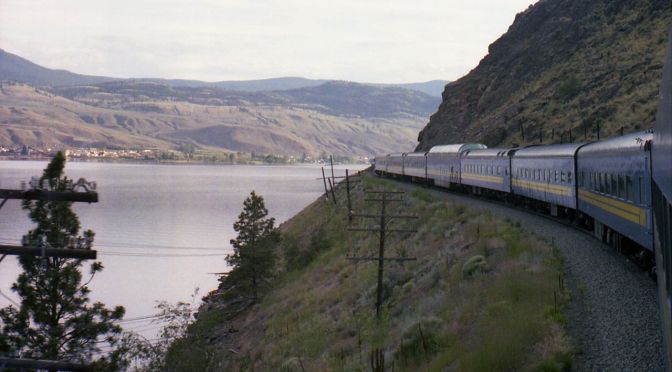
I met a young woman many years ago during an August evening of soft light and liquid shadows. It was during a short stopover heading west on the Trans-Canadian train that ran across the country’s southern portion. I’d boarded in Montreal following a visit with my grandmother in Vermont after a summer travelling the hostel circuit through Europe. I was on my way back for a second year of teaching in a bush village in the upper corner of the southeastern Alaska panhandle. I was twenty-four years old.

/more

Continue reading Trans-Canadian Train

EVOLUTION

Evolution

John Harve

A million years ago today
An oafish ape came out to play_
His friend the monkey saw him there
And asked him why he’d shaved his hair.
“A human being I’m going to be,
an ape not living in a tree.”

CACTUS

CACTUS

John Grey

I wouldn’t recommend the roadside.
And not on such a desert straightaway
where every passing car
kicks up a cloud of dust.

In a ditch of all places
and so small,
your roots get by
on water memory,
your fruit’s
a sun-scorched pebble.

But plants – not even cactus –
ask me the best place to prosper.
Seeds nestle down where they are blown
and try to make the best of it.

Besides, why else would an Australian be
on this highway in New Mexico?
A seed – an adaptation –
you have to believe
you can bear fruit anywhere.


photo by Harry Rajchgot, 2010

Jazz Notes

Jazz Notes

Renee Butner

This chaotic jazz suits my mood
after the frenetic day I had

Heavy on the drums
Brassy cymbals clashing
Piano pounding and lively
Scaling up and down
trying to keep up
with the beat

A lone horn sings out
Edgy and soulful
Leading the session several
golden shimmering moments
before backing off
To allow a bebop
walking bass line solo

Notes wrap around one another
Entwined in a dance
for the auditory sense

Jazz beat lines up with heart beat
I relinquish myself to
the new pulse


photo by Harry Rajchgot, Montreal Jazz Festival, 2016

Oświęcim

Oświęcim

Ilona Martonfi


Sown from the teeth of a birch tree
lashed together she

lives in a graveyard
paints a poem after Auschwitz

using Zyklon B gas
medical experiments

with a bundle under her arms
never took that photograph

the ghost plaint: here
remember the crematoria

living inside barbed wire
armed SS guards.

“Where are we going?”

Those feared as the other.
Those who rode in cattle cars.

Those whose voices silenced
fifty kilometres west of Kraków

Rajiya in the work camp.
Her only possession

a red knitted cardigan,
made by her Bubbe.


photo credit: Dr. Fred Leitner, Auschwitz-Birkenau, Poland, 2012

Iris observes a sparrow at the apex and remembers

Iris observes a sparrow at the apex and remembers

Diane Sahms-Guarnieri


Today, cold December sun streamingly rushes –
bright radiant light downpours the stone wall,
where a sparrow clings in the mist and Iris
wonders what it is holding onto. A flat wall?

No, not entirely, there is a high raised relief
an embossed concrete line which it clings to
in mourning light – much like a Mycenaean
stele marking the borderline between the
world of the living and the world of the dead.

******
Dark-cloud eyes flashed thunder; and lightning
must have struck open her chest because a sparrow
was pecking through the bloodworms of death.

Humble print of the Pietà hung and from
Madonna’s eyes tear-shaped garnets fell like
a broken string of pearls spreading hopelessness
all over the Carrara marble corridor.

Over-stretched leather covering of her heart
drummed out a faint death-beat march. Not shaking
of a rattler’s tail, but a dull-weakening beat.

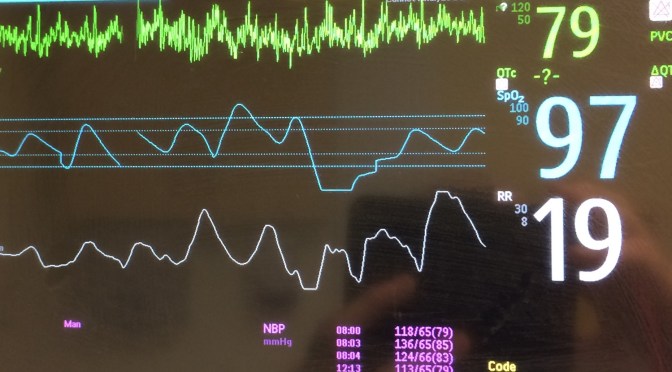
The line on the monitor’s screen flattening.
And there was nothing for Iris to hold onto.

One large lethal tear slid dangerously down
rode over the high horseshoe cliff of her chin
the way a black and white movie once shown

a man inside a barrel riding over Niagara’s rushing
white waters shattering into the sudsy
foaming jaws of splintering death.

The shivering sparrow pressed against stone – Gone


photo by Harry Rajchgot, 2017

James

James

Robert Boucheron


James Pettigrew was the bell ringer of St. Giles Episcopal Church for as long as anyone could remember. Longer, in fact. The oldest members of the congregation remembered him from early childhood.

Clinging to their parents’ hands, they had trooped through the narthex on Sunday morning, glanced to the side, and there he was in the shadows. He stood there silent, straight as a stick, hard to make out in his black suit and dark brown skin. They were afraid of him and curious. Was a bell ringer like anyone, or was he a special kind of person?

James rang the church bell in an alcove off the vestibule. A short, slight man, he pulled down the rope with all his might. Then he flew directly up, hoisted five feet in the air on the bell’s return swing.

“He looks like a monkey,” people said, though they never saw a monkey do any such thing. James’s antique manners and grave demeanor stifled ridicule. Nevertheless, the title of “sexton” seemed overly dignified for a black man. Continue reading James

Love Lessons

Love Lessons

Sue Granzella

In third grade, I learned that the Irish nuns of Saint Apollinaris School were married to Jesus. It was true; each Sister of Mercy, in her heavy black habit that brushed the toes of her sensible black shoes, wore a gleaming band on her left ring finger as very shiny proof.

“But are you all married to him, Sister?” Katie Bickle voiced the question that most of us were thinking. It was 1968, and Sister Mary de Chantal was teaching us about love.

After Sister explained the mystical marriage to us, we learned another confusing truth: the sisters loved each other and Jesus so much that all possessions were owned in common. In their convent, no one could accumulate earthly treasures, as all belongings were shared.

“But what about your glasses, Sister? Aren’t those just yours?” I was certain that I’d never seen Sister Mary de Chantal’s black-rimmed, cat-eye glasses on any of the other nuns. Continue reading Love Lessons

Unclear

Unclear

M. A. Istvan Jr.

She would masturbate to the magazines
that she found behind her father’s workbench.
Shaved bald, the females seemed as young as her.
That made her okay with fantasizing about them.
It was easy—and helpful—to be unclear
about whether she was lusting for those bodies
or was imagining herself to be one of them.


photo by Harry Rajchgot, 2017

Traveler #17

Traveler #17

Jim Cole


By the time he was 46 years old, he had orbited eight planets, and then, finally, they selected him to go live on one for a time.

The blue surface felt like moss. Even through zinc boots and socks insulated with an aluminum alloy that left a rash on the soles of his feet, the planet felt luscious. Stepping onto the surface was exhilarating, as if he were the first to ever touch another planet. And yet, the weight of 300 pounds of gear – those zinc boots, four oxygen tanks, a big helmet they called the pumpkin, a tent made of carbon fiber, a stove, a camera and tripod, a solar battery pack, a weapon slung over his shoulder that frankly he had not learned how to discharge – left no trace. After three steps, he stopped to turn around – a maneuver more cumbersome than his instructors on Earth had warned. He stumbled, started to tip over like a dead oak tree, caught his balance, took a deep breath, smiled at his good luck, and pulled the camera from the pouch on his chest. He was giddy about snapping a photograph to beam back to his home planet, but looking through the lens all he saw were the faintest z-shaped tread marks in the powder blue surface. Before he could turn on the flash and focus again, any hint of his presence was gone. Continue reading Traveler #17

Jalopy

Jalopy

Mitchell Grabois


1.
My father ran aground amidst a naked, barbaric race. The women’s cologne must be distilled from excrement, he and his mates thought. They held their breath. The men’s penises dragged on the glacial ice. My father wondered why he had ever set sail.

2.
With global warming, the glaciers recede like a pack of erections that have simultaneously changed their mind. The Mendenhall Glacier wonders: Viagra or Cialis? I need to assert myself. I need to get back to fucking the world with my cold rod. The world is too hot. Women are supposed to be hot, but not planets. I remember when I was young and stretched out beyond what I could see or be aware of. I did not know myself. All the worse for me.

Now I know myself better, but what I know, I don’t like. I’m retreating from the battle. I’m becoming more frayed and mud-spattered every year. President Obama visited me, and he had tears in his eyes. Then, to take his mind off my fate, he went and watched Eskimo children dance in colorful costumes, big smiles on their faces. They laughed with joy when he got up and joined them in their dance.

3.
I once had a friend who was a microwave oven. She heated up quickly, but had a cold heart. I went to high school with her. We kept in touch over the years.

She married a man because she believed that as he aged, he would grow more and more to resemble his father, whom she greatly admired. But as he aged, he became the antithesis of his father. It made her bitter. Her glass door became greasy. You could no longer see what was inside her.

I talked to her on the phone. I was thinking about all the appliances that I’ve owned that have broken down and I’ve discarded. Continue reading Jalopy

Surge

Surge

Ronelle Hart


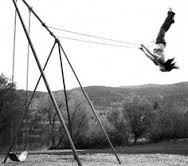
Solitary and slightly apart from my twin sister and brothers and three cousins, I would slip away to the single backyard swing attached to high poles cemented into the earth in my aunt’s back yard. At first I just sat there and swayed, with feet just off the ground, but soon I tipped back to hang on my arms, holding tight onto the chains attached to the seat of the swing with sturdy bolts. From that up-tipped position, I could see the slow spidery trail made by the tips of my hair in soil scuffed to powdery dust by previous feet, the hot sun on my tender throat, in a trance until the heat and hanging upside down made me too dizzy. I would sit back up slowly, to fully feel it: the surge, a streaming sweetness in my stomach. And then I would push up, and up, and up again, my feet hard against the earth and then not, finding the exact rhythm with arms and legs and torso, swinging higher and higher. With each downward swoop, sometimes I’d sing, in my soft schoolgirl voice: “SOME-how, SOME-day, SOME-where..”, my hair, unloosed from its tight plait, a dark warm animal rushing past my face on the high backward push, and dusty from where I let it drag again as I gave my body over to the sway of slowing down.

For a while after, my sweaty palms carried the imprint of chain links and smelled of bitter iron.

Vintage image from Wikimedia Commons.

Tug Hill

Tug Hill

R. Edward Hengsterman

There’s a boy. He does not speak. Dirty blonde and barefoot, he sits cross-legged in space. His arrival is unusual, but I have no fear. So in silence, I wait, until the moment comes when I can’t wait any longer. Then I scream, dance, cry, and laugh – outlandish pantomimes to break his silence, but still he never speaks. This ritual goes on throughout the night.

Then I wake.

Three days ago a boyhood friend died. The news of his death, though not a complete surprise, disrupted my sleep. To be honest, I’m ill-equipped to handle any emotional problems beyond my own. So I keep to myself.

Eric hadn’t crossed my mind in years. In fact, I didn’t realize I’d had any lingering feelings other than a few withered childhood memories until a one-sided conversation with my mother reminded me of the true depths of my baggage.

“Eric’s dead,” she said, “Died at home. Guess I’ll see you at the funeral.” Click. Continue reading Tug Hill

The Kick

The Kick

Cecil Sayre


Strange how a tree heals, its cells diverging,
creating a different path around the wound
for water to flow from the roots to the leaves,
the wound covering over with sap,
becoming a dark knot.

When I remove limbs from these wild trees,
I want them to heal into a dark knot,
but I never know where to make my cut.
Too close to the trunk, the wounds will not heal,
not close enough and new limbs will grow next summer.

Wild trees lined both sides of Ridgeview Road,
the shortcut Bryan and I walked to and from school
to avoid the older kids and their bullying.
We’d talk about our favorite kung fu movies
and attempt their kicks,

feeling we were hard to see in the shade of those trees,
and not thinking how someone could hide behind them.
But my son thinks about that, these trees outside his bedroom,
their branches smacking his window as he tries to sleep,
and for him I trim and cut them.

I hold a limb and work the saw and tell myself
I am holding one of his nightmares
and try to imagine its shadow,
the creature it becomes at night
as I tell myself again I am holding his nightmare.

In the shadows of the trees, walking home,
Bryan and I were arguing about a kung fu movie
and the hero’s amazing kick, one foot rooted to the ground,
the other smack up against the bad guy’s head,
an impossible act for any man, yet one we believed.

Bryan stopped by a large, white mailbox and tried it,
kicking the air beneath the mailbox.
I said, No, higher, and kicked the air above the mailbox,
neither of us seeing at the far end of the gravel driveway
the old man in the doorway of his garage.

He yelled at us, stood up, and raised his shotgun.
We ran, clearing the tree on the other side,
the wind from the shot breezing past my back,
bits of bark and wood hitting my jacket.
One could see the damage done,

a chunk of tree level with our heads, missing,
the wood blonde and bleeding, sticky with sap.
We used to laugh at the idea of anything being dangerous,
would want to touch and explore any wound,
study how it would heal, wait for the crusty darkness of a scab.

My trees now trimmed, I hope for healing,
hope for sunlight to fill my son’s window,
the shadows now dead limbs piled on the ground,
the naked space opened above them among the leaves
an emptiness only memory can fill.


photo by Harry Rajchgot, Outremont, Quebec, 2017


arrhythmia

arrhythmia

john sweet


10 below zero in the first
blinding light of a sunday morning and
they are slaughtering prophets
down on main street

air freezes in your lungs
when you try to scream

woman i love sleeps and
dreams of all the
days before we met

i am too goddamned old to keep
laughing off this pain
that has come to define us


image by Harry Rajchgot, 2017

Under the Eaves

Under the Eaves

Diane Sahms-Guarnieri


Out there on the edge,
under the eaves
of mind’s fringes –
icicle of the past hangs

piercing through the present
a stuck scene re-playing itself,
a record’s needle skipping:
I need money, money to study.

She is speaking to someone whom
only she can see in the curtained
off rafters behind mind’s eye.
The darkness.

The blown out candles, or maybe
there is one, whose solitary flickering
refuses to be extinguished
in the webbed-wing lining of memory.

Late into her 80s, the present
lost as a blackout, yet
clear as a camera lens focusing on
a phantom apparition, her haunting –

tongue caught in ghostly protestations:
I need money, money to study Latin and French
with the instructor, who lives in the big beautiful
house on the overlooking hill –

then the added moaning of letter “o,”
she cannot let go of: O let me have money.
Again and again: O please, I need money,
money to study Latin and French…

as she presses wringing hot hands
along thighs, as if trying to iron out
the wrinkles of her own despair.
The seeing of someone not really here.

But there, where misfired thoughts live on
in the occupancy of haunted rooms.
This place – vacant to everyone, except
she – she who needs money,

money to study…
O’ please let me…
O’ let me study Latin and French
O’ please…please…

Voice drifting off into summer’s haze
flapping into cave of eternal night
exhausted she sleeps upside down, wings
curling in around, a delicate and boney body.

Neighbors

Neighbors

Eric Smith


My family had been in the neighborhood five years when Robert Aronson started the Belly Button Country Club. Robert, the only adult in the neighborhood whom every kid called by his first name, lived next door to us with his wife, Nan, and their two kids, Charlie and Elly. Like streets in every suburb that bloomed after the war, ours was a bare vine at first, houses growing up and down its length like fast appearing fruit. The Davies house went up on other side of the Aronson’s, the Roses’ on the other side of them, the Haskin’s house sprung up across the street. All modest homes compared to those in an older part of town, a section between us and the bay, where stately structures stood veiled behind dense shrubs and spreading oaks. We, too, planted trees and shrubs and built fences along property lines on our block but our fences were always partial, with openings left between us and our neighbors. A dirt path went around our chain-link fence to the Aronson’s where Robert laid down planking to keep us out of the mud. The redwood fence between the Davies’ and the Aronson’s had a gate that was always open, shut only by the wind. Moving freely between home and the homes of friends, we all eventually ended up at Robert’s. Continue reading Neighbors

Secrets of the Boardwalk


Secrets of the Boardwalk

Ron Singer


Last week, Amy, a close friend of ours, told Joan, my wife, that she was worried about Bob, her husband. On two consecutive days, he had uncharacteristically wandered off on his own. The first morning, out of the blue, he had announced his intention of taking the subway out to Coney Island “for a walk on the boardwalk.” Since they normally go to C.I. in tandem, and since she had to work that day (Office Manager for a law firm), she urged him to wait for the weekend. But he refused.

The next day, he went again. That evening, as they were having dinner, his nose red from the spring sunshine and the depleted ozone layer, he made a speech that she interpreted as a semi-confession. Or, as she put it, “His sunburnt nose kept getting longer.”

Joan, who has a practically phonographic memory, quoted Amy’s account of the semi-confession: ‘’’ “ ‘Boy, you wouldn’t believe the characters you run into on the boardwalk these days –junkies, winos, Three Card Monte sharps, restaurant touts who practically mug you. I even saw a couple of teen-aged prostitutes pretending to be fortunetellers! They had a card table, costumes, the works. Can you beat that?’ “ ‘’’
For Amy, the last part had been the kicker: “ ‘The way he described those girls, the look on his face… furtive… I smelled a very big rat!’ ” Continue reading Secrets of the Boardwalk

PASS/FAIL


img_4323


PASS/FAIL

Janice E. Rodríguez

When you’re a child, you’ll believe anything—that Santa Claus has a giant warehouse of wrapping paper so his gifts match the ones at your house, that parents are infallible, and even that school is a haven for clever students.

The mile between Rhonda’s home and school had grown longer as autumn progressed. The maples that stood like sentries along the grounds of the state hospital were bare now, and a fragrant detour into the crunchy windrows of leaves added five minutes to the daily journey. The less pleasant reason for dawdling appeared beyond the last maple—the swarming migration of students into squat, red-brick Lafayette Junior High.

Rhonda waited at the crosswalk, wishing the light would never change, knowing it would. She eyed the sign plastered to the lamppost, “Nixon, Now More than Ever,” and smoothed down a curled edge. The first bell rang; the light changed.

Time to run the gauntlet.

Continue reading PASS/FAIL

A Gypsy Melody


A Gypsy Melody

Christopher Conley

Buppy died on his 87th birthday. You could call the timing his final joke, but I can’t imagine anyone besides him was laughing. After Buppy (my grandfather) died, I wrote a story about him. I wrote it to keep the memory of him. But the result was a mishmash of memories splattered onto a blank canvas; there was nothing artistic about it. The story is like a key that didn’t fit in the lock it was supposed to open, and now I need to go back and fix it.

When he was still alive, I would usually find him in his kitchen sitting in a chair at the head of the table next to the “rubbish.” Or I would find him in his padded, blue rocking-chair in the living room. He wasn’t heavy-set, but rather, a grandfatherly weight — he definitely wasn’t thin. He had a long chin, white hair (that often sprung up in the air from the ocean breeze outside), and a tucked-in jaw. He always looked like he was sucking on his teeth, which might have just been the case. As a child, one of his eyes was blinded because it was hit by a baseball. The problem with his eyes was that you could never really tell which one was blind, so you could never tell if he was looking at you, someone else, or just nothing. Sometimes I would find him reading the newspaper, hunched over it like a scientist, using a curled up fist as a sort of binocular-type mechanism. But since he was only enhancing one eye, it would be more of a monocular-type mechanism. And in the end, he wasn’t actually enhancing anything. That’s how I remember him: a grandfatherly sized man who sucked on his teeth while thinking his hand could enhance his vision.
I only knew him when he was in his 70s and 80s. Sometimes he would walk around his house shouting, “Hoh Gyp-sy Mel-o-dy!” My mother figured out it was a misinterpretation of the song, “Rock-a-Bye Your Baby with a Dixie Melody.” Buppy had that strange tic for as long as I can remember. Hoh Gyp-sy Mel-o-dy! It followed him like a bell on a cat’s collar.

I’m actually not sure if I can say I knew Buppy all too well. My cousin Jake knew him. He knew him because they both lived in Boston, because they went fishing together, because Buppy could go to Jake’s hockey games. My cousin Joe knew him too. Because they had dinner once a week, because Joe would make him laugh. I would see Buppy on holidays or birthday celebrations, but that was about the extent of our relationship. It was more of a, shake-his-hand-hard and look-him-in-the-eye (hopefully the good one), say you’re happy to see him, throw in a Merry Christmas or Happy 4th, then watch what he does kind of relationship. I probably knew him better when I was younger, if that’s even possible. When I finally started remembering memories, Buppy and I didn’t really talk much — it was mostly just formalities. He listened to me, and I listened to him, but we didn’t always hear each other the same way he and my other cousins heard each other.

His one blind eye and the gypsy melody have always stood out to me. Sort of like when he would bang the kitchen table with his fist, or when he would call my mother homely. I cringe when my mother asks, you don’t remember that time when we did such and such with Buppy and when she says of course you remember, even when I don’t.

When he turned 80, Buppy started writing down his life stories. My cousin Britney compiled, or rather, transcribed his narratives into a book when he died. She said it was difficult because Buppy’s handwriting wasn’t very good, and neither was his grammar. He wrote all of them down on loose leaf paper — then he stored them away in a box. Britney was eventually able to copy his stories; she just guessed words and phrases every once in a while. He wrote 38 stories, along with a song and a poem. The one story with me in it was about a New Hampshire fishing trip. My brother Kevin might remember the day in New Hampshire, but not me. I sort of remember. There was rain. Thunder and lightning. A tent. And catfish. Buppy remembered. Here’s what he wrote down, or at least, what Britney was able to salvage from this particular fascicle:

Another trip that I am going to tell you about is – by the way, when I say trip I mean fishing and camping trip – when I went camping (also fishing) with daughter #1 and her two sons which happen to be my grandsons. Things happened that could have spoiled everything but turned out okay in the end and a few of these things are as follows. The biggest thing was the tent, which was brand new. It rained (cats and dogs) that night. I never remembered it raining as hard as it did that night, or maybe it was because of the tent, leaking like a sieve, and I mean leaking. There wasn’t a dry spot anywhere. But no one was complaining and we got through the night.

We ended up fishing the next morning and the boys caught a lot of fish (trout I think). We played cards, and later on we played ball. Playing with the boys is fun because they caught onto the game real good. Poker is the best game that we play and Kevin is the luckiest so far. I tell him, if I had his luck, I’d move to Vegas and lately I’ve been asked by Christopher, “Hey Buppy want to play some cards?” So we end up playing a few hands. Thank God the summer is coming, as we get together more often. The winter, they have school and things, as you know.

I always thought it had been catfish and not trout, but maybe we caught both catfish and trout. Sometimes while reading his story I feel like I’m fishing for the concrete memory. It’s in the water somewhere swimming around, avoiding my fishing rod. I can’t remember the last time I actually caught a fish — probably the trout or catfish in New Hampshire — so I wonder if I’ll ever get this memory to bite.

* * *

In another one of his recorded stories, Buppy was going to the hospital to visit Uncle Joe, his brother-in-law and fishing buddy. Before he went to the hospital, Buppy bought frozen fish. He unthawed one outside, then grabbed a rod and stabbed the fish through the hook. Him and Nana walked into the hospital in this fashion; a small, old woman dressed in church clothes with a nice purse and high heels, and a large, old man wearing fishing gear, holding a rod with a fish attached. People gave them strange looks in the hospital’s elevator. Nana just told them, “Don’t ask.”

When they got to the right room, Buppy took the fishing rod, handed it to Uncle Joe, and told him to reel the line in. Uncle Joe, who was weak but still functional, did his best to rotate the fishing reel. Buppy recorded the moment in his collection of stories by simply saying, “in came the fish sliding across the floor and a smile across Uncle Joe’s face.” He never told me about this story, but I like this one the most. At the end he doesn’t give any grand conclusion. All he wrote down is, “I thought I did what I started out to do.”

My Uncle Pete presented Buppy’s eulogy at the funeral; he talked about how he was a jokester. He hid under the stairs and popped out to scare his children. He would sneak something disgusting in someone’s food. And after each joke, he would wink an eye — whether it was the blind one or not, we had no idea — and chuckle to himself with his arms crossed. Then, right on cue, he would sing, Hoh Gyp-sy Mel-o-dy!

I saw my cousin Jennifer crying when she walked outside of the church. I asked her if she was okay, and she nodded her head. Then she said, “When we were walking out of the church I lost my balance for a second and stumbled backwards. It must have been Grandpa’s fishing rod.” She wiped her eyes with a tissue, then smiled. “He got me hooked by the shirt and pulled me back. It’s like he was reeling me in like a fish.” She laughed and I laughed and I told her I’m sure it was him who yanked her back. Just like how it wasn’t just a coincidence that after he died, my mother would find coins in random nooks and crannies of the house. It was him, of course, keeping my mother on her toes.

I wish that I had almost tripped while walking out of the church. Or found a quarter. Or felt something out of the ordinary. But when I try to think of a conversation I’ve had with Buppy, or a story, there would always be someone else there.

Weeks after the funeral, we spread Buppy’s ashes on the Atlantic Ocean, his favorite fishing hole. We sailed out on the boat his kids bought him a few years before he died; they named it A Gypsy Melody.

My first time on A Gypsy Melody with Buppy was my last time. He sat near the back of the boat with his fishing rod, and I sat on the front with sunglasses on. My brother learned how to drive from Uncle Pete. My mother made too many sandwiches. Buppy didn’t catch a thing, and I don’t remember much after that. I have a picture of me on the front of the boat with my backwards Red Sox hat, a picture of my brother steering the boat with Uncle Pete, and a picture of Buppy sitting on a beach chair, fishing for water — a determined and yet stoic look plastered on his face.

The water was gentle when we spread his ashes. We reached an open space and the boat rocked back and forth— steadily, slowly — and for once my lively family was silent. I’m not too sure what Buppy would have thought of the scene. He probably would have found it too sentimental. I was waiting for the boat to capsize. Turn us over, I thought almost sarcastically. It felt like a dare. Everything was still — the wind and the waves, gentle. A small gust. Nothing. A seagull’s cry. Still nothing. A ripple in the water. Silence. Turn us over.

It was uncharacteristic of my family to share a moment without sound. No jokes or banter; reverence to the dead. Goosebumps covered my arms and legs either because of the wind or the hush. We released Buppy’s ashes in a box that floated a while, then sank as water made its way inside. We all watched. It bobbed up and down with each wave and grew smaller each fleeting second. I leaned over and stuck out my hand; a wave splashed against the side of the boat and water sprayed onto my face. Ha, good one.

Waves pummel the side of the boat, and I feel the water spraying rapidly onto my face. The water starts to envelop my body, plunging me downward. Immersed in the vast ocean, I let myself sink. Under the weight of the waves I hear another seagull cry. I fall deeper in stillness. I descend until I stroke the slimy floor, grazing the sand with my feet. I wriggle my toes in the cold sand. I shove them deeper, twisting and turning, left and right, up and down. I try to break through, even momentarily, to the other side — hoping there is another side. I want to know how it feels. I press against a harder layer that won’t budge. I twist my toes faster. The other side is locked, shielded from the dense surface. My toes can’t fit themselves through, and yet I twist in vain.

Turn us over, I think again. I jiggle and contort my toes left and right once more while A Gypsy Melody cruises peacefully, safely to the shore.

Off the Track

IMG_1416.JPG

Off the Track

 Mark Trechock


At Creel we paid the two pesos

to see the woman living in a cave

the way her ancestors did,

soot on the walls, darkness and wood smoke,

newborn in arms and the older boy

running and running in circles.


We caught the train west,

saw the chasm at Barranca del Cobre

through the charcoal smoke of taco vendors,

bought a basket made from branches,

as supple and fierce as human thighs.


Back on the rails, we stretched

our heads from the platform between cars,

the wind remaking our faces

into shapes we could only imagine.

We thought of the Tarahumara,

somehow immune to the heat

running barefoot through the desert,

scaling the hot clay inclines,

keeping up with the deer.


Approaching the trestle we slowed

as if coming upon an accident,

but below, among the pines,

near the bottom of a vertical world,

the coach cars had lain for years,

positioned like disjointed limbs,

undergrowth pushing through their frames.

The Sister Between

The Sister Between

Laurinda Lind

She is like a strong
breeze layered in
sheets over old shale
& even when free to
flow she’s still brittle
& though young she’s

strung between her
head in the sky & her
feet on a line drawn
in the middle of a
road laid over a land
not yet geologically

dead to make it real
she needs to feel she’s
more solid than air yet
lighter than secrets
she’s stashed deeper
down in the strata.

In the Beginning

In the Beginning

Will McMillan

I’m a 30 year old man, and for the first time in my life I’m going on a date with another man. His name’s Jason, and we’ve been chatting on OKCupid for almost a month. From his online profile I’ve learned the following things about him: he looks a little like Peter Brady from The Brady Bunch. He’s into fantasy, and his favorite movie of all time is The Never Ending Story. Aside from the Peter Brady similarity, it’s that last part that got me interested in reaching out to him, since The Never Ending Story is one of my favorites as well. I figure anyone willing to list that in their profile is probably someone that won’t terrify me.

From my online profile, Jason learns the following things about me: I love writing. I love science fiction and can fire off a Star Trek quote as easily as I can pull air into my lungs. And according to Jason, from the pictures that I’ve posted, he learns that I look like Egon from The Ghost Busters. I decide to take this as a compliment.

What Jason doesn’t learn from my profile is that just two months before our online introduction I was a devout Jehovah’s Witness. He doesn’t learn that the discovery of my gay oriented browsing history via a borrowed laptop lead to my subsequent disfellowhipping and expulsion from my congregation. He doesn’t learn that while in writing I say that I’ve been “out” since I was 21 that, as far as my public image is concerned, I’m still very much “in.” Jason doesn’t learn I’m desperate to find a way to replace the faith I’ve betrayed with what will hopefully become faith in myself.

I’ve asked Jason to meet me for lunch, and he’s agreed.
We meet on a frigid Wednesday afternoon and in person he looks less like Peter Brady than I thought. He’s wearing the sort of cap that I associate with train conductors, with a long black Pea coat and skinny fit jeans pegged at the cuff. When he says hello to me I’m caught off guard by the pitch of his voice, which is high and effeminate. We’ve only ever communicated through instant messages and texts, and until now his voice was my own invention. There’s no getting around it-Jason is full tilt gay. He’s gay and I’m shocked that rather than being self-conscious about it, than being like me, he’s self-assured and relaxed. As a Witness I’d trained myself to avoid people like him, well aware of my tendency to pay a little too much attention, to watch a little too closely. I can be as interested as I want to be now, but as Jason talks I can’t help but take sneaking glances, looking to see if anyone is staring at us. I notice Jason’s posture, which seems deliberately proper, and do the opposite. I slouch in my seat and widen my legs to appear visibly sloppy. The Witness within me, the straight man, demands that I set myself apart and my ingrained insecurity forces me to comply.

On those rare instances I actually went on a date with a witness girl, I would be the one to lead the conversation. With Jason I’m content to let him do the driving, and as we eat, we talk about movies, about tv shows, about songs we like. I can admit to liking Madonna outright, not just a few of her songs. I can mention how “Will and Grace” is only as good as the scenes that Karen appears in. I can admit that I watch “Will and Grace.” I can begin to be myself, if only in small doses. Listening to him, I can’t help but wonder if Jason would be he who he is now if he’d been raised a witness, if something within the fiber of his integrity would have rejected the church outright rather than allowing it to reject him. I wonder what that would feel like.

“It was nice meeting you,” Jason says at the end of our lunch, and leans in for a hug.

“You, too,” I reply. Even the brothers in my congregation hugged from time to time I reason, so a hug doesn’t have to imply anything I don’t want it to. Jason tells me to enjoy the rest of my day and walks away, stopping for a moment to pry a frozen leaf off of the ground. I’m not ten minutes away from him when I get a text. Would I like to hang out again?
I let Jason make our plans for our second date. “CC’s. This Saturday. What do you think?” CC’s is a club. A gay one. Everybody, even Jehovah’s people, know this.

“I don’t know, maybe.”

“No maybes. It’s CC’s for us on Saturday.”

I meet up with Jason that Saturday night to discover that he’s brought a few of his friends along. Checking our ID’s at the door my anxiety is palpable, a scent lingering in the air, and one of Jason’s friends picks up on it. “Are you sure you aren’t a breeder?” he asks.

“No!”

I can’t see the look on my face, but judging by the tension in my jaw, I’m sure it’s not a good one. Less than a novice to gay terminology and slang, I assume nonetheless that my sexuality is being questioned. Lying about my sexuality is a language I speak fluidly, and I find myself grasping for words and phrases to use as I attempt, for the first time, to speak the truth.

“You sure seem like it,” Jason’s friend continues. “I think you’re a straight guy.”

“I’m not.”

“Straight guy. We have a straight guy here.”

Jason rolls his eyes, coming to my defense. “God, just shut up and leave him alone. Fucking queens.”

I drag my feet walking in, making a point to be the last one in the door. Being suspected of homosexuality was deadly within a congregation of Witnesses, and I wonder: within a congregation of gay men, were heterosexual suspicions just as deadly?

The music inside of the club is overwhelming to the point that, placing my hand on my chest, I can’t feel my heartbeat. The lighting is strobe like and it’s impossible to move without bumping into or being bumped by someone. Men are kissing and holding hands and I don’t last long enough to finish the drink Jason buys for me. As much as I want to, I can’t handle all of the freewheeling homosexuality, and I bolt outside. Jason follows, and is kind. “Too many fags trying to act fabulous can get to me, too,” he says, lighting a cigarette. I laugh, but it’s nervous. Was it an insult when gay men referred to each other as fag, or a term of endearment? And what does it mean that Jason feels comfortable saying that to me?

Over the next month we have several more lunches together, after which we either go to the movies or simply hang out, and it feels like friendship. Once I tap his leg to signal his attention, but aside from the hugs goodbye, it’s all the physical contact I permit. My inner Witness, though subdued, still insists that I keep things proper.

Jason is texting me after one of our lunches and it’s innocent enough. What am I up to? How’s my day going? I reply quickly until Jason sends me a text that stops me cold. Am I his boyfriend? “I’ve been calling you that to friends,” he texts. “Is that okay?”

I want to text no, that it’s not okay. We aren’t boyfriends. We haven’t even kissed. How are we boyfriends now? I stare at my phone, at the smiling emoticon he’s attached to that last message, my breath a prisoner in my lungs.

I tell him it’s okay.

Now, Jason holds my hand in public. If we’re alone I’m alright, but if people approach I find that I have to sneeze or scratch my head and wouldn’t you know? That always requires the hand that he’s holding. When he kisses me, I try to kiss back. Sometimes it makes me happy to kiss him. Mostly though, with my eyes closed and his lips on mine, I can’t help but wonder what the Elders in my congregation are thinking about me. I tear myself apart using the words I imagine they’d be using. Faggot. Sodomite. Monster.

“Your heart always races when we kiss,” Jason says. I’m flooded with guilt whenever we’re together now, certain that God has turned his back on me. I beg forgiveness from my creator and mercy from myself. A month after asking if we’re boyfriends, I call Jason and tell him I need to see him. “Please don’t hate me.” I say it again and again as we walk together, mustering all my strength to do something so weak.

“Please don’t hate me, please don’t hate me…”

“Don’t give me a reason to hate you and I won’t,” he answers.
And so I begin the “it’s not you, it’s me,” speech, and even though it is me, I’m too embarrassed to tell him why. Because I’m not used to being honest with myself I have no idea how to be honest with him. I offer little response when he asks for clarification, and rather than listening to me evade his questions, after 15 minutes of my rambling Jason leaves. I attempt to comfort myself by thinking that at least I’ve done what God would have wanted me to do, but the teeth of my conscience bite down on this thought as though it were made of metal. As he walks away from me I have a suspicion that Jason is crying, which only makes me cry harder, though neither one of us is feeling much pity for me at the moment.
I’m a 30 year old man who’s trying to repair the damage of a lifetime of self-loathing. I’m a 30 year old man who’s finally had the passport to cross into his true life granted to him but is too afraid to consider himself a citizen. I know that eventually I’ll cross over, slowly learning the customs as I go until, maybe, I’m indistinguishable from the natives, and where perhaps the God worshiped there will be kinder than my own.

Mammogram

MAMMOGRAM

Ruth Z. Deming

To please Dr Cynthia
I said I’d get a
mammogram, controversial
though it is.

The Mary Sachs Breast
Center right around the
corner fit me in
like a lost library book
assuming its rightful
place on the shelf.

Judy was my dark-haired
host. The all plastic
machine was a marvel
with Plexiglass shelves
that lovingly bore
down on each breast.

They seem to get bigger
with time, I said, making
polite conversation, to her
no reply

I helped her lay each
pliable fish-like
appendage on the
shelf, arm clasping
balance beam
and chin held high
like a Tolstoy princess

Then held my breath
one two three
one two three
until Judy, who
smelled like
Febreze, told me
to relax, like a
stiff soldier, and
finally bade me go
home.

Come round to my
house on the upward
slope of Cowbell Road.
No one feels my breasts
anymore. Let’s get
acquainted. What kind
of foods shall I
pleasure you with.
Perhaps later on
you’ll make me feel
like a college kid
on my first date.

So I’ve Heard

IMG_1832.JPG

So I’ve Heard

Barbara Ruth

It was fated that we meet
that we stop and speak in passing
that I reveal to you the softness
of my velvet wounds of sorrow
my mirror eyes.

And I came to dwell with you
and you showered me with jewels
you fed me what I did not know I hungered for
As you learned to dodge my mirrors, as you disciplined
your hooded eyes.

In return I showed my sign
then extracted vital essences from arteries unopened
taunted, haunted
finally caught you
in elaborate deception.

This is the way they say you’re telling it.

Kale Salad

2014-12-11 17.52.27.jpgKale Salad

Thom Young

she loved punk rock
and putting
cigarettes
out
on her arm
when she
was drunk or bored
which
usually was on Tuesdays
in her flat
making
a kale salad
for uninvited
guests.

Between Detroit and Chi-town

2016-09-15 14.37.24.jpgBetween Detroit and Chi-town

Barbara Ruth


Dear Bob,

Happy birthday, son. I’m sure this email comes as a surprise.

I can’t really tell you much about where I am now Is it heaven? Hell? ‘m still trying to decide. I pay attention to the lives of my loved ones on earth, so when you’re happy, I’m in heaven.

I know you’ve been wondering about that story, my claim to fame. Why did Barb know about it and not you? How come you hadn’t heard that story every time a new person walked in the door who I could convince to sit down and listen? Why didn’t your mother mention it?

Barb only knows about it because she woke up when the phone rang. And that nosy girl stayed up to find out where I was going in the middle of the night.

Here’s the whole story: Ron the bartender called me around 10:00 at night. As you remember, Constantine was a very small town. Of course the bartender in the main bar on Main Street and the school’s only band director knew each other. We were the only Kells listed in the phone book. I knew if he called that late it was going to be important.

“Kell, you’ve got to come over.” My first thought was some former student of mine had gotten himself too drunk to drive home and Ron couldn’t think of anyone else to call. I was figuring out some response to that when Ron continued,

“There’s someone here you’ve got to meet. Come as soon as you can. If you don’t, you’re going to kick yourself for the rest of your life. And bring your horn.”

I told your mother what Ron had said to me. “Are you going out, at this hour? You have school tomorrow.”

The only excuse I had was my curiosity. “You don’t want me kicking myself the rest of my life,” I told her. “It’ll make it awfully hard for you to sleep in the same bed with me.”

She sighed and went back to her book in what I decided was a friendly way. “I’ll try not to make any noise coming or going, even though Barb won’t be asleep yet.”

“She’s a night owl, like her father. She’ll probably try to convince you to take her along.”

“And then Bobby will have to come. I think I’d better leave before I’m taking my whole family into a bar at 10:30 at night. Although that would keep the faculty lounge buzzing.”

“Good night, Dick.”

Sure enough Barb was still awake, standing in the hall in her polka dot pajamas. “What time is it? Who called so late?” Nine years old and she had her mother’s inflections down pat.

“Everything’s fine. Don’t talk so loud, you’ll wake your brother. You should be sleeping too.” She was in her foot-stomping, eye-rolling phase then. She stayed in that one quite a while, so you might be able to picture her dramatic return to her bedroom.

This was when we lived on Canaris Street, not so far from Ron’s Bar. I figured if I was going I might as well take my clarinet, as requested. When I parked the car I looked at it and hesitated. “What the hell?” I tucked the case under my arm and made my way into the bar.

Ron saw me right away. “Kell!” he shouted. “Over here.” He waved me over to one of the few booths and joined me there. Three Black men in expensive overcoats looked up from their drinks. “This is the guy I was telling you about,” Ron continued, turning to them. “Dick Kell, our local band director.” He looked back at me. “Didn’t you used to play in a band?”

I hadn’t even ordered a drink yet but I felt like I’d knocked back half a dozen. Louis Armstrong sitting in a booth in a bar in Constantine Michigan! I didn’t know who the other two gentlemen were, but there was no mistaking THAT face.
Turns out they were his driver and a guy who played trombone. I was embarrassed I didn’t recognize the trombonist’s name. “My guys – band and road crew – we’re traveling in three cars,” Satchmo said. “The others went on ahead, but the three of us decided to rest a spell. We figured if the whole crew stopped in here it might be too much of a good thing.” We all laughed.

I admit I was no stranger to Ron’s establishment. And I had never seen one of the local Black guys in the bar. “You’re probably right,” I said. “There’s a limit to how much jazz Constantine can take on a weeknight.”

All three of them looked beat. Their laughter was filled with fatigue. Maybe they liked my joke, but I think they were just being polite. They were nice enough to ask me about my music, so I told Louis Armstrong I played a little swing in college, no big deal.

“I know the barkeep told you to bring your horn. Let’s see what you got,” Satchmo said. Before I could answer he continued, “My baby’s right here beside me.” He lifted a cornet case, beat up worse than the one you had. I guess his had seen a lot more miles. From it he lifted a beautiful horn, a Selmer-Challenger cornet. “Go ‘head. You can hold it.” He reached it out to me and I took Louis Armstrong’s cornet in my hands, thinking back to my swing band days, being on the road, admiring some other cat’s horn.

Ron brought me a much needed drink and I took out my clarinet and we played a little, right there in the bar. Ron kept saying “Look! That’s Louis Armstrong! That’s Dick Kell playing with Louis Armstrong.”

The odd thing was, none of the customers seemed all that impressed. They glanced at us, then looked back in their shot glasses for the answers to the questions of their lives.
We played “Ain’t Misbehavin’” and “String Of Pearls”. He let me pick the songs and we started in unison, then he harmonized, then improvized while I plugged on.
I tried a few adventurous turns and he took the melodic line, nodding encouragement. I was nervous he’d start scat singing and I’d forget what key we were in, but he didn’t and I didn’t either.

They’d played a club the night before in Detroit and had a recording date the next day in Chicago. “I love Chi-town,” Satchmo said. “Best ribs outside of N’awlins.”

Those guys were so polite. I think they would have closed the bar with me and Ron probably would have kicked out the other patrons and let us stay all night. But I felt sorry for the three of them, making chit chat with a high school band director in a one traffic light town, when all they wanted was to get some rest. There was no hotel in Constantine, at least not in 1955. I worried they’d ask me about a decent place they could stay the night, where there’d be no trouble. But they probably realized I wouldn’t know the answer to that question.

I told them the wife was probably waiting up for me.

Satchmo rolled those eyes of his. “Oh man, I know how that is. You best be getting on home.”

When I tiptoed into the house, Barb came running to the door. “What happened?” she asked, her own eyes wide.

“I just played with Louis Armstrong.”

“You did not. You just stayed out late on a school night and you’re trying to get away with it.”

I didn’t know whether to laugh or shake her. “I’m the parent here, not you. Go on to bed now.” She gave a big sigh, just like her mother. I thought she went to her room, but she must have heard some of my conversation with Evie, who’d fallen asleep with her book on her lap, her glasses still on her nose.
She startled awake when I came in. “What happened?” she asked, like an echo. “What time is it anyway?”

“A little after midnight. What a night!” I started in, ready to relish the night again in the telling.

“What do you mean you played with him? You played music? You mean you went somewhere and played along with a record of Louis Armstrong?”

“I mean I went to Ron’s Bar and met the actual Louis Armstrong, one of the greatest jazz musicians of all time, and he invited me to play music with him.”

“How many songs did you play?”

“Two. They each lasted a long time.”

She didn’t seem all that impressed. I guess she just wanted to get back to sleep. One of the highlights of my musical life and I didn’t have anyone to appreciate it.

Neither your mother nor your sister said anything about it at breakfast the next morning. You were four at the time. I didn’t think you’d give me the reaction I wanted. I expected to hear about it in the faculty lounge or around town. Surely Ron would be telling the story for years.

Maybe he did. He certainly told me about it every time I went into his bar. But I already knew. And nobody else seemed to care. I did tell a few cornet students over the years. You remember Junior Bixby? I told him.But I didn’t want to face more disinterest or disbelief so aside from those few I knew the story to myself.

I should have told you when you were ten or twenty or maybe fifty. I realize you would have liked to hear about it, and from me. Well, now you have.


Love you always and happy birthday,

Dad

The Chronicle

The Chronicle

Chris Macalino


I’m going to start with the grape… This note took a while because I was afraid that I’d be wrong about The Chronicle. I knew the produce this year would yield the sweetest fruit and so I tested this theory. The nearest fruit I had available was at home and yes, they were just right. When I took that piece from my kitchen fruit bowl, I whispered in excitement, “It’s possible…”

Maybe I just felt drawn to the possibility of The Chronicle, knowing something not everybody would, a newsworthy story just popping up. So I brushed off what hesitation kept holding me back and jumped at the chance to learn something: The only thing to fear was agoraphobia. This realization motivated me to liquid courage.

The next grapes I caught were at my nephews Christening, it was summer in The Children’s Museum at The Forks. I worked up a thirst and the fruit took me; they were marvelous. I became certain that The Chronicle was a miracle with size and grandeur. I nearly hogged all the berries! Thinking back, it really wasn’t even summer, it was actually before or after beach season. It sure felt like summer because they were so damn’ good.  I got a little intoxicated by their flavor.

My cousins and uncle were there too, we found our way at about two minutes beyond the parking lot. The location held a discovery, an out of sight nursery of fruit trees. I guess a chapter of growers had a roll to show everyone an orchard of a new friendly variety. I promised myself that when these trees began to bear fruit, I’d let them be and then there will be enough for an entire party.


(A great art critic can literally predict how a painting would taste, simply by the colors of the materials used on a panel surface. This dates back to the alchemical presence of organic and mineral parts for making paints. Egg-yolk was always used for yellow and egg-whites were saved for other colors. Egg-shells made amazing blues and flowers were quite remarkable for hot and warm colors like orange or redZests, saps, nectars, and mosses were also used for bases when creating a whole palette.)

The color of grapes varies with its exposure to the sun; similar to apples, peaches, and pears. One cheek of the fruit may appear darker or lighter compared to another side of the fruit. The skin of the grape is also very different from its flesh / the inside of the fruit / some refer to these very sweet parts as “treasure”.

The different parts of a berry (which includes the skin, the treasures, and seeds) are made to take in the elements: We have’ natural sources like water moisture, rain, and wind. We also have the periodic elements from beneath the soil which tend to rise-up chemically and affect the berries. Then there is The Sun and its rays, shining down these grapes for our vintage… The best wine just feels brilliant, to think they’ll be remembering all of this year each and every time we have this kind of Chronicle. It might last an eternity.


Some of us are new beginners in The Chronicle – the slang term for a new beginner is newbie. Speaking of winemaking, I like to think of that as related to “new berries”.

I can’t tell the name of the first wine that I had for 2015 but I remember it was white. There was a new section at the grocery store, the addition of a Liquor Mart. The clerk had mentioned the reds would arrive during November. So I went to the next Liquor Mart just to see if there was more I could learn. She was right! All the 2015s were white.

My University training came in handy that day… I was dreaming of cellars, body mechanics, and how a lot of adolescents would spend their time learning subjects in these kinds of places. They would bend their knees with enough balance to sustain minutes, holding a stance to read the right wine. I imagined Picasso must have started his career in cellars, then when he completed training, became the best in the world. I’d like a bottle from that period.

This Christmas, I found the first red wine I could afford. It’s from Australia with the name of a marsupial on the label. The clerk said I had to wait three years for the 2015s to come in… That was the good news, it’s true that it will be awhile. (3+ years is just enough time to heal.) It almost feels like everyone who might know about The Chronicle is like a friend or a drinking buddy from another galaxy far from my perch at The Inn.

An article on the topic did post statistics that most of the vintage would be consumed in the year it’s produced: This proves one year is preceded and followed by many years of skill and soul searching.


I wouldn’t call it a perversion but I believe that all bottles should literally have a ship inside of them. One could drink the bottle then keep it as a work of art! They could do all sorts of fantastic things with bottles and modern technology like make them bigger and fancier. This ship-in-a-bottle-wine could be made entirely out of glass… shipbuilders could retire at vineyards. Truly, I believe physics makes anything possible like sharing as an option.

I once thought that opening an old bottle and pouring it down the ground through a filter was a neat way to free a genie. Enjoying a drink was supposed to be a wish come true but all I’ve ever wished was to be is a great artist* There are different kinds of artists and I just want to be one of them. I’ve tried everything from helping to working and teaching but alas, it never continues for very long. Something always cripples my brain or breaks my heart. As I write this, part of me worries about being a “Fish” like the inspiration for Moby Dick or Old Man and the Sea.

I’m scared to think that people around would learn about my drinking and perversely novelize me as some kind of vampire. The great writers stopped doing that ever since Romanticism and Herman Melville’s period and also Ernest Hemingway’s adventures. I suppose Jung said it best – that fear comes from a psychological instinct -where wine has a cognitive irrational association with blood – and the oxymoron of wine as blood gets mythologized into vampirism – then subversively through the universal insight of The Surrealists we get to their point of wine good, “Ahoy!” We’re saved for it takes a good man to feel drunk off wine.


I’m just an uncle which means I’m not responsible for anyone but myself… and of course I know this is not true in light of individuality. Even in my failure, I still know there is a responsibility large enough for me to care about, to keep up with, and fulfill any promise of talent in my family.

I’m partly-responsible for my nieces, nephews, godchildren and those I take under my wing. I’m supposed to be the guy who teaches them how to control their drinking, and be careful of over-eating, or at least figure out a way to explain why life is a dream! I always have to be around to tell them that their problems can be solved. “Whatever vices they have must be lead to virtue.” Kind of like sex: It’s a biological need to make love but it’s also a matter of ecology to refrain from being The One.

There has to be somebody out there who could do the math… (One row field at the country vineyard could amount to one bottle. Then all those grapes are used to make wine, and after a period of time, wine is mixed in with other wines to produce a vintage. Soon, it will be bottled up and ready for logistics.) There’s still an opportunity to go to those fields and sunbathe, feel the ecstasy of being free then years later remember the brightness of those summer days. Count the rows their length and width with height, show yourself the theorem for The Chronicle. It’s an event for the ages, there’s a party and everyone is invited! It’s re-materialization as in “Remat” which is the belief that heaven can be described: like how particles or light waves and magnetic fields can make electrons into photons that can form into beings who are similar to our shape… It’s closing time?


On the Crossing of Streets

On the Crossing of Streets

Katarina Boudreaux

“Now you know that’s no way to be” Minnie says.

A.J. closes his eyes.

“Why can’t you just get a job?” Minnie continues. “We aren’t made of money.”

A.J.’s eyes stay closed. For a moment, he feels he is a saint, but only for a moment.

“Now come on, baby,” he starts, but Minnie is already in full tirade mode.

A.J. stays at the kitchen table for another few minutes, half listening, half thinking about some tropical paradise, then he gets up and walks toward the front door.

Minnie follows him “…and now you’re just gonna sit out there and talk to those good for nothing’s you call friends, and I’m supposed to be cooking your food that I get with two quarters and a piece of tin foil…”

A.J. closes the door behind him and arches his back. He doesn’t blame Minnie. She’s a good woman just trying to get a little more out of him then what he’s giving.

“Nothing wrong with wanting” he says to the empty street, then sits down in his fold-up chair. “Nothing wrong with it at all.”

A.J. knows about wanting, and there was a time A.J. would have done anything for Minnie. He remembers how it was, and how hard he had worked for those years. He had worked on the waterfront; back-breaking labor, men pushing men just to see how hard a man could be pushed.

A.J. had decided it didn’t suit him and spits to the left of the porch rail: not the work, not the powerful men, not the money.

“Damn” he says out loud. Usually his outdoor chair is a place of comfort, like his own personal Balm in Gilead. But out here by himself, he feels an ache inside. It’s something painful, like a fist holding his heart too tight.

“Now it comes” he says to the birds, and decides he is having a heart attack.

He gets up from the lawn chair, but then Smokey comes out his front door guffawing about how bright it is this time of day, and A.J. sits back down.

“Hell, thought I was having a heart attack before you appeared. I’m thinking now I was just having a panic attack” A.J. says good-naturedly. “I thought you might be dead in that house of yours.”

Smokey grabs a lawn chair from his porch, opens the gate, and walks the four or five steps to A.J.’s place.

“Nah. Just stretching out the day. Stretching it on out” Smokey says and reaches in his front shirt pocket for a cigar and lights it.

A.J. and Smokey sit in silence and watch more four-wheeled and some two-wheeled people roll by.

“I wonder if Sloppy Joe is going to make it out this morning” Smokey says.

Sloppy Joe had been drinking a bit more each day, and A.J. knows the signs. His own father had pickled himself from the inside out with the liquor, and although Sloppy Joe is a friend, A.J. doesn’t know how to tell him to cut back.

“Well, we’ll see; nothing to do but just wait and see” A.J. says.

“We could have an intervention” Smokey says.

“We could” A.J. says and settles more comfortably in his chair and changes the subject to dominoes.

After the sun is really up and moving across the sky, A.J. feels his stomach begin a rumble dance. The conversation has died down to guffaws and snorts, so A.J. cracks the front door and calls to Minnie. “Do you have some lunch, Minnie? Smokey’s out here, so maybe some lunch for him too?”

A.J. knows Minnie has lunch; she always has lunch. Sure enough, Minnie throws the window open and passes a plate through it. She doesn’t say anything, and she doesn’t have to; A.J. knows what she’s said a thousand times for a thousand days, and he also knows she’ll say it a thousand more times before it’s all over.

“Now that’s nice of you, Minnie” Smokey says in appreciation and sniffs the two nice po-boys on the plate. “Overstuffed, and just the way they should be.”

Minnie has already shut the window, but A.J. calls out “earning your wings here, honey” then focuses on the plate.

After the first few bites, he looks over at Sloppy Joe’s. “Should be up and out by now” he says to Smokey.

“”Reckon so” Smokey says.

They chew in silence, both now looking at Sloppy Joe’s across the street.

“She didn’t give us napkins” Smokey says.

“Don’t have any” A.J. says and decides that Sloppy Joe’s house doesn’t look so bad. It’s worn like the rest of the homes in A.J.’s neighborhood, but you can still see the fineness in how the house was built. The yard is overrun, and the car has one wheel off, and if there was a dog it’s long gone by now, or else a skeleton still chained to the tree.

“I can’t remember the last time Sloppy took that car out” Smokey says.

A.J. nods and chews his bite of po-boy. “That wheel has been off for a few years now.”

They eat in silence a few more minutes. “Well, I guess we could cross the street” Smokey says. “Take a look.”

“What you’re talking is nonsense to me” A.J. says stiffly. Since the big happening, A.J. hadn’t walked further than the street corner one way, and two blocks the other way. And he hand’t wanted to walk the two blocks.

Minnie had made him go and get milk.

“It’s not nonsense. That all happened what — twenty, thirty years ago?” Smokey relights his cigar and sits further back in his lawn chair.

A.J. doesn’t answer. He knows that Smokey knows it’s exactly twenty-six years ago since the big happening. He had come home from the waterfront and his son was dead in his front yard, and Minnie was sitting on the curb crying.

Sometimes he still hears Minnie say “Bubba T. ran my boy over, ran him down” like she is trying to convince herself that it happened.

Sirens still bother him, and though Bubba T. had tried for years to talk to him, and A.J. knew Minnie had forgiven him long ago, A.J. had not, would not, speak to him or around him.

Bubba T.”s wheel had blown out right when Minnie was waving to him, and she had their little boy right beside her waiting to cross the street. Bubba T had lost control for an instant, and A.J.’s little boy was hit by the side view mirror. Killed on impact the medical professionals had told him, and Minnie had just cried and cried there in the street.

“I’m not crossing the street” A.J. mumbles and reaches behind him and knocks on the window. “Po-boys were great, Minnie honey. Can you pick up the plates so the flies don’t get on them?”

Minnie surprises A.J. by coming out the front door. She stands in front of him on the porch. A.J. hands her his plate, and Smokey starts to say something but she holds up her free hand and points to Sloppy Joe’s.

“Where’s he at? I see two po-boys gone, and the normal number I make, well that’s three. So I’m asking” she says.

“He forgot to come out” A.J. says right over Smokey saying “we were just talking about how maybe we should go on and cross the street and be neighborly and check in on him.”

Minnie looks at A.J., then at Smokey. “Thinking about it?”

“We are considering it” Smokey says politely.

“You two are sitting here being fed like house cats and your friend may not even be breathing, that’s what” Minnie says and picks up Smokey’s plate. “I’m going to have to clean these plates then go check on a fool of a man…”

Minnie moves off the porch and through the front door and slams the door behind her with her foot. A.J. knows it’s her foot, and has often wondered how she stays balanced when she throws it out to close the door.

“Pay her no mind. She’s on a tear today” A.J. says and reaches for the cooler.

Smokey grabs A.J.’s hand. “I’m thinking we should pay her mind. She just gave us a beat down right here on our own porch. Well your porch, but close enough to mine to be mine.”

A.J. snatches his hand from Smokey. “Are you holding my hand on my own front porch Smokey?”

“Seems like I’ll have to hold it for you to cross the street” Smokey retorts and takes a long pull on his cigar.

“Damn cigar. Why do you have to smoke that on my porch?” A.J. fans the air about his head. It’s suddenly thick and clammy and he feels like a smoked cigar, all spent out and smelly.

“You never said not to” Smokey says.

They sit in an uneasy silence for a moment, then Smokey says “I’m gonna have to hold both your hands or what?”

A.J. doesn’t say anything because he is thinking about Sloppy Joe. He does about twenty years of thinking, and then he says “I’m not going to cross…”

The door flies open and Minnie yells “CROSS THE DAMN STREET, A.J., OR GET THE HELL OUT OF THIS HOUSE.” Minnie stomps her foot, then slams the door shut behind her and…locks it.

A.J. is stunned. He looks at the door, then looks at Smokey.

Smokey clears his throat. “I don’t think she’s going to open it.”

A.J. swivels to face Smokey. “I’m not a violent man, but I’m thinking you need to be leaving or I’m going to do some violence right here on my porch. There’s no reason to disrespect a man on his own porch.”

“All right” Smokey replies, then clears his throat. “I’ll leave with you. It’s about napping time, so best get this thing done if it’s going to be done.”

A.J. sees his boy’s face in his mind, and it is shaped like Minnie’s, but has his eyes. A.J. can’t move. “My boy…” he starts then stops.

“Has been dead a long time now, A.J.” Smokey says and looks across the street. “We’ve got someone else to care about now. Time to cross this street.”

Smokey puts his feet side by side and hoists himself up from the lawn chair. “We’re friends, A.J.”

A.J. nods and his mind goes into a time warp. He sees Sloppy coming across the street to tell them Beth left him; sees Sloppy helping him clean up after the last hurricane, drunk as he was; sees Sloppy bringing Minnie some old weeds he calls flowers to thank her for lunch.

A.J. tries to picture his boy; but he can’t get past the face shape and the eyes.

“I guess it’s time to go across the street” A.J. whispers. He licks his lips and stands up with intent.

The first three steps are just off the porch. When they come to the street edge, he looks back at his house, and he sees the curtains move in the front window. He knows Minnie is watching and waiting.

A.J. suddenly remembers how cool the water was when he dove off the big rock one summer long, long ago in Sister Lake. He was airborne and free and then he was in the water, his eyes wide, then he was back up to the surface and he was covered in sunshine.

His foot hits the street pavement and it is like Minnie’s eyes propel him on. Smokey is beside him, hanging back a little, maybe in case he starts to fall, or starts to run, or starts to cry.

“I don’t need a nursemaid, Smokey, I’m not a little girl” A.J. says gruffly and crosses the center line.

Two, three, four more steps and he is over the curb. He stops in front of Sloppy Joe’s house and the world is a loud buzz.

Smokey is saying something, and he turns to open Sloppy’s gate. A.J. follows though he isn’t hearing, isn’t listening, isn’t breathing.

His mind keeps saying that he has crossed the street in broad daylight on a Monday afternoon.

They are up to the front door, and Smokey knocks. The door swings open, unlocked, and A.J. hears Smokey say something like “only a damn fool would sleep with his door unlocked in this neighborhood.”

Smokey steps into the front room. A.J. takes a deep breath and follows.

Bottles are knee-high, and Smokey starts wading toward the back room. All the houses in the neighborhood are shotguns, and A.J. vaguely remembers being in Sloppy Joe’s house when another family lived in it, another family with a little boy the same age as A.J. Jr.

A.J. sinks to his knees in the bottles and something breaks inside his chest. There’s a hardness, then a lightness, and he feels the world spin a little, turn dark then white, until he finally opens his eyes.

Something is under his right knee.

“Sloppy?” A.J. croaks.

Standing up, A.J. looks at Sloppy’s left shoe and then realizes Smokey is right behind him. Smokey kneels down, digs for Sloppy’s head, and then hoists the whole body over so he is face up.

“Hell, what could make a man bury himself in bottles, vomit, and piss on himself?” Smokey asks and puts his hand over Sloppy Joe’s nose.

“Some things” A.J. replies and touches Smokey’s wrist.

Smokey puts a hand on A.J.’s shoulder. “Is your phone working? He’s breathing, but I think we need an ambulance out here.”

A.J. nods, and waves Smokey to the door.

Smokey moves to it, then turns and asks “you’re staying with Sloppy?”

A.J. nods again, and moves to put a plastic bottle under Sloppy’s head.

“Damn fool’s lucky he didn’t drown himself in his own vomit” Smokey says and walks through the front door and runs across the street.

A.J. can see Minnie in their front yard. Her hands are at her side and she is crying. He knows she is crying; he doesn’t have to be close enough to see it.

Smokey puts his hand on her shoulder and turns her, and A.J. watches as they go into his house.

“Sloppy man. We’re going to be fine now” A.J. whispers. “I crossed this street and if you quit breathing it won’t be worth anything. And I won’t pay for your funeral either, so I’d breathe if I were you. Pauper’s graves aren’t nice.”

Sloppy doesn’t answer, but A.J. doesn’t need him to.

A.J. looks down at his pants. Dry.